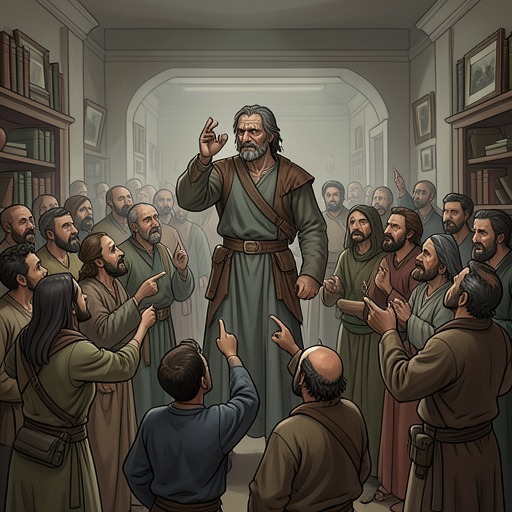
Never be an easy meal
The Legend of William Oh“Never be an easy meal” is a survival principle that crystallizes William Oh’s conduct in The Tower. It turns danger into a social and material calculation: a person becomes prey not only when physically weak, but whenever others believe that cooperation can be withheld, property can be taken, or desperation can be exploited.
Origin in Scarcity
The maxim is tied to William Oh’s first major lesson, which returns to him after a profitable expedition with Loth. As they leave with bags of coin, William notices hungry eyes following them toward the exit. The money is the most he has ever possessed, yet it immediately makes him conspicuous and vulnerable. Wealth therefore does not simply provide security; it can advertise that he is worth robbing. His recollection of the lesson changes the meaning of the apparent victory, placing caution beside triumph.
William’s resource calculations show why the phrase has such force. Buying a spirit turtle Sacrifice costs twenty silver, more than half of what he earned from selling a tongue, and he recognizes that the apparent sale price did not equal the value he could actually realize without preserving the material himself and finding customers. He nevertheless stores the Sacrifice in his satchel, judging himself two-thirds of the way toward his objective on the first day. Survival requires accepting painful expenses without allowing those expenses to leave him helpless.
Suspicion as Defense
The principle becomes explicit when William reaches a camp with Kaith coming in behind him and asks for a rope. The people across the gap demand that he throw over his weapons first, claiming that they cannot trust a stranger, especially one accompanied by a Kobold. From William’s perspective, the situation is not a minor dispute over crossing protocol. He understands the conflict as Climbers against The Tower and concludes that anything less than total cooperation means the people in camp intend to rob him.
That judgment immediately translates distrust into a physical stake: if he surrenders his weapons, he may cross, but he may also become defenseless; if he refuses, Kaith remain behind him while the camp retains the advantage of distance and elevation. The gap is about fifty feet across with a drop of roughly ten feet, so the demand is backed by terrain as well as social pressure. William’s fear is not abstract. He identifies the likely consequence in the language of the maxim: he would become an easy meal.
A Principle of Resource Management
The phrase also governs William’s relationship with Charges, equipment, and purchasing decisions. His recorded status lists four Charges out of ten, together with the primary abilities Aspect of the Goat and Phantom Hand. Charges are therefore a limited reserve rather than a decorative statistic, and maintaining options matters as much as immediate power. Later, when he examines an Endless bag of salt, he asks how much salt it produces and learns that it yields about a quarter cup per Charge, up to four Charges a day. Even a seemingly ordinary item must be judged by output, consumption, and long-term usefulness.
This way of thinking connects bodily danger, money, equipment, and information. William has already endured a broken shield strap badly enough to leave a jagged seam of puckered flesh across his midsection. The injury is presented as bad luck, but it is also evidence of what happens when protection fails. His later choices seek to prevent comparable exposure: preserve resources, retain weapons when trust is uncertain, and spend only when an item advances his capacity to survive.
The Maxim Under Extreme Pressure
The rule is tested most brutally during the failed sequence in which William collapses against a wall. After thirty-six hours, thirst has become severe enough that he considers the best way to kill himself, while expecting two more days of agonizing pain before death. Yet even then he cannot find an effective means of ending his life. The episode strips the maxim down to its bleakest foundation: survival is not heroic abstraction but the refusal to let an environment, an enemy, or one’s own despair dictate the final terms.
William’s endurance in this moment does not make the world safer. It reveals instead how narrow his choices have become. The maxim is consequently less a promise of victory than a discipline of resistance. When escape, trust, money, or comfort cannot be secured, remaining difficult to consume becomes the minimum form of agency still available.
Narrative and Thematic Significance
“Never be an easy meal” functions as a recurring interpretive key for William’s development. It links the hungry observers outside the exit, the armed strangers guarding the crossing, the cost of a Sacrifice, the limits of his Charges, and the bodily consequences of failed protection. In each case, danger arises when another force can define William’s value and choices for him.
The expression also gives the book’s survival narrative an economic and psychological edge. William does not divide the world neatly into allies and enemies; he evaluates incentives, leverage, and exposure. Cooperation may be genuine, but it cannot be assumed, and generosity cannot erase the risk of exploitation. The maxim therefore describes both an external tactic and an internal posture: stay alert, preserve alternatives, and make predation costly enough that survival remains possible.