Oilton Stronghold Investigation
The Legend of William OhOilton Stronghold Investigation marks the moment when a promising destination becomes a dead city and an apparently local danger becomes a rapidly expanding systems crisis. Drawn toward the Stronghold associated with Travis’s family and its valuable oil infrastructure, William Oh and his companions first encounter an abandoned road and then a city filled with corpses. Their investigation does not end with discovery: after meeting survivors and learning that thousands of Tangled are multiplying inside the city, the group shifts from reconnaissance to an engineered counterattack using fire, water, and the Stronghold’s own facilities.
Approach to the Stronghold
The investigation begins during travel across the Third Floor, where Travis points out the distant Stronghold as an indistinct smudge because the floor’s atmospheric conditions make long-distance viewing difficult. He describes the settlement as belonging to his family and emphasizes its distinctive industrial foundation: the entire city is built around a giant corkscrew that pumps oil from the ground through steam power. The question of where such an operation obtains its water immediately points toward the infrastructure that will later become central to the group’s plan.
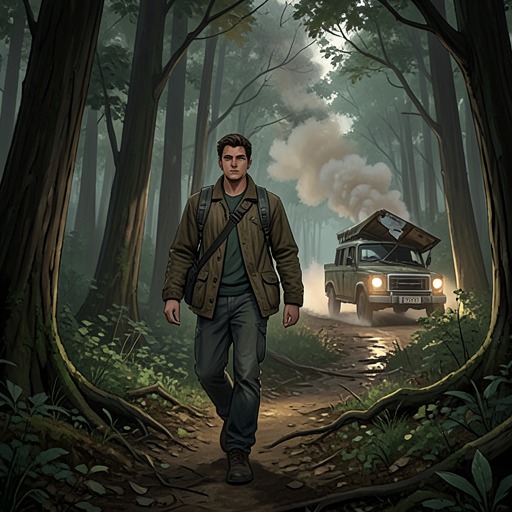
The approach is unsettling before the party reaches the city. After roughly half an hour on the road, William Oh notices that no people are using it. Their footprints in the ash are the only visible sign of recent passage, turning an ordinary route into evidence of disappearance. The absence matters because the Stronghold is not merely remote or temporarily quiet; it is a functioning settlement whose population seems to have been erased.
Reconnaissance of a Dead City
William Oh, Travis, and Brianna climb to the inner edge of the wall and look down into the Stronghold. What they find is not an empty settlement awaiting occupation but streets lined with corpses. The bodies show varying degrees of physical damage, confirming that the city’s silence is the aftermath of violence rather than a routine evacuation. The investigation therefore changes the party’s immediate problem from locating Travis’s relatives or entering a functioning Stronghold to understanding what killed its inhabitants and what remains active inside.
Travis identifies a taller central building as the Lord’s castle and proposes going there. William Oh does not simply advance on assumption: he fires a shot from his sling into a distant alley, striking a metal shop sign and using the noise to test the city’s response. This small act of reconnaissance establishes his practical caution. The party is navigating a place where an apparently empty street may conceal an enemy, and information has to be obtained without exposing the group unnecessarily.
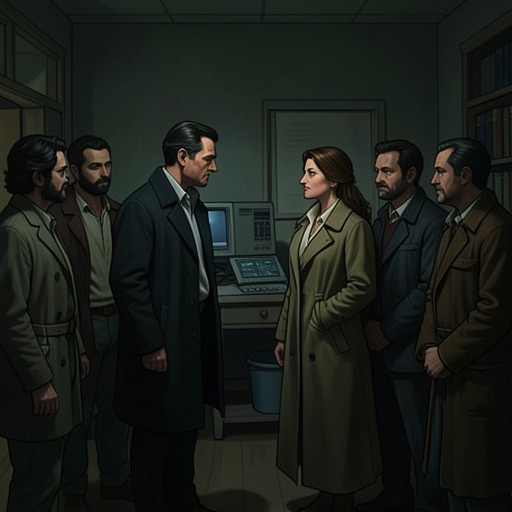
The castle itself is not unoccupied. A spear emerges from the darkness, carried by a small, shiny pink hand, and a Jibleya orders the humans to stop. More Jibleya appear, their translucent pink flesh naturally resistant to poisons and acids and their culture associated with industrious alchemical work. At the same time, kobolds emerge from beneath the damaged throne room’s unusually neat stools. The room’s arrangement, initially easy to overlook amid the battle damage, becomes part of the ambush: the Stronghold’s apparent emptiness has concealed organized inhabitants.
Information, Threat, and Tactical Reversal
The encounter with the Jibleya and kobolds gives the investigation its decisive information. The party learns that the Stronghold is not simply a corpse-filled ruin but a contested space containing groups capable of watching, hiding, and negotiating. William Oh later asks Loth to preserve his threatening presence while they return to the castle to deal with the kobolds, reminding the group that daylight is only a few hours away. Loth reluctantly agrees, and William Oh guides the others along a route he has already traveled, converting prior movement through the city into a tactical advantage.
The scale of the danger becomes clear when Loth examines information supplied by the Jibleya. Thirteen thousand Tangled are stalking the city, up from just under nine thousand only three days earlier. Loth calculates a daily population increase of 14.28 percent. The figures transform the Tangled from a dangerous infestation into a compounding emergency: delay does not preserve the existing threat but enlarges it. Travis also explains that his older siblings are underrepresented among the dead and may arrive within weeks to reclaim the city, which makes the Stronghold strategically important rather than disposable. Its oil production could generate millions of gold each month by selling crude oil to other floors, so the group faces both an immediate survival problem and a future struggle over critical infrastructure.
The party therefore treats destruction as a fallback rather than an automatic solution. William Oh calls blowing everything up “plan B,” while Loth recognizes that the group’s real task is to find a way to neutralize the Tangled without wasting the Stronghold’s value. The investigation’s military logic is consequently logistical: the decisive resources are not only weapons and levels but information, routes, water storage, fire control, and knowledge of where the Tangled gather.
Turning Infrastructure into a Weapon
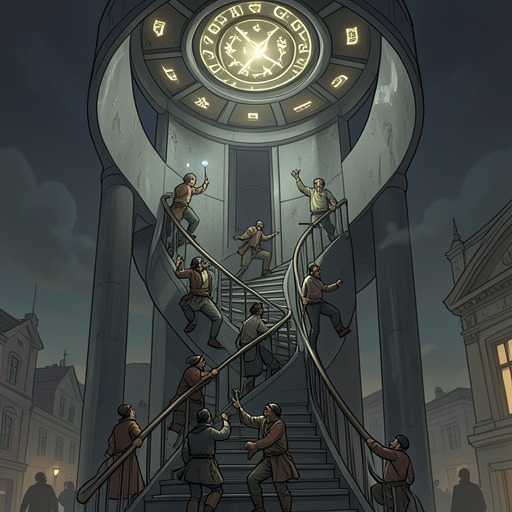
After planning, Travis is assigned to lure the swarm of fire-motes while William Oh, Loth, and Carrie descend into the water tanks and rig them to explode. The tanks are especially important because the Tangled sleep there at night, making the infrastructure both a reservoir and a concentrated target. Loth explains that the tanks must be underground to retain water for a week after the people who supplied them have died, a detail that links the city’s survival systems to the catastrophe that emptied it.
The intended explosion is not a conventional demolition. When Carrie asks how they will create an explosion of steam, Loth reasons that the flow controls can be restricted so the water’s natural heat builds again. The stored pressure can then be released all at once when the curtain of fire reaches the desired position. He searches his satchel for fireproof rope and prepares the available wire and springs, treating the tanks as an engineered mechanism whose controls can be repurposed against the Tangled.
The plan is built around coordination rather than direct superiority. Travis must draw the fire-motes into position; the others must prepare the water tanks; timing must bring fire and steam together. The operation thus continues the broader pattern of the Climbing world, in which a lower-level party can survive and make progress by exploiting terrain, equipment, infrastructure, and rules instead of meeting every threat in a straightforward fight.
The Tangled Crisis and Significance
The investigation also reveals that the Tangled are more disturbing than their numbers alone suggest. When one collapses and writhes in pain, a head and torso bud from its body and pull themselves free. Within seconds, the single creature has become two Tangled wandering aimlessly. Their growth is therefore not merely a matter of reproduction occurring over time; it can happen visibly and rapidly within the scene. Loth’s recorded 14.28 percent daily increase is given a physical counterpart in this grotesque splitting, turning a statistic into an immediate tactical reality.
Oilton Stronghold Investigation is significant because it joins discovery to intervention. The road without travelers, the corpses, the concealed Jibleya and kobold presence, the oil city’s economic value, and the Tangled’s accelerating multiplication all revise the party’s understanding of the location. The Stronghold is simultaneously a ruin, a strategic resource, a hidden social space, and a biological crisis. By choosing to manipulate its fire and water systems, William Oh and his allies begin answering the disaster through logistics and engineering, not merely courage or force. The investigation therefore establishes the Stronghold as a battlefield in which the city’s own machinery may decide whether it remains a dead monument or becomes a weapon against the swarm consuming it.