Oilton's giant oil pump
The Legend of William OhOilton's giant oil pump is the defining machine of Oilton: a city-sized, steam-powered screw that draws crude oil from the ground and turns extraction into wealth, infrastructure, and danger. It dominates the Stronghold physically and economically, while its pressure lines and steam systems provide the means by which Loth’s trap ultimately destroys the entire city. The pump therefore functions as both the Stronghold’s engine of survival and the material fulcrum of its collapse.
Design and Industrial Function
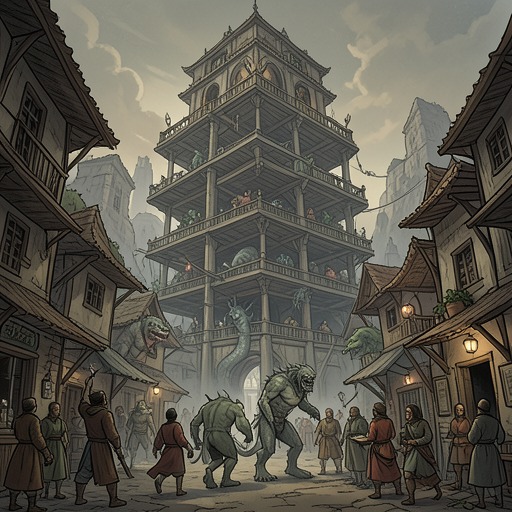
Travis describes the Stronghold as a city built around a giant corkscrew that pumps oil straight out of the ground using steam power. The description makes the machine’s scale inseparable from the city’s identity: Oilton is not merely near an oil well, but organized around an immense industrial device. Its output is crude oil, a resource valuable enough to be sold to other floors for millions of gold each month, making the pump the foundation of the ruling family’s prosperity and the city’s strategic importance.
The pump’s operation also depends on water. When Will asks where the Stronghold obtains its water, Travis explains that Oilton relies mostly on Abilities, especially water-creating Abilities that the Third Floor pays Climbers well to possess. The pump is thus part of a wider technological and magical system: steam power requires a managed supply of water, while the city’s commercial success depends on the machine continuing to extract oil. Its apparent mechanical independence conceals a network of labor, supernatural utility, and storage infrastructure.
First Sight and Material Presence
The machine is initially visible only as a distant smudge because the optics of the Third Floor make long-distance observation difficult. As Will and the others approach, however, the Stronghold becomes unmistakable. A massive plume of steam rises above the city, and Will hears an extremely low grinding sound, as though the earth itself were sliding against itself. The pump’s operation is perceived before the machine can be clearly seen, through pressure, noise, and vapor spreading across the landscape.
At the Stronghold’s walls, man-sized flames burn brightly, fed by the endless oil being drawn from below. Travis reads the working pump and the illuminated walls as signs that the city is still functioning. The scene places the machine at the center of an ominous contrast: its continued operation signals prosperity and security, yet the same abundance of oil supplies the fuel for catastrophic fire.
Inside the castle, Will later pauses during a methodical search and catches the metallic edge of something rotating in the darkness. Judging from its curve, the object is at least as large around as his entire village. He recognizes it as the same giant screw and briefly rejects the scale of what he is seeing before returning to his search. The moment turns an extravagant report into physical reality. The pump is not background machinery viewed from afar; it presses against the castle’s interior, making the Stronghold’s built environment feel like an enclosure around a machine too large to contain.
The Pump as a Strategic Vulnerability
After Oilton falls under the threat of the Tangled, the pump becomes central to the survivors’ planning. Loth learns that approximately thirteen thousand Tangled are stalking the city, up from just under nine thousand three days earlier, a daily population increase of 14.28 percent. The growing swarm makes direct elimination increasingly impractical, forcing the group to treat Oilton’s infrastructure as a weapon rather than merely something to defend.
Loth leads the others to a window overlooking the screw, beneath which a plume of steam rises to the size of several city blocks. He proposes using that burst of steam against the swirling motes of the Fire-Mote Swarm. The plan depends on the pump’s relationship with the city’s water and pressure systems: by restricting the flow through controls, the natural heat can build again, after which the stored water can be released all at once when the curtain of fire reaches the desired position.
The strategy extends beyond the screw itself to the water tanks that support its operation. Grak identifies squat, round buildings halfway around the city from the pump. Will wonders whether the tanks extend underground, and Loth confirms that they must, since they were designed to keep holding water for a week after the people who supplied it had died. The pump is therefore embedded in a deliberately resilient system, one whose reserves outlast its human operators. That resilience becomes exploitable: the same capacity meant to preserve Oilton’s operations supplies the pressure needed for a sudden, destructive release.
Destruction and Narrative Significance
The trap begins to take effect when a light blinks atop a water tower and the steam pouring from the engines gradually increases, subtly raising pressure in the oil lines. About half an hour later, while Will and Loth are discussing Build strategy, Oilton explodes. The castle erupts first as the over-pressured main line ruptures directly beneath it. Burning oil tears through the structure, shattering the castle and hurling flaming boulders in every direction as a fireball rises higher than the mountain on which the observers are gathered.
The destruction then cascades through the city. Flaming boulders land in the streets, rupture additional oil lines, and spread burning oil across the town. Smoke and hellfire engulf Oilton, transforming the pump’s productive circulation into a chain reaction of ruptures and fire. The machine is not explicitly shown breaking apart before the city falls; instead, its pressure network becomes the pathway through which the disaster propagates. The distinction matters: the pump’s power survives long enough to make the city’s own infrastructure destroy it.
The pump also explains why Oilton cannot simply be abandoned or casually demolished. Travis warns that his older siblings, with relatively few of them among the dead, may return within weeks to reclaim the city because it is critical infrastructure capable of producing millions of gold each month through crude-oil sales. The machine gives the Stronghold value after catastrophe, even as it makes that catastrophe more difficult to contain. Its economic importance and destructive potential are two sides of the same mechanism.
As an object, Oilton's giant oil pump embodies the book’s recurring tension between mastery and exposure. It appears to represent industrial control over the environment, but that control depends on linked systems of steam, water, pressure, labor, and containment. Once those relationships are manipulated, the pump ceases to be a neutral tool and becomes an active force in the plot’s nonlinear escalation: a local adjustment produces rising pressure, one rupture triggers many others, and a city built around extraction is consumed by the resource it extracted. The giant screw is consequently both Oilton’s monument and its failure point.