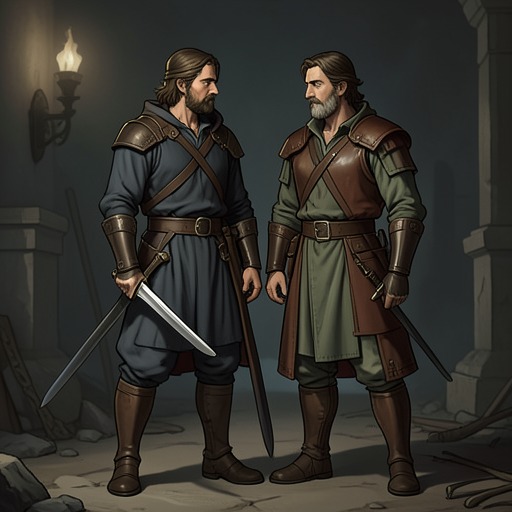
Paranoia serves a Climber well
The Legend of William Oh“Paranoia serves a Climber well” is both a joke and a compact survival philosophy. Kyle Fontaine uses the expression to acknowledge William Oh’s suspicion while dismissing the immediate threat he fears; later, Will repeats it to himself as he prepares for The Hunt, turning Kyle’s mockery into a principle he can apply. The phrase therefore moves from banter into self-protective reasoning, linking distrust, vulnerability, and the practical demands of remaining alive as a Climber.
Origin in Kyle Fontaine’s Teasing
Kyle Fontaine introduces the expression while speaking to William Oh after Heath leaves the group. Heath has just been addressed dismissively and walks away with a jingling coin purse filled with copper pieces gathered from hunted Wheat Gremlins and a giant two-hander over his shoulder. Once Heath is out of earshot, the five stoic Climbers erupt in laughter, establishing that the exchange has been treated as comedy rather than immediate danger. Kyle then tells Will that he likes the way the young man’s head works and that paranoia serves a Climber well, but adds that it does not apply in this case. His explanation is brutally practical: the ring on his finger alone is worth a dozen people like Will, so Will is not worth the effort of exploiting. The statement reassures Will only by humiliating him, and Will answers with sarcasm rather than gratitude. Kyle’s pat on the shoulder, delivered with a calloused hand that feels hard as rock, reinforces the mixture of rough camaraderie and overwhelming disparity between the experienced Climber and the vulnerable newcomer.
From Insult to Survival Principle
The expression gains a second function when Will later recalls it while preparing for The Hunt. He is wounded enough to hiss and wince from a sudden jolt of pain and recognizes that he needs to rebandage himself, even as he hopes such injuries will become less frequent. He looks at the Uru Drake scale in his hand and connects his developing equipment and abilities with the prospect of becoming a Tank alongside the Spirit Turtle and the Uru Drake. The surrounding thought is explicitly organized around survival: as the saying goes, a person has to be alive to become a Lord. At that moment, Will repeats Kyle’s line internally as a question: “Paranoia serves a Climber well, does it?” The wording shows that he has not simply accepted Kyle’s lesson. He tests it against the scale, his wounds, his planned hunt, and his ambition to obtain the Sacrifices he needs. The phrase has become a mental tool for evaluating danger rather than merely a joke heard from an older Climber.
Practical Distrust and the Climber’s Condition
The expression defines paranoia less as irrational fear than as an adaptive response to a world in which weakness can be exploited. Kyle’s own refusal to take advantage of Will is based not on goodwill alone but on a calculation of value: Will is not yet worth the effort, while Kyle’s ring represents superior resources. That logic makes Will’s suspicion understandable even when it is misplaced. The danger is not disproved; it is temporarily rendered unprofitable. Its later placement beside Will’s injuries and preparations makes the principle more concrete. A Climber must assess people, equipment, wounds, and opportunities before acting. Will’s ragged, ill-fitting clothes and satchel contrast with his hoped-for future as a properly equipped Tank, while the Uru Drake scale serves as the immediate object through which he thinks about that future. Paranoia thus belongs to the same practical vocabulary as rebandaging, gathering Sacrifices, and judging whether he can survive The Hunt.
Narrative Significance
The phrase marks a small but important transfer of knowledge between Climbers. Kyle delivers it as condescending humor, yet Will preserves it and reworks it into an instrument of self-direction. The contrast reveals how advice in the climbing world may arrive disguised as mockery: a stronger figure can laugh at Will’s fear while still naming a quality that may keep him alive. The expression also echoes the larger distinction between immediate survival and later advancement. Will wants the Sacrifices required for his next step and imagines becoming a Tank and eventually a Lord, but both thoughts are subordinated to the same condition: he must remain alive first. “Paranoia serves a Climber well” crystallizes that order of priorities. Suspicion may be embarrassing, excessive, or wrong in a particular encounter, but abandoning it altogether would be more dangerous in a world where the cost of misjudgment is measured in wounds, lost resources, or death.