Quest Assignment
The Legend of William OhQuest Assignment is the System’s operational mechanism for turning advancement into obligation. It does not merely announce that William Oh has survived the Class Trial: it classifies the methods by which he survived, assigns him usable roles, opens institutional permissions, and directs him toward missions whose objectives are tied to the Tower’s wider conflicts. Through it, progression becomes both opportunity and governance.
Definition and First Assignment
Quest Assignment appears immediately after William Oh completes the Trial. The System congratulates him and states that, based on his methods, he has been assigned the Scout/Infiltrator roles. The assignment is not presented as a purely descriptive label. It identifies the kind of work the System considers him suited to perform and offers a formal procedure for challenging that judgment: he may dispute the assignment and apply for a different role by taking a new Trial at the Kiosk on Floor 5. The same notification expands William Oh’s practical freedom. Once the Trial is complete, he may travel freely between floors at Key Locations, receive Quests, form Parties, and petition to subjugate land. Quest Assignment therefore stands at the threshold between private survival and recognized participation in the Tower’s organized society. It grants access while simultaneously placing William Oh inside a system of roles, missions, and institutional expectations.
Missions as Military Direction
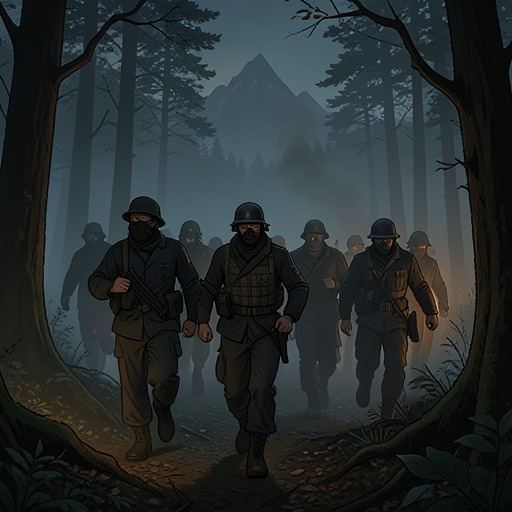
The first major Quest attached to this system is Establishing Quest: Break the Supply Lines. The assignment explains that the Kaith have pushed into the First Floor and are under an extermination order issued for higher-level Climbers. Their primary nest is already under siege, but supplies continue to reach it through unknown channels. William Oh is directed to locate those channels and sever them so that the main attacking force can drive the Kaith back to the Second Floor. This objective reveals the political and military character of Quest Assignment. The System does not ask William Oh simply to kill enemies or gather experience. It gives him a strategically defined task within a larger campaign, identifies the enemy’s logistical vulnerability, and connects his individual actions to the movement of an entire front. The quest also assigns him a role suited to that task: the Scout/Infiltrator designation makes sense for tracing hidden supply routes rather than meeting the besieged nest in direct combat.
Acceptance, Risk, and the Quest Door
The system presents the mission as a choice, asking whether William Oh accepts it and providing a brief countdown. He must answer outside Leon’s General Store, because Leon refuses to have an interdimensional doorway cut through his floor or to risk William Oh returning wounded and dirtying the shop. Once William Oh accepts, a doorway opens in front of him, identical to the portal that had previously trapped him in the featureless Class Creation Room for two days. That repetition gives Quest Assignment a material as well as administrative form. Acceptance is not a clerical confirmation; it creates a route into danger. The same kind of doorway that once represented confinement now becomes the entrance to an authorized mission, but William Oh remembers that survival depended on luck. The quest system thus converts a familiar threat into a usable tool without removing the danger embedded in it.
How the System Shapes Action
During the supply-line mission, Quest Assignment’s objectives determine the party’s movement through the Kaith cavern system. William Oh and Loth divide into seven scouting groups and search the branching tunnels for the hidden route. The workers are weaker than the Kaith warriors at the front, while the larger battle is being handled by higher-level Climbers; the mission’s structure therefore separates strategic reconnaissance from frontline fighting. Loth’s barrel of soil and food scraps, which houses dozens of insect species under his control, becomes a practical instrument of exploration, while glowbug juices mark arrows at every branch so the party can retrace its path. The mission also exposes the gap between a system’s clean wording and the physical improvisation required to satisfy it. A quest can specify that supply channels must be found and severed, but it cannot perform the scouting, rope work, or engineering itself. When William Oh catches Loth’s rope after a dangerous gap crossing, the formal objective is sustained by fragile cooperation and material skill. Quest Assignment supplies direction; Climbers, tools, creatures, and terrain determine whether that direction can become action.
Progression, Ranking, and Consequences
Quest Assignment continues beyond the first mission. After William Oh reaches level five on his first Establishing Quest, the System issues a new Quest instructing him to ascend to the Second Floor. It congratulates him while also ranking his performance: among that year’s Aspirants, he stands at 1053rd. Advancement is therefore presented as both a personal achievement and a comparable statistic. The notification rewards progress, but its ranking language places William Oh within a competitive population whose members can be measured against one another. The quest system also interacts with the practical limits of climbing. William Oh and Loth consider following a bus toward the next floor, since assisting in the clearing of a Key Site is the fastest route upward and the rules allow Climbers to participate as long as they are present and do not actively sabotage the others. Yet they are still acclimating, and Loth argues that entering a higher Floor below the current Floor’s maximum permitted level would be foolish. Quest Assignment can open the next objective, but it cannot erase acclimation, level restrictions, or the danger of advancing too quickly.
Narrative and Institutional Significance
Quest Assignment makes the Tower’s progression system legible as a form of procedural governance. The System classifies William Oh, offers a mechanism for appeal, authorizes movement, distributes missions, records advancement, and converts achievement into rank. Its language is impersonal, but its effects reach into every layer of the story: it determines where William Oh may go, what kind of work he is expected to perform, which dangers become official opportunities, and how his performance is compared with that of other Aspirants. At the same time, the surrounding events prevent the mechanism from appearing omnipotent. The Trial can leave an Aspirant trapped in a white room with three Altars and no exit; a sacrifice can be rejected as suboptimal and fail to generate a Class Seed; a floating mountain can make the destination physically unreachable; and even a successful quest cannot make premature ascent safe. Quest Assignment offers structure inside an unstable world, but its prompts remain exposed to bad luck, terrain, bodily danger, and human judgment. Its decisive significance lies in that tension: the Tower presents advancement as an executable sequence of choices, yet every choice still has to be carried out by vulnerable beings in spaces the System does not fully control.