Relics
The Legend of William OhRelics are enchanted objects whose importance extends far beyond equipment. In the Tower, they mediate between a Climber and the System: they may grant Abilities, enhance attacks, preserve precious materials, or provide an escape when ordinary strength is not enough. Their value depends not only on what they visibly do, but also on rarity, compatibility with a Class, Charge expenditure, and the knowledge required to recognize their potential.
Definition and Role
Relics occupy the point where magic becomes tangible and usable. The clearest example is Gertrude’s Relic of the Host, which glows faintly as she directs William Oh to clean his dishes. Its power is not presented as a weapon or treasure, but as an instrument of household authority. The object makes an ordinary command carry supernatural force, showing that Relics can reinforce social order as readily as they can support combat.
For William Oh, Relics are also bound to the dream of changing his status. Before leaving Saint Gertrude’s Orphanage, he imagines using the many Abilities associated with the Uru Drake Sacrifice to acquire Relics, become a Climber, claim territory on an upper Floor, and eventually become a Lord. In that imagined future, Relics are the material foundation of upward mobility: wealth, power, independence, and the ability to send supplies and money back to the orphanage all appear connected to obtaining and using them.
Abilities, Classes, and Value
The value of a Relic is determined by its interaction with a Climber’s development rather than by price alone. A traveler explains that the Uru Drake Sacrifice is exceptionally valuable because it may provide the Teleport Ability to a Climber, has strong growth, and blends with nearly any Class to produce more powerful Abilities than that Class might otherwise offer. Its worth is therefore greater than the combined value of everything else in the bazaar. The revelation changes William Oh’s understanding of the scale’s importance: rarity is not merely a matter of prestige, but a direct influence on future capability.
A cheaper object demonstrates the other end of the spectrum. A ring priced at twenty silver adds only a small amount of acid damage to attacks and, once its owner has Charge, can launch an unerring acid bolt. William Oh judges that its effects are probably modest because of its low price, and he recognizes that a Climber with a direct-damage Ability would usually prefer the ability provided by their own Class. Because Charge regeneration is measured by the week, even a minor expenditure matters. Relics thus enter a larger economy of opportunity cost: a useful effect may still be inferior to saving Charge for a stronger personal Ability.
The System’s treatment of sacrifice reinforces this economy. When William Oh places a thumb-sized piece of pemmican on the Class Trial Altar, a beam of light consumes it, but the System identifies the offering as suboptimal and fails to generate a Class Seed. The failed sacrifice does not produce a Relic, yet it reveals the same governing principle: magical objects and transformations are conditional, and the material input must satisfy rules that the participant may not fully understand. Relics belong to a world where objects are consumed, evaluated, and converted according to an unforgiving interface.
Material Carriers and Hidden Properties
Relics are not always conspicuous. The satchel carrying the Uru Drake scale appears plain and unassuming, but its leather remains as new as when it first arrived at the orphanage, labeled only with William Oh’s name and address. William Oh suspects that a subtle enchantment is bound into it because the satchel always fits, never becomes unbalanced, and weighs slightly less than it should. Its magic is therefore expressed through consistency and convenience rather than spectacle. The container preserves and transports the scale while quietly accommodating its owner’s body and needs.
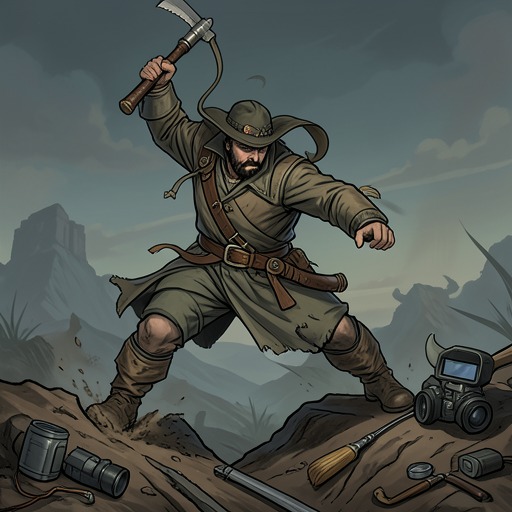
This hidden functionality establishes a recurring distinction between appearance and operation. A Relic may look ordinary, or its effect may be too weak to justify attention until the user understands its conditions. Conversely, an object can become materially decisive in a crisis. William Oh recognizes a maksu weapon as probably a Relic because of the ominous light it had emitted while a maksu wielded it, even though he does not know what the Tomahawk of the Serpent does. The weapon’s physical construction is elaborate: a straight wooden handle, a grip carved like a rattlesnake’s tail, a hollow cup in the hammer, a snake forming the base of the blade, and holes along the blade where fangs appear to have been torn away. Its strange craftsmanship and faint supernatural sign make it legible as a Relic before its function is understood.
Relics in the Tower’s Material World
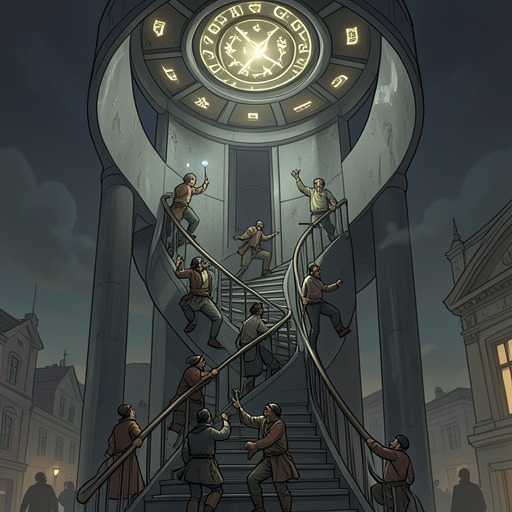
The Tower itself is filled with objects and structures whose purposes are only partly understood. Above the surface, Climbers from thousands of years earlier installed reflective surfaces to catch sunlight and send it back down, leaving a blank grey ceiling studded with glittering points. William Oh treats the abnormal sky as the Tower’s first mystery. This environment places Relics within a broader archaeological landscape: magical tools, engineered systems, and inherited infrastructure coexist, while their makers and original purposes remain uncertain.
Even non-Relic mechanisms display the same dangerous material logic. During an underground expedition, the floor gives way beneath William Oh, revealing a pitch-black shaft only about three feet wide but apparently immeasurably deep. He catches the far edge with his good hand and pulls himself back into the tunnel. Elsewhere, an emergency escape hatch is clearly marked in immaculate white paint, while an iron ladder beneath it has dissolved into a ruddy stain. These details contrast guidance that remains usable with equipment that has failed completely. They make the Tower’s objects active conditions of survival rather than passive scenery.
The contrast continues at the Stronghold. From a distant hill, William Oh sees a massive plume of steam and hears grinding at an extraordinarily low pitch, as if the earth itself were sliding against itself. Travis infers that the giant pump is still working, while lights and man-sized flames continue to illuminate the walls, apparently fed by oil drawn endlessly from below. The working pump is not identified as a Relic, but it belongs to the same world of inherited mechanisms in which survival depends on reading devices, judging their condition, and understanding what unseen system sustains them.
Consequences and Significance
Relics transform knowledge into power, but they also make ignorance costly. William Oh’s ambitions depend on finding objects compatible with his Class, learning their effects, and conserving Charge; his uncertainty about the maksu tomahawk leaves him with a powerful weapon whose operation he cannot yet control. The Uru Drake scale, by contrast, represents potential so great that its value is difficult to measure, while its enchanted satchel shows how magic can remain intimate, quiet, and nearly invisible.
Taken together, these objects define the Tower as a place where advancement is never purely a matter of personal strength. Class Seeds, Abilities, Charge, sacrifices, equipment, and ancient infrastructure form an interlocking system that allocates possibility. Relics are the most concentrated expression of that system: they promise escape from weakness and access to higher status, yet they demand interpretation, payment, restraint, and risk. Their recurring presence turns every object into a possible threshold between the ordinary life William Oh knows and the dangerous future he intends to build.