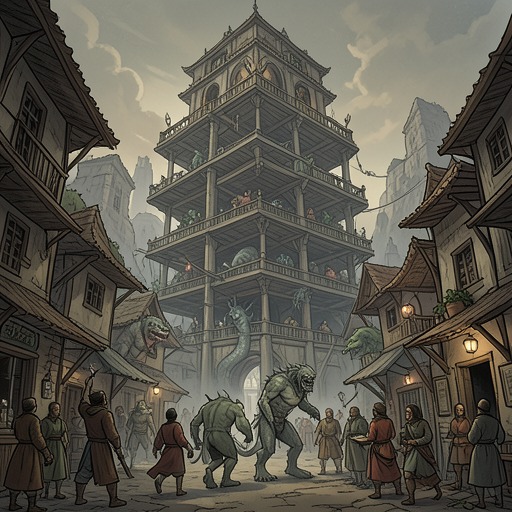
Sacrifice
The Legend of William OhSacrifice is the foundational exchange mechanism of The Trial. Aspirants hunt living creatures or obtain suitable objects, then offer them to the system in return for Class Seeds, Ability options, upgrades, or other transformations. The practice appears mechanical when a beam of light consumes an offering, but its consequences are economic, strategic, bodily, and ethical: Sacrifice determines when an Aspirant can advance, what kind of Class becomes possible, how a Build develops, and what a Party is willing to give up for another person.
Definition and Function
Sacrifices are hunted or acquired materials whose value lies not merely in their physical substance but in the abilities and attributes they can unlock. Gertrude warns William Oh not to rush into The Trial with the first three Sacrifices available. She advises him to hunt throughout the summer, sell unwanted Sacrifices, buy gear, inspect the market, and wait for another Aspirant to pass on something ideal. The system imposes no time limit, so selection is presented as a strategic act rather than a ceremonial formality. A poor choice can shape an entire Class, while patience can turn the hunt into preparation, commerce, and controlled experimentation.
The value of a Sacrifice is therefore plural. A Jumper can add leg-based Abilities, especially kicks and jumps, while providing two Strength and one Kinesthetics per level; its listed price is twelve copper per leg. A Wetlands Gulper offers Earth, Water, Slime, and Tongue-based Abilities, grants one Strength, one Resistance, and one Acuity per level, and is sought by potters, farmers, and wealthy Lotharios. These descriptions make each creature both a monster in the field and an item in a specialized market, with tactical use and resale value existing side by side.
The Trial and Class Creation
The Class Creation Room makes the necessity of Sacrifice absolute. The walls resist every force an Aspirant can bring against them, including Relic weapons lent by high-level Climbers. The only way to open the Door to The Trial and avoid dying from dehydration is to offer three Sacrifices. Usually the Door opens automatically when a person possesses the required three, but William Oh enters the room without them and is trapped by the system’s requirement.
His first attempt exposes the difference between possession and suitability. William places a thumb-sized piece of pemmican on an Altar. Light descends, intensifies, and consumes it completely, after which the system reports, “Suboptimal Sacrifice detected…attempting to generate Class Seed… Failed.” The food is accepted as an offering in the narrowest sense, yet it cannot produce a Class Seed. Sacrifice is thus not simply payment: the system evaluates quality according to rules that an Aspirant may understand only imperfectly.
The Uru Drake scale produces the opposite result. William places it on the rightmost Altar, and the system announces that a Sacrifice has been detected and that Class Seed generation has succeeded. The result is Uru Drake Primogenitor. The scale adds Spacetime Abilities, modifies the Abilities offered by other Sacrifices, and supplies five points of Growth, as well as one Strength, two Resistance, one Acuity, and one Focus. Its appeal is described as universal, making it a rare example of a material whose value extends beyond a narrow combat role.
Once the Class is generated, the system asks William to choose his Primary Abilities. The Sacrifice has not supplied a finished identity so much as opened a structured field of possibilities. Later, the system offers an upgrade to Aspect of the Goat: sacrificing an Uru Drake can grant a breath attack, flight, and increased potency for all space-time Abilities, while sacrificing a Gravity Goat can strengthen footing and shift personal gravity toward the direction of contact, enabling wall-climbing at an acute angle. Sacrifices therefore remain active in the Class after creation; they become branching decisions in an evolving Ability tree.
Sacrifice as Build Strategy and Economy
William repeatedly treats Sacrifice as a problem of timing and opportunity cost. When he learns that a Relic Worm would allow the Scaling of Phantom Hand to apply to any Relic effects imprinted on it, he recognizes the possibility of increasing a Relic’s effect through Acuity. Because the ordinary value of Relic Worms is too modest to attract Climbers who ought to possess Demesnes on higher Floors, he concludes that the desired specimen must be hunted personally in the swamps of the Fourth Floor. The best Sacrifice is not always the most expensive one, and the most profitable market object may be less useful than a difficult-to-obtain material that transforms a central Ability.
His spending choices also connect Sacrifice to trust and responsibility. After buying what he needs, William gives his remaining eight gold coins to Gertrude, asking her to earmark half for Jason Salazar’s Sacrifices. William does not trust twelve-year-old Jason with enough money to obtain a Class immediately, fearing that the boy would spend it at once, but he does honor the help Jason has provided. Sacrifice here becomes deferred advancement: money is converted into another person’s future opportunity, under supervision rather than through direct possession.
The same logic governs William’s later use of objects. He sends an Amulet of the Hearth-Keeper into Phantom Hand as a Sacrifice after deciding that the Amulet of the Homefield Advantage will remain useful longer, particularly because of its fire-damage resistance. The choice is not framed as simple destruction. One item is surrendered so that its effect can become part of a larger Ability, while another is retained because its practical value better fits the expected journey. The system’s vocabulary of Sacrifice makes equipment management resemble ritual, but the decision is recognizably a calculation about durability, specialization, and future need.
Sacrifice, Bodies, and Other People
The word also acquires a grave human meaning when William’s missing limb is restored. A priest verifies a payment of fifteen hundred gold for the restoration of the limb and asks whether all Parties agree to the Sacrifice. William reacts physically to the word, feeling goosebumps at the prospect of what is being surrendered. The exchange places bodily repair inside the same economy as monster parts and Ability upgrades, but its stakes are far higher: the price is not merely a lost resource but the shared cost of reversing a disability that has already been treated as a permanent disadvantage.
That disadvantage is made explicit when another Climber tells William that he should abandon the path to becoming a Climber because his missing hand means one fewer Relic slot and leaves him permanently behind others. The system translates amputation into reduced equipment capacity. Restoration therefore promises more than physical completeness; it can repair an institutional penalty built into the rules of advancement. Yet the temple scene complicates any easy idea of benevolent exchange. Behind the priest’s counter, William sees dozens of people in ornate Andover priestly robes locked in steel cages. They are identified as Debtors, people who have not bought their way into Andover’s favor. Sacrifice, payment, healing, and captivity occupy the same social machinery.
Sacrifice also describes the obligations created when one person’s material is used for another’s power. William gives Loth a Bullet Wasp Larva, and Loth unscrews the glass container, removes the larva, and holds it up toward The Tower before a flash of light makes the Bullet Wasp disappear. The result improves Loth’s Master of the Vivarium by adding a direct damage option without removing its previous abilities. Loth explains that his Class had always lacked such an option and thanks William. William replies that he would have given him the bug regardless. The scene turns a system transaction into a gesture of Party loyalty: the larva is consumed, but the relationship is strengthened through deliberate generosity.
A harsher version appears when William discovers a young man whose body is covered with bright-white torture scars, including a semicircular scar on the skull that has only begun to grow hair back. William identifies the wound as a lobotomy and understands that action is necessary. Although the available evidence does not specify the later outcome, the discovery shows how closely the world’s institutions can come to treating bodies as materials to be altered, controlled, or expended. Sacrifice is not limited to voluntary offerings at an Altar; its surrounding logic makes bodily vulnerability legible as a resource and a liability.
Narrative and Thematic Significance
Sacrifice gives the book’s progression system its central irony. Advancement is represented as choice, but every choice is also a loss. A creature disappears into light; pemmican is consumed without producing anything; a valuable scale opens a powerful Class; an amulet is surrendered to preserve another; a larva vanishes so a Party member can gain an offensive capability. The system promises agency through menus, statistics, and upgrade paths, yet it governs agency by deciding what counts as sufficient, suboptimal, or transformative.
The concept also binds together hunting, commerce, preparation, and moral judgment. Gertrude’s advice to wait resists the fantasy that immediate advancement is always best. William’s search for the Relic Worm shows him choosing a difficult future objective over a convenient purchase. His contribution to Jason Salazar’s Sacrifices turns wealth into responsibility, while the payment for limb restoration exposes the human cost concealed by the same neutral term. Even the food offering that fails carries a lesson: survival material is not automatically advancement material.
By making every major gain depend on something being consumed, The Trial turns power into an economy of irreversible exchanges. Sacrifice is the point where the system’s cold procedure meets the characters’ judgment. It determines what William Oh becomes, how Loth’s Class changes, how another person’s body may be restored, and how institutions classify debtors, Aspirants, Climbers, and victims. In that sense, Sacrifice is not merely an ingredient in Class creation. It is the governing metaphor of advancement itself: nothing powerful is obtained without deciding what, or whom, can be given up.