Saint Gertrude’s Orphanage
The Legend of William OhSaint Gertrude’s Orphanage is the institutional home that gives William Oh a family before he has a Class, and the place from which his identity as a Climber begins. It is not merely a backdrop for his departure. Under Gertrude’s stern guardianship, the orphanage represents food, discipline, dependence, affection, and an ordinary life that William Oh regards as both a burden and a responsibility. His first step beyond its door therefore carries two meanings at once: escape from confinement and an extension of the household he hopes to protect.
Home, Discipline, and Ordinary Work
Saint Gertrude’s Orphanage is presented as a working household rather than a sentimental sanctuary. Gertrude considers practical labor a legitimate future for William Oh, suggesting that a job at the mill could provide a grounded life. When Dana handles a pebble as though she might eat it, Gertrude immediately takes it away, and she connects the scene to the possibility of William Oh becoming a miller’s apprentice. Her argument is concrete: honest drudgery can support a family, while milling grain is not beneath anyone. The orphanage’s care is therefore expressed through chores, food, supervision, and preparation for adulthood rather than through indulgence.
Gertrude also imagines William Oh settling into domestic life. She tells him that it would be good to raise children and be happy, observing that many Climbers are not happy, and even proposes Marissa as a possible bride because that would mean one fewer mouth to feed in the household. William Oh rejects the match after looking at Marissa, who is picking her nose, but the exchange reveals the orphanage’s material reality: affection exists alongside scarcity, and family decisions are entangled with the number of people the house must feed.
The Door to the Hunt
The decisive departure from Saint Gertrude’s Orphanage begins only after William Oh receives permission to join The Hunt. He is waiting at the breakfast table while the other children watch him, and Gertrude finally tells him that he may go. William Oh springs to his feet and marches toward the door, understanding the journey toward his Class as inseparable from the future of his family. The door slams before he has crossed the room, however, because Gertrude requires him to clean his bowl and crumb-covered plate first. Her glowing Relic of the Host makes the household rule unmistakable: even the beginning of a heroic career does not excuse ordinary responsibility.
When the door is unlocked, the narration casts the moment as a small personal movement with enormous institutional consequences: one small step for William Oh becomes a giant leap for Saint Gertrude’s Orphanage. William Oh imagines using the abilities granted by the Uru Drake Sacrifice to obtain Relics, become a Climber, claim a range on an upper floor, and eventually become a Lord. His fantasy of Lord William sending supplies and money back to the poor residents of the orphanage shows that departure is not conceived as abandonment. He turns ambition into a promise of future provision, even while imagining that promise in the grandiose language of benevolence.
Gertrude’s Guardianship
Gertrude is the orphanage’s governing presence and William Oh’s principal guardian. Her care is severe enough to resemble punishment, but it repeatedly takes the form of practical protection. After William Oh returns from his first hunt battered and having used half the household’s bandages, Gertrude gives him an earful and forbids him from leaving until the following week. The restriction is not an abstract moral lesson: William Oh is genuinely in too much pain to want to leave, even as malicious gremlins haunt the halls and Marissa repeatedly tries to start fights.
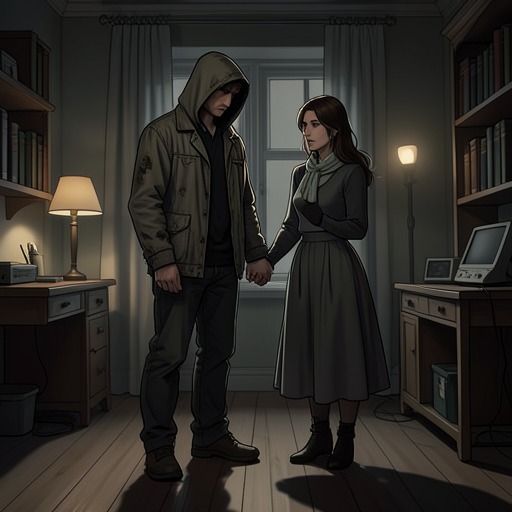
The orphanage also gives William Oh a degree of privacy unavailable to the other children. Because he is the only young man there old enough to join The Hunt, he has the rare privilege of his own room. While he is recovering from cuts, scabs, and a massive bruise around his torso, Gertrude visits him there to discuss his parents. The scene places family history inside the most private space the orphanage can offer, suggesting that the house shelters not only William Oh’s body but also the unresolved questions surrounding his origins.
Before another expedition, Gertrude kisses William Oh on the cheek and wishes him good luck. He interprets her unusual kindness as a sign that she expects him to die, and she answers with a wrinkly smile that he will indeed die if he fails to return and tell her before taking The Trial. The exchange captures their relationship precisely: tenderness is present, but it is delivered through warning, threat, and insistence on accountability. Even as William Oh leaves in ragged, ill-fitting clothes with a satchel over his shoulder, the orphanage remains the place to which he must report.
Community, Rumor, and Return
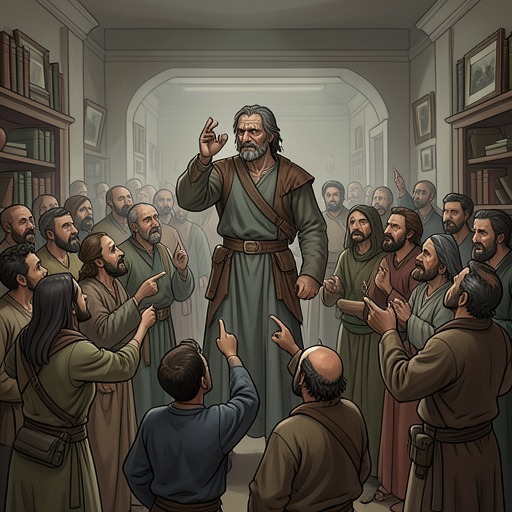
Saint Gertrude’s Orphanage is also a social base from which William Oh’s reputation begins to circulate. Jason Salazar acts as his hype man, and his verbal skill earns him five silver from another orphan; William Oh sees the arrangement as a possible way to find a reliable team member and admits that nobody could fail to use a good hype man. The orphanage thus becomes an early audience and staging ground for the public construction of William Oh’s legend. Jason later tells stories over soup about William Oh’s supposed origins on the Hundredth Floor, turning the household’s local relationship into public mythology.
As William Oh’s exploits spread, the stories become more extravagant. In an inn, people claim that he can turn into lightning, that his missing hand became a cursed talisman, or that he can eat a lightning bolt fired into his face. These rumors are not accurate biographies, but they show how the modest starting point represented by Saint Gertrude’s Orphanage is being overwritten by a supernatural public image. Even the System’s administrative chaos echoes this process: a clerk remarks that five people have already tried to claim William Oh’s quest reward before identifying the real one. His name has become detachable from the person who left the orphanage.
Yet the orphanage remains a fixed point behind the exaggeration. After a dangerous run, another Climber praises William Oh’s performance, saying that although he is level six, he fights like level nine and runs like level forty. The compliment measures the distance he has traveled from the injured boy confined by Gertrude and the bandage supply, but it also makes the orphanage’s formative role more visible. His speed, endurance, recklessness, and ambition emerge from a life that began in a household where survival was communal, supplies were limited, and every departure required someone to wait for his return.
Narrative Significance
Saint Gertrude’s Orphanage embodies the tension between the grounded life Gertrude wants for William Oh and the ascending life he imagines for himself. The mill, marriage, children, food, bandages, and cleaning duties belong to a world of continuity; The Hunt, the Uru Drake Sacrifice, Relics, upper floors, and Lordship belong to a world of risk and expansion. William Oh does not simply choose one world and discard the other. His dream of becoming a Lord includes sending money and supplies back to the orphanage, while Gertrude’s warnings continue to shape the terms on which he may leave.
The orphanage is consequently both threshold and tether. It launches William Oh toward the Class and the wider Tower, but it also gives his ambition a human measure: he wants power partly so that the people who raised him will no longer have to endure poverty and dependence. The house’s significance lies in that contradiction. It is the ordinary place William Oh rushes to escape, the wounded body he must return to, the family that disciplines him, and the community whose needs turn private advancement into a larger promise.