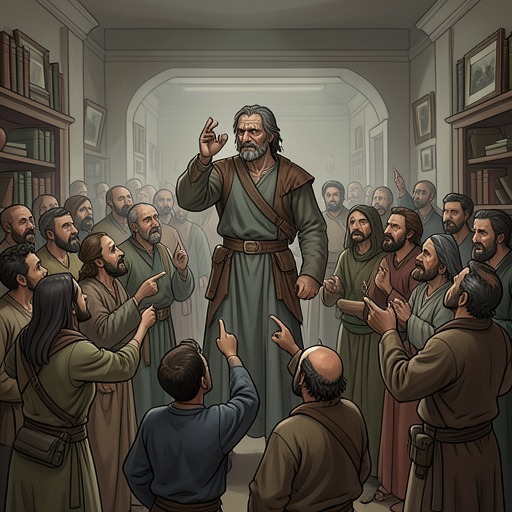
Skyhold
The Legend of William OhSkyhold is a fortified mining settlement perched on one of the floating mountains of the Second Floor, and its decisive importance comes from the way geography, commerce, and military power converge there. It is a destination for Climbers, a source of valuable salt, and a defended point of infrastructure whose position above the abyss makes the mountain itself part of its walls. Yet Skyhold is not simply a safe haven: access to its resources is regulated, its surrounding routes are dangerous, and its authority is backed by soldiers, contracts, and the threat of forced Vassalage.
Setting and Approach
Skyhold first enters the journey as a destination identified through uncertain information. After meeting other Climbers, William Oh and Loth learn where they must go and mark the route on a rough map scratched into the dirt. The map was made under duress and therefore remained suspect, but William Oh judged that it broadly matched what he had observed from a higher vantage point. Their route led across a chain of isolated floating mountains, where a sheer cliff could separate travelers from their destination by hundreds of feet of open air. The apparent mountain peak was not connected to ordinary terrain at all; it floated so high above the ground that even the existence of “the ground” became difficult to take for granted. Once they had crossed the mountains, William Oh saw the faintest plume of smoke three mountains away. That distant smoke marked the direction of Skyhold. As the pair approached, abandoned campsites and permanent bridges revealed increasing signs of human travel and settlement. The bridges were rickety rope constructions spanning the broken landscape, and their precariousness made ordinary caravan movement seem nearly impossible. Skyhold was therefore reached not through a continuous road but through a sequence of exposed crossings, improvised infrastructure, and dangerous vertical terrain.
Fortification and Physical Structure
When William Oh and Loth rounded a corner, Skyhold suddenly appeared before them. The settlement was built as a Stronghold on the edge of a floating mountain. It had no conventional wall, because the cliff edge provided a barrier more absolute than masonry: beyond the settlement lay open air and a fall of hundreds of feet. Instead, ballistae were positioned around the perimeter, while soldiers patrolled the edges and watched for Kaith invasion forces and flying threats. The defensive design treated the mountain’s natural isolation as a military asset, supplementing it with weapons and constant surveillance. The mining works occupied the portion of the mountain that had been sheared away in onion-like layers. Those exposed layers revealed a solid substance that William Oh initially took for quartz, though the caravan’s earlier remarks led him to suspect that it was salt. The uncertainty itself reflects Skyhold’s alien environment: a resource that would ordinarily appear in an underground mine was displayed in vast, regenerating strata along the side of a floating mountain. At night, the Stronghold became even more imposing. Darkness pressed around the settlement until only small pools of light remained at the edge, maintained by man-sized beacons burning on the walls. One nearby section of wall fell into shadow at its base, creating a concealed approach from which an enterprising climber could begin ascending without being seen.
Salt, Trade, and Regulation
Salt is Skyhold’s central economic resource. It is difficult to obtain elsewhere and highly valued as a spice, since even a little can transform food. Personal-use sacks of salt were sold in Skyhold, but buyers without a contract with the Stronghold could purchase only a small amount at a time. The restriction turned a seemingly ordinary commodity into a controlled resource and made commercial privilege part of the settlement’s social structure. The mine’s productivity was not merely large but systematized. William Oh later examined an “Endless bag of salt,” a fist-sized container whose label suggested a portable source of the same resource extracted from the mountain. The merchant explained that it produced about a quarter cup per Charge, with a maximum of four Charges each day. The item transformed Skyhold’s industrial advantage into a compact magical commodity, while its Charge limit preserved the scarcity and value of the underlying resource. Skyhold’s power therefore rested on both extraction and controlled reproduction: the mountain supplied salt on a massive scale, while Relic-like equipment allowed limited access to that productivity beyond the mine. Skyhold also supported a wider market for materials gathered from the floating mountains. Roc down harvested from nests was sold at street stalls and woven into unusually warm cloaks. William Oh and Loth bought a cloak for Loth and a cozy for his barrel despite the extraordinary price. The purchase demonstrates how Skyhold’s commerce answered the practical needs created by the Second Floor’s environment, where frost, sun, exposed bridges, and open air made warmth valuable enough to command a severe premium.
Climbers, Power, and Danger
Skyhold’s roads and approaches became safer as human traffic increased. William Oh and Loth eventually found themselves among such a thick stream of Climbers that a monster ambush was no longer a realistic concern. The settlement thus functioned as a temporary zone of collective security, in sharp contrast with the isolated floating peaks and the deadly routes between them. After obtaining supplies, the pair visited an inn for food and sleep, confirming Skyhold’s role as a service center as well as a military and industrial site. That security was conditional. The broader area around Skyhold included the yeti spawning ground, located several switchbacks down a trail that turned inward toward an extensive network of ice caves. The underside of the mountain received no warmth from the sun; passing clouds allowed ice to accumulate faster than it sublimated, producing solid frozen layers. The Ice Caves route was therefore part of Skyhold’s strategic hinterland, connecting the settlement to a dangerous hunting and expedition zone. After Loth secured the route back, William Oh’s party could return quickly and smoothly because most of the yetis they encountered were already dead or badly injured, a condition that sharply reduced the Charge and combat burden expected by Mason Lanover and June. Skyhold’s political danger was no less serious than its physical danger. Steve Holland claimed that talented young people were dragged to the Stronghold and forced to become Vassals, ending their possibility of achieving Lordship, or were killed. He presented this as a theory, but William Oh immediately recognized the plausibility of coercion after his own party had used the threat of a tomahawk to impose a lopsided arrangement on a Healer. Skyhold thus represented a place where protection, infrastructure, and domination could occupy the same institution: the Stronghold defended its territory while potentially converting vulnerable Climbers into instruments of its authority.
Strategic and Narrative Significance
Skyhold concentrates the book’s recurring tension between survival and independence. Its cliffs protect the settlement, but they also make every approach a threshold crossing. Its salt mine promises wealth and practical security, but contracts determine who may buy the resource and how much. Its crowded routes reduce the danger of monster ambushes, while its soldiers and political power introduce the danger of human coercion. Even its darkness is double-edged: the beacons preserve life within the settlement, while the gaps between them create opportunities for a concealed ascent. The Stronghold’s importance extends beyond its own walls because salt can support trade across multiple floors. Later discussion identifies Skyhold as critical infrastructure capable of generating millions of gold each month by selling crude oil to other floors, placing the settlement within a larger economic network rather than treating it as an isolated mining camp. This scale explains why its control would matter to powerful families and why destroying it would be considered only a last-resort plan. Skyhold is consequently both a place the Climbers seek for shelter and commerce and an asset whose ownership can shape regional power. Its floating position makes the geography spectacular, but its true significance lies in the systems built upon that precarious height: resource extraction, regulated exchange, military defense, travel routes, and the struggle over who is allowed to remain free within them.