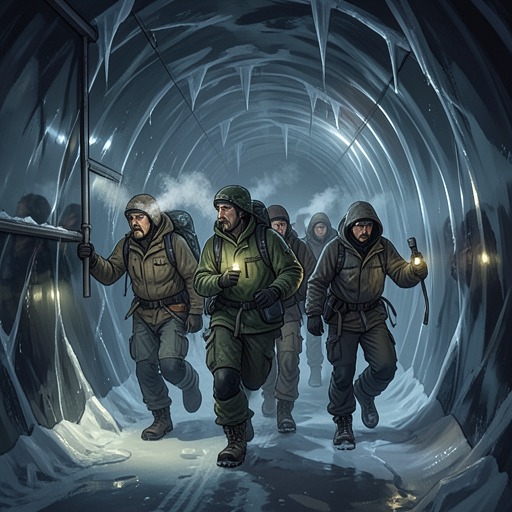
Snowman Cave Escape
The Legend of William OhThe Yeti spawning-ground raid is the desperate incursion and escape from the Ice Caves near the Yeti breeding grounds. What begins as an attempt to obtain precise information about the inhabitants becomes an enclosed ambush: William Oh crosses the threshold alone, finds that the hoarfrost itself is alive, fights through creatures attacking from both sides, and reaches the entrance only to be pursued by a growing pack. The escape succeeds through a combination of William Oh’s movement and violence, the tomahawk’s active power, and Steve Holland’s improvised use of magic, a mannequin, and the cliff edge.
Causes and Setting
The raid is prepared as an information-gathering operation. William Oh first demands that Steve Holland explain everything he knows about the spawning ground and its inhabitants, with particular attention to the exact point at which the danger begins. Steve identifies the site a few switchbacks farther down the trail, where the route turns inward and opens into a cavernous entrance to an extensive network formed largely of ice. The precision of the questioning establishes the expedition’s immediate concern: not merely finding the Ice Caves, but locating the boundary at which the Yeti threat starts.
The entrance is a physical threshold between an exposed mountain route and a concealed ecosystem. William Oh steps tentatively onto the smooth frozen floor, entering a space whose apparent stillness conceals its inhabitants. The cave’s ice is not passive scenery. It becomes camouflage, enclosure, and an instrument of surprise, making the walls themselves part of the Yeti ambush.
The Ambush Inside the Ice Caves
The first warning is the unsettling possibility that the hoarfrost is moving. Almost immediately, a patch of wall lashes outward, its clawed hands nearly as large as William Oh’s torso. The attack overturns the assumption that the cave can be read visually: what looks like frozen surface may be a living predator waiting for movement.
The first creature reveals a red face and massive canines when its mouth splits open in a roar. That sound awakens other patches of ice, bringing additional Yetis into the confrontation. They emerge both in front of William Oh and behind him, converting the cave into a trap with threats on either side. The episode leaves open whether the Yetis have only just noticed him or whether they knew he was present and deliberately baited him with the boot. That uncertainty intensifies the danger, because the object may have been accidental loot or a lure designed to draw him into the spawning ground.
William Oh responds by turning the cave’s vertical space into an escape route. He chooses a point on the ceiling halfway between himself and the exit and jumps as his Ability activates. Rather than attempting to hold ground against the entire pack, he uses movement to break the enclosure’s logic and create distance from the attackers. The action makes traversal itself a form of combat: the ceiling becomes a platform, the exit a calculated destination, and the Ability a means of converting a surrounded position into momentum.
Violence, Flight, and the Pursuit
Mobility does not eliminate the immediate need to fight. William Oh draws his axe and chops off one creature’s finger, then drives the tomahawk into its skull. He flips his body around and rides the twitching corpse back to the ground, a violent maneuver that combines the kill with controlled descent. The creature’s death gives him a brief opening rather than a complete victory.
At the next moment, William Oh whips the tomahawk around and triggers its Active Ability. The weapon therefore functions as more than a conventional axe: its special capacity is part of the sequence by which he survives the cave. After landing at the entrance, he immediately sprints out and up the switchbacks, abandoning the spawning ground before the encounter can become a prolonged engagement.
The retreat does not end the threat. Following Yetis shove through the mass of bodies at the entrance and scramble up the switchback after him. The pursuit extends the cave ambush into the open route, showing that the boundary of the spawning ground is not a secure boundary for those who escape it. William Oh has left the enclosed space, but the creatures retain the initiative and the ability to turn the route itself into another killing ground.
Steve Holland’s Decoy and the Escape
Steve Holland supplies the intervention that William Oh’s speed and weapon cannot provide. He observes that the Yetis are not slowing down, then asks William Oh not to move while he prepares a mannequin attached to a rope. He forms a whorl of dense magic and thrusts it forward as a conical wave, sending the spell through the charging line. The maneuver temporarily disrupts the pack’s pursuit without requiring Steve Holland to defeat the creatures directly.
The decoy depends on performance as much as on magic. Steve Holland holds the mannequin in front of himself, wiggles it to suggest motion, and speaks through it in a deliberately high-pitched adventurer’s voice: “I’m a big, bad adventurer!” He follows with, “Can’t catch me!” The theatrical bait gives the Yetis a visible target and redirects their collective attention away from the escaping climbers.
The deception succeeds in the most dangerous and absurd way possible. The Yetis shake off the confusion, lock onto the mannequin, and dive from the cliff to pounce on the decoy. In doing so, they inadvertently throw themselves over the edge of the floating island. Their pursuit collapses into self-destruction, allowing William Oh and Steve Holland to survive without having to overpower the entire group.
Consequences and Significance
The raid establishes the Yeti spawning ground as a hostile space whose apparent resources and surfaces cannot be trusted. Frozen walls conceal living attackers, a boot may be bait, and the entrance provides no guarantee of safety once the pack is awakened. The event’s decisive reversal is therefore perceptual before it is physical: the expedition fails as a simple inspection because the environment is itself an active participant in the attack.
The escape also clarifies the partnership between William Oh and Steve Holland. William Oh handles penetration, close combat, vertical movement, and the final sprint; Steve Holland handles disruption, misdirection, and crowd control. Neither contribution is sufficient alone. The sequence’s survival logic is distributed among the climbers, the Ability, the tomahawk, the mannequin, the magic wave, the switchbacks, and the cliff. Direct strength kills one Yeti, but coordinated use of movement and deception defeats the pursuit.
As an action, the Yeti spawning-ground raid is both a pursuit and an escape plot. Its rhythm moves from inquiry to threshold crossing, from concealed threat to encirclement, from individual violence to flight, and finally from tactical improvisation to an accidental mass fall. The episode’s humor does not erase its danger; it makes the danger more legible by showing that survival in the Tower may depend on exploiting a monster’s attention as effectively as striking its body.