Tangled
The Legend of William OhTangled is not merely a monster species but the living consequence of a human being’s transformation into an Originator. Its first appearance in Oilton turns an apparently ordinary young man into a nightmare of proliferating limbs, while later discoveries reveal that the creatures are created through an Ability, multiply at an accelerating rate, and can be used as disposable weapons in a larger political scheme.
First Encounter and Physical Form
The first reports of Tangled reach Will through the Jibleya, who describe them as creatures hiding throughout the streets of Oilton. They sleep near the city’s water storage at night, when the cooler surroundings suit them, then spread through the city during the day. The Jibleya have been killing them repeatedly, yet their numbers continue to rise while the defenders themselves become fewer. When Will questions the name, the leader points to the bodies encountered on the way into the city, implying that Tangled are already a familiar and devastating presence there.
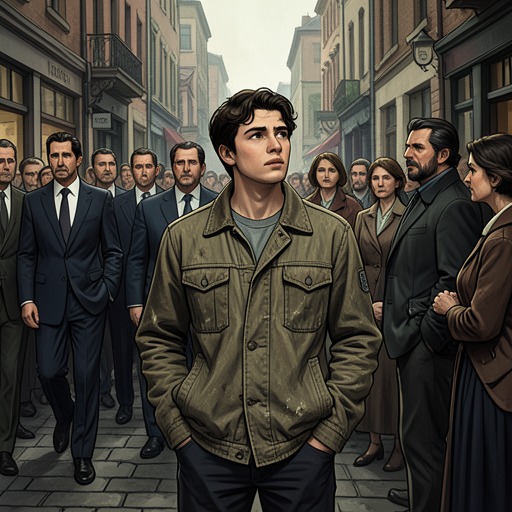
The first direct sighting deliberately frustrates expectation. Will, Loth, Grak, and the kobolds hide motionless in the rafters of an abandoned house as dawn turns the street orange through the smoke. The approaching “monster” is initially only a naked young man about Will’s age, stumbling with a vacant expression. The apparent victim becomes the threat when two kobolds confront him: the dazed look vanishes, hatred seems to travel across his body, and limbs and torsos burst from every part of him. The resulting form is an immense tangle extending as far as ten feet in every direction, sprinting after the kobolds with hundreds of limbs clawing at the surroundings for traction.
Regeneration and the Limits of Containment
The Tangled’s body makes ordinary combat almost useless. Wires fired from the surrounding walls sever dozens of limbs and pin the creature in place, but each amputated limb immediately sprouts replacements. Kobolds and Jibleya attack from murder holes opened in the walls, driving dozens of spears into the mass, yet the dense thicket of limbs makes it difficult to reach the body and any injury heals within seconds. The scene shifts from a conventional fight to a struggle against an organism whose damage is temporary and whose body seems to answer every act of violence with renewed proliferation.
The creature’s ability to reproduce itself is even more alarming than its healing. When a Tangled collapses and writhes in pain, a new head and torso bud from its body and pull free. Within seconds, one creature has become two, each wandering aimlessly. This process explains why the defenders’ victories do not reduce the danger: killing individual Tangled may be only a local success against a population capable of physically generating more of itself.
The Originator and the Human Cost
Will eventually discovers the mechanism behind the monsters in the city’s enormous water tanks. Inside, three Tangled remain apparently asleep, while one human is bound to the floor beneath restraints from head to toe in a deliberately painful position. The revelation is immediate and devastating: the restrained person is the Originator, and the Tangled are the result of that human’s Ability. They sleep near the tanks because their creator is there.
When Will kills the bound human, the other Tangled begin leaking Miasma like ordinary monsters upon death, but the human Originator does not. The distinction confirms that the creatures are extensions or products of the human being rather than an independent species. Will sees in the Original a possible version of himself: a young Climber who might once have received an extraordinary Class, only to be betrayed, tortured, and converted into a disposable weapon. The comparison makes his own lost hand seem almost merciful by contrast, because his injury did not reduce him to an engine for producing monsters.
The discovery also changes the moral meaning of the Tangled. Their violence is real, but the horror begins before they enter the streets. They are manufactured through the torture of a human body, and the monstrous form conceals the exploited person from whom it originates. The creature therefore functions simultaneously as predator, victim, and evidence of a system willing to turn a Climber’s potential into military infrastructure.
Population Growth and Political Weaponization
The Tangled are not only difficult to kill; they transform every attempt to contain them into a race against multiplication. The Jibleya report that the population in Oilton has risen from just below nine thousand to thirteen thousand in three days, an increase that Loth calculates as 14.28 percent per day. That growth rate turns the city into an approaching catastrophe rather than a static infestation. The defenders’ experience already suggests the same pattern: each day brings more Tangled and fewer Jibleya, regardless of how many creatures are killed. Their regeneration and budding reproduction therefore operate at two scales, restoring individual bodies within seconds and expanding the total population through new bodies.
This abundance is not accidental. Loth concludes that the Tangled’s deliberate weakness is their dependence on the Originator: if the Originator dies, all of the Tangled die with it. That vulnerability makes the city strangely convenient for a powerful claimant who wants to appear as its savior. A single assassin can eliminate the hidden human source, allow the entire monstrous population to collapse, and then arrive with an army to reclaim Oilton as though restoring a pristine city from an inexplicable plague. The Tangled are thus both victims of torture and instruments in a political deception, their existence preparing the stage for a Lord to manufacture glory while concealing responsibility for the crime.
The same implication reaches beyond Oilton’s immediate defenders. Travis warns that his older siblings may come within weeks to reclaim the city because its crude-oil infrastructure can earn millions of gold each month by selling to other floors. The Tangled infestation therefore occupies the intersection of bodily horror and economic power: the creatures make Oilton appear lost, but the city’s value ensures that someone will eventually seek to possess it. Their explosive population growth accelerates that contest, while the hidden Originator provides the convenient single point of failure needed for a staged liberation.
Tangled Beyond Oilton
The revelation at Oilton becomes a pattern rather than an isolated horror. Will later recognizes Brianna as a Tangled in human form: a poor Baker girl who was offered a powerful experimental Class by an unidentified Lord, whose identity she either does not know or is forbidden to disclose. Her apparent injuries provide the first clue. When Will dragged her from the palanquin, she had a bloody clump of hair at the side of her head and claimed it belonged to someone else, but the wound had already healed. Combined with her extraordinary Strength and the Tangled’s ability to regrow entire limbs within seconds, the healing suggests that Brianna has not merely survived violence but possesses the same dangerous potential as the creatures in Oilton.
The supposed bandits who intercepted Will’s group reinforce that conclusion. They were unusually focused on Brianna, called her a payday, and, after hearing that a Tangled had gone wild in the center of Oilton, assumed that she was the creature responsible for the destruction. Their misunderstanding protected her temporarily, but it also revealed that others knew what she was or believed she was valuable because of it. Loth judges that Brianna has not yet been tortured to the point of insanity, distinguishing her from the Originator Will found bound beneath the water tanks. Tangled is therefore not an inborn species identity but a condition that can exist along a continuum: a human subject may still retain her mind before the process is completed, while torture and the experimental Class threaten to turn that person into another proliferating weapon.
The danger is intensified by Brianna’s Contract. Will suspects that she is compelled to fight back with all her ability if anyone attempts to prevent her from reaching the Lord, meaning that an intervention could force the group to kill her and might produce another Tangled catastrophe. The Contract is designed with a cruel legal gap: it expires when she reaches the Seventh Floor, so the Lord can begin torturing her immediately without violating the agreement. A normal Contract might include a period of servitude alongside a clause requiring the Lord to protect her well-being, but Brianna’s arrangement avoids that protection altogether. The Tangled thus represents not only bodily transformation but the conversion of exploitation into enforceable procedure.
Will chooses not to tell Brianna what he has inferred. He believes that revealing the truth could trigger the Contract and make her attack the group, while his Party lacks the strength to follow her to the Seventh Floor and rescue her after the Contract ends. His decision leaves her fate unresolved, but the memory of the restrained young man at Oilton prevents him from treating that uncertainty as harmless. Tangled is the name for a monster, yet it also names the future concealed inside an abused Climber, a future Will can identify clearly enough to fear but not powerfully enough to prevent.
Tangled Beyond Oilton
The revelation at Oilton becomes a pattern rather than an isolated horror. Will later recognizes Brianna as a Tangled in human form: a poor Baker girl who was offered a powerful experimental Class by an unidentified Lord, whose identity she either does not know or is forbidden to disclose. Her apparent injuries provide the first clue. When Will dragged her from the palanquin, she had a bloody clump of hair at the side of her head and claimed it belonged to someone else, but the wound had already healed. Combined with her extraordinary Strength and the Tangled’s ability to regrow entire limbs within seconds, the healing suggests that Brianna has not merely survived violence but possesses the same dangerous potential as the creatures in Oilton.
Tangled Beyond Oilton
The supposed bandits who intercepted Will’s group reinforce the conclusion that Brianna’s condition is connected to Tangled. They were unusually focused on Brianna, called her a payday, and, after hearing that a Tangled had gone wild in the center of Oilton, assumed that she was the creature responsible for the destruction. Their misunderstanding protected her temporarily, but it also revealed that others knew what she was or believed she was valuable because of it. Loth judged that Brianna had not yet been tortured to the point of insanity, distinguishing her from the Originator Will found bound beneath the water tanks. Tangled is therefore not an inborn species identity but a condition that can exist along a continuum: a human subject may still retain her mind before the process is completed, while torture and the experimental Class threaten to turn that person into another proliferating weapon.
The Tangled Condition in Brianna
The supposed bandits who intercepted Will’s group reinforce the conclusion that Brianna’s condition is connected to Tangled. They were unusually focused on Brianna, called her a payday, and, after hearing that a Tangled had gone wild in the center of Oilton, assumed that she was the creature responsible for the destruction. Their misunderstanding protected her temporarily, but it also revealed that others knew what she was or believed she was valuable because of it. Loth judged that Brianna had not yet been tortured to the point of insanity, distinguishing her from the Originator Will found bound beneath the water tanks. Tangled is therefore not an inborn species identity but a condition that can exist along a continuum: a human subject may still retain her mind before the process is completed, while torture and the experimental Class threaten to turn that person into another proliferating weapon.