Tangled Originator Kill
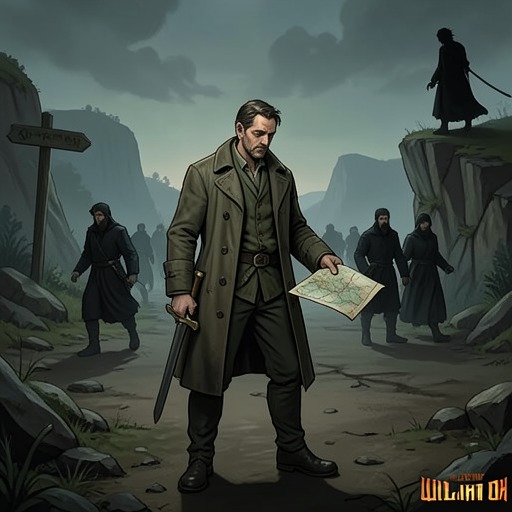
The Legend of William OhThe Tangled Originator Kill is a turning point in William Oh and Loth’s campaign through the industrial ruins of Oilton. What first appears to be a monster-clearing operation becomes an encounter with the human source of the Tangled: a young Climber tortured, altered, and used as a living weapon. William Oh’s killing of him terminates the Tangled outbreak, but the victory leaves William confronting the possibility that his own amputation was a comparatively merciful fate.
Discovery in the Water-Tank Complex
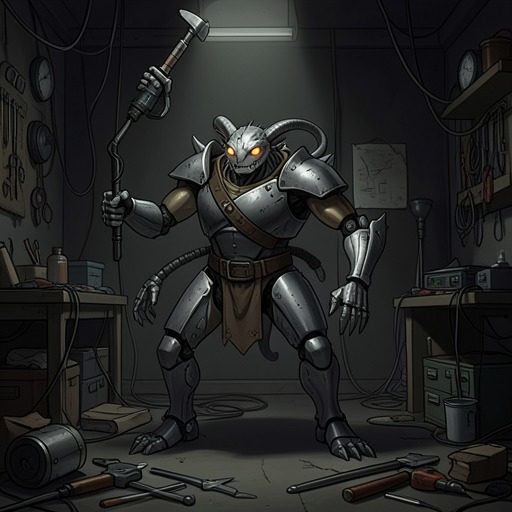
William Oh reaches the enormous water tanks during an operation involving Loth’s plan to create an explosion of steam. The tanks seem squat from a distance, yet their actual height exceeds every surrounding structure, and the water stored within them is comparable in volume to a massive lake. Inside the dim building, William finds three Tangled apparently asleep. One is bound to the floor in restraints, held in a painful position that distinguishes it from the other creatures.
The scene produces the essential recognition: the restrained figure is human, while the Tangled are the result of an Ability. They sleep in the water-tank complex because their Originator is present there. The discovery changes the nature of the encounter. William is no longer simply facing hostile monsters in a dangerous facility; he is standing before the mechanism that has converted a person into the source of a recurring biological and magical threat.
The Originator’s Condition
William approaches the restrained Climber despite Loth’s whispered warning. The young man’s body is covered with bright-white torture scars, with the damage concentrated around a semi-circular scar on his cranium where hair has only begun to grow back. The injury is identified as a lobotomy, making the Originator’s condition not merely mysterious but the result of deliberate physical destruction.
The restraints, scars, and cranial wound establish the human cost behind the Tangled. The young Climber has been reduced to an instrument whose Ability generates or sustains the creatures around him. His body is both victim and source, and the room turns that contradiction into the central ethical problem of the event: freeing him may not be possible, while leaving him alive allows the Tangled to remain active.
William Oh’s Killing Blow
William Oh decides that the Originator must die. He apologizes before drawing the Serpent Tomahawk from his belt, a gesture that acknowledges the restrained Climber as a person even while preparing to kill him. The boy opens his eyes and meets William’s gaze for a moment. William may only imagine that the expression contains recognition, but the brief exchange gives the act a human witness before violence begins.
William buries the Serpent Tomahawk in the young man’s skull, then pulls it free and severs his spine to ensure that the killing is final. The force of the act makes the weapon’s wooden handle creak in his grip. The narration’s abrupt, almost congratulatory response creates a harsh contrast with the brutality of what has occurred: the action is treated as a successful objective while William has just killed a tortured Climber who may have resembled the person he could have become under different circumstances.
Outbreak Termination and Moral Cost
After the attack, the Tangled begin leaking Miasma as ordinary monsters do upon death. None of the Tangled shares the exceptional status of the human victim; all die as the Originator’s continued existence is ended. The distinction confirms the causal structure of the outbreak: the creatures are manifestations dependent on the Originator, while the tortured Climber is the source whose death collapses the threat.
William’s reaction is not triumph. He sees the dead young man as someone he himself might have become if he had received an extraordinary Class, been betrayed, tortured, and repurposed as a disposable weapon. That comparison makes the kill a form of self-recognition as well as an act of extermination. William had already lost a hand, but the Originator’s fate persuades him that he may have escaped more lightly than he once believed.
Place in the Larger Climbing Campaign
The killing occurs within a broader campaign shaped by supply lines, scouting, hazardous infrastructure, and the rules of advancement. William and Loth had earlier divided their party into seven groups while searching the branching caverns for the kaith supply line; Loth’s controlled bucket-sized barrel of soil, filled with food scraps and dozens of insect species, and his glowbug-marked arrows show how improvised tools and nonhuman agents help make exploration possible. When William later falls across a gap, Loth’s thrown rope allows him to secure the route, reinforcing their interdependent partnership.
The campaign’s wider logic is equally practical. Climbers can advance rapidly by running in the wake of a bus and helping clear a Key Site, provided they do not actively sabotage the other Climbers, but William Oh and Loth remain subject to Acclimating and decide that entering a higher Floor below the current maximum level would be foolish. Against this system of levels, rules, equipment, and calculated risk, the Tangled Originator Kill exposes an unquantifiable remainder: a human life has been converted into a tactical problem, and solving that problem does not erase the suffering that made it necessary.