Temple of Andover
The Legend of William OhThe Temple of Andover is both sanctuary and business, presenting miracles through a price list while binding its priests and customers to enforceable financial obligations. Its importance lies in the collision between sacred power and commercial calculation: healing costs money, resurrection costs vastly more, priests can be rented or purchased, and even a dead priest remains a billable asset whose corpse must be returned.
Public Face and Services
A garish gilded sign identifies the Temple of Andover as Rent-a-Miracle, an intentionally commercial presentation of religious power. The dim interior contains a single priest at the front desk, positioned to watch visitors reconsider the prices and leave. The posted rates make the institution’s hierarchy of intervention explicit: healing costs 100 Gold, resurrection costs 10000 Gold, and renting a priest costs 500 Gold for the current Floor or 3000 Gold for a journey to the 5th Floor and back. Purchasing a priest is negotiable, placing permanent or semi-permanent access to sacred labor in the same economic register as a transaction for equipment.
The temple’s priests possess genuine restorative abilities, but those abilities are not offered as an unconditional ministry. When William Oh asks whether the temple can restore his missing hand, a priest quotes a price of fifteen hundred gold rather than the advertised one hundred for healing. The difference establishes that the temple distinguishes between ordinary treatment and the restoration of a lost limb, pricing the latter according to the scale of the miracle and the value of the beneficiary’s continued usefulness.
The transaction is formally framed as a sacrifice. After counting the payment, the priest asks whether the Party agrees to the sacrifice required to restore William Oh’s limb, turning the financial exchange into a ritualized consent. The language gives the payment theological weight without removing its commercial character: money is not merely a fee but the material offering through which divine restoration becomes available.
Hidden Cages and Institutional Debt
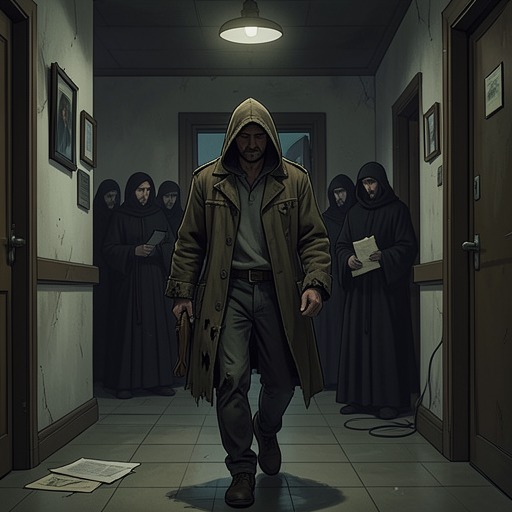
Behind the temple’s public counter lies a far more disturbing institution. William Oh and Loth pass through velvet curtains into a dim interior containing dozens of people, ranging from William Oh’s age to their mid-thirties, all dressed in the ornate robes of Andover priests and all confined in sturdy steel cages. The priest identifies them as the Debtors, people who have not yet bought their way into Andover’s good graces.
The cages expose the labor system concealed beneath the temple’s polished service model. The priestly robes suggest religious membership, but the steel bars and debtor status show that these individuals are not simply volunteers or devotees. Their sacred abilities have been absorbed into an economy of obligation, in which access to the church’s favor depends on payment and unpaid claims can become physical confinement. The temple therefore operates simultaneously as a provider of healing and as a creditor controlling the bodies of those who owe it.
The same logic governs the priests sent into the field. The temple allows a Party to rent a priest, but the arrangement carries guardianship responsibilities and replacement conditions. When Steve Holland dies during the Party’s journey, William Oh returns within the half-hour replacement policy window and asks for a better healer, one less likely to die on the first rise. The priest agrees in principle to arrange a replacement, but first requires Steve Holland’s corpse to be brought back.
The paperwork signed when the Party accepted guardianship states that if an Andover priest dies in the course of duty, the guardians are responsible for returning the corpse to a Temple of Andover within thirty days. Failure to do so incurs a fee commensurate with the priest’s value. What appears to be a replacement policy is thus also a liability contract: the customer does not merely purchase service, but assumes responsibility for the employee’s body and residual market worth.
Prices, Corpses, and Contract Enforcement
The temple’s refusal to refund miracles or priests makes every failed transaction final. William Oh points to the wall’s notice stating that there are no refunds on the purchase of miracles or priests, but the policy offers no relief when the temple’s own arrangements go wrong. After spending fifteen hundred gold on the restoration of his limb, William Oh resents having invested money that could have bought life-saving gear in a service he considers mishandled. His anger sends him back to the Temple of Andover rather than ending the dispute.
The corpse requirement becomes more severe when the priest explains Steve Holland’s actual retail value. The earlier fifteen-hundred-gold price had been a large discount because of the temple’s mishap; Steve Holland, at level thirty-five, is valued at fifteen thousand gold. The institution’s accounting system converts level, experience, and priestly usefulness into a monetary figure, so death does not erase the contract. It activates a larger charge.
William Oh responds by attacking the temple’s journeyman priest with the back of his tomahawk, then forcing his way through the panel into the area called Retribution. He passes through the hall of caged Debtors and reaches a small room where the ancient master of the temple is eating lunch with Steve Holland. The scene reveals that Steve Holland is alive and that the temple’s apparent corpse problem has been part of a deception or mishap from which its senior figures have profited. William Oh’s confrontation changes the temple from a distant service provider into a directly hostile institution.
The dispute is resolved through coercive legal improvisation rather than reconciliation. William Oh’s Party and Steve Holland establish a Contract requiring Steve Holland to tell the truth, refrain from attacking, abandoning, or misleading the Party, support it to the best of his ability, and guide it to his hidden monetarily valuable assets. In exchange, the Party agrees not to kill him and to use those assets to pay his Corpse Fine, attempting to raise the money within thirty days and killing him only if success becomes plainly unlikely. The Contract is sealed by mingled streams of smoke and becomes the twelfth active Contract; William Oh explains that breaking it will literally cause Steve Holland to keel over and die.
The temple’s authority is therefore upheld by several overlapping systems: posted prices, signed guardianship paperwork, replacement windows, corpse fines, and supernatural contracts. Yet the encounter also demonstrates that these systems can be contested by force. William Oh uses the tomahawk to create a lopsided arrangement with the healer, and Steve Holland later observes that this is not fundamentally different from forcing someone to become a Vassal. Andover’s contractual order does not eliminate coercion; it gives coercion paperwork, prices, and religious legitimacy.
Repeated Business and Wider Power
The Temple of Andover remains commercially useful even after William Oh condemns it as skeevy. When the Party later pays fifteen thousand gold for the Corpse Fine associated with Alicia Zodiac, a bruised priest bows and thanks them for paying it, insisting that the Temple of Andover appreciates their business. The exchange is especially grotesque because Steve Holland is standing alive behind Loth while the temple has been informed that he expired. When Loth points this out, the priest treats the discrepancy as a possible admission of fraud by the Party rather than as evidence of institutional absurdity.
The encounter also shows that the temple’s personnel are subject to internal hierarchy. A young healer named Nate has a bruise that remains untreated because he does not yet have permission to use his own powers freely; his daily resources apparently do not exceed a threshold established by his superiors. The temple’s healing ability is thus rationed even among healers, and access to divine power depends on rank, authorization, and institutional control rather than simple possession of the ability.
Steve Holland claims that the church once intervened on his behalf, explaining how he survived despite crossing a dangerous swordsman. He also theorizes that Lords seize talented young people, force them to become Vassals, and thereby end their possibility of attaining Lordship, or kill them. His account places Andover within a broader power structure in which religious intervention, aristocratic domination, and economic payment overlap. The church may not prevent exploitation; it can instead preserve or profit from the people caught inside it, provided the relevant debts and prices are honored.
Narrative Significance
The Temple of Andover is a concentrated expression of the book’s distrust of institutions that claim to provide safety. It offers exactly the services adventurers most need—healing, resurrection, and field support—but packages them with opaque prices, irreversible purchases, labor ownership, corpse obligations, and punitive contracts. The contrast between the bright gilded promise of Rent-a-Miracle and the dark hall of caged Debtors makes the temple’s theology legible as an economy of dependency.
Its most important irony is that the temple’s miracles do not abolish mortality or uncertainty. A restored hand costs enough to compete with survival equipment; a rented priest can die and become a fifteen-thousand-gold liability; a replacement policy exists, but only if the customer retrieves the corpse; and a living priest can be recorded as dead while the institution continues to demand payment. When the Party later decides to try a different temple because Andover is untrustworthy, the decision is not a rejection of divine power itself. It is a rejection of a particular institution’s habit of converting necessity into leverage.
The Temple of Andover consequently stands at the intersection of religion, law, and commerce. Its sacred authority is real, but its everyday operation is governed by ledgers, terms, valuation, and enforceable obligations. In this world, a miracle can restore a body while deepening a debt, and a church can welcome payment more readily than it welcomes mercy.