The Hunt
The Legend of William OhThe Hunt is the organized monster-hunting economy surrounding entry into the Class system, and it is the first practical institution through which William Oh tries to change his status. It promises a route from the orphanage to a Class and, in his imagination, toward family and authority; in practice, it requires patience, supplies, market knowledge, partners, and the willingness to survive setbacks before attempting The Trial.
Purpose and Setting
The Hunt takes place beneath the immense structure of The Tower, whose exposed upper section radiates heat and whose reflective surfaces create the strange grey sky that covers the inhabited world. The environment is not a neutral backdrop: the orphanage lies in arid land heated by proximity to The Tower, while people from distant frozen regions may spend days or weeks traveling merely to reach the places where Classes can be earned. William Oh needs only an hour to walk from the orphanage toward town, but even that relatively short route begins with a supply problem.
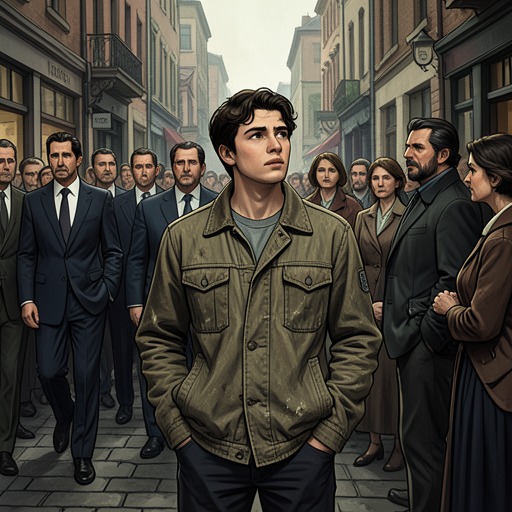
The expedition joins a steady stream of men and women moving toward The Tower beneath its sweltering heat. The Hunt therefore operates both as a dangerous outdoor activity and as a public migration toward social advancement. Its destinations include the Hunting Grounds, where hunters stalk monsters for useful Sacrifices, and the bazaar, where those materials can be sold or exchanged for equipment and provisions.
Rules, Preparation, and Economy
Gertrude warns William Oh not to rush into the Class Trial with the first three Sacrifices available. Her advice defines The Hunt as a process of selection rather than simple collection: he has the entire summer to hunt, can sell unwanted Sacrifices, can buy gear, and may wait for another Aspirant to pass along an item better suited to his eventual Class. The Trial has no time limit, so beginning it prematurely would exchange flexibility for an uncertain result.
William Oh initially approaches the expedition with practical but modest preparation. He buys a sling, two dozen bullets, two pounds of pemmican, and a waterskin before entering Leon’s General Store. The contrast between these supplies and the specialized clothing of better-equipped hunters exposes the economic hierarchy within The Hunt. Ben, for example, wears a leather cuirass, flexible Gollak-glued trousers, and expensive comfortable shoes, while William Oh goes barefoot and mocks Ben as a “try-hard.”
Ben’s father has taught him to begin with easier prey, sell the returns at the bazaar, and wait roughly a week while more experienced hunters soften the dangerous locations. William Oh receives essentially the same recommendation from Gertrude and reluctantly agrees to follow the “smart way.” The arrangement turns hunting into a staged investment: early prey generates cash, cash improves equipment, and improved equipment reduces the risk of pursuing the Sacrifices that matter most.
The Trial and the Sacrifices
The Hunt’s immediate objective is to obtain three Sacrifices capable of initiating The Trial. When William Oh and Ben encounter the Trial’s glowing archway, its appearance confirms that the system recognizes the required materials. The Trial presents itself only after all necessary Sacrifices have been acquired, and Ben looks toward the satchel containing William Oh’s dried Uru Drake as the third piece that summoned it.
Not every Sacrifice is equally valuable. William Oh pays more than half the money earned from selling a tongue to buy another preserved material, because retail value is unavailable unless the hunter preserves the item personally and finds customers willing to pay. Even so, he regards being two-thirds of the way to his objective on the first day as a success. The episode makes the economic logic of The Hunt inseparable from its ritual logic: materials must be hunted, preserved, priced, and chosen before they can become a Class.
The system also judges the quality of what is offered. When William Oh places a thumb-sized piece of pemmican on one of the Class Trial Altars, a beam of light consumes it and the voice in his mind reports that the Sacrifice is suboptimal; the attempt to generate a Class Seed fails. The result turns preparation into a negotiation with an impersonal mechanism. Possessing three offerings is not enough: the offerings must meet the system’s hidden or exacting standards.
Companionship, Injury, and Risk
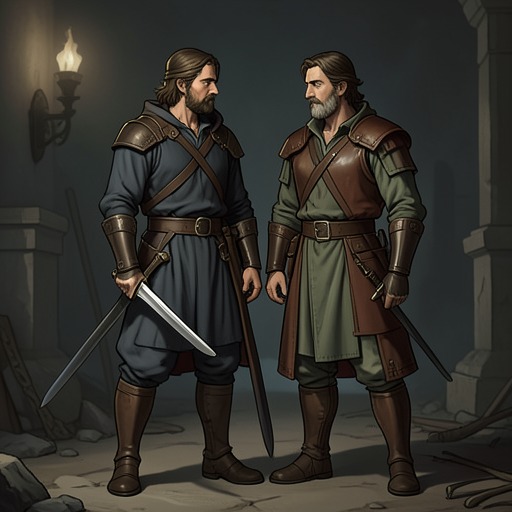
Although The Hunt is competitive, it repeatedly depends on temporary partnerships. Ben provides William Oh with a hunting companion and a second perspective on how to approach the market. When William Oh is injured, a week passes before his wounds become manageable, and he worries that Ben may complete his Trial during the delay, leaving him without a partner and placing him at a disadvantage.
The danger is not abstract. Before leaving again, William Oh considers rebandaging his wounds in case deeper scratches begin to ooze blood during the hunt. Gertrude’s unusual kindness, including a kiss on his cheek and a solemn good-luck wish, makes him suspect that she believes he may die. He nevertheless leaves with his satchel over his shoulder, convinced that he can obtain every remaining Sacrifice by the end of the day.
His route later expands beyond the secure familiarity of the orphanage and shop. William Oh tells Leon to inform Gertrude that he is leaving overnight with complete strangers, then travels with them to the Hunting Ground. They arrive at the apparent sunset, when the sun sinks below the horizon and throws long, ominous shadows across the woods. The group spends an hour stalking signs of an elusive monster without seeing it, making anticipation itself part of the event’s danger: the unseen threat consumes time and attention before any confrontation occurs.
From Hunting to Climbing
The Hunt is the foundation of William Oh’s progression, but it does not end when he obtains a Class. After his advancement, the system assigns an Establishing Quest involving the Kaith supply lines. Nathan explains that the Kaith are using an extensive cave system to move food toward front-line battles and that the new Climbers must destroy the supply route rather than engage the Kaith directly. The expeditionary logic of The Hunt thus develops into organized military logistics, where reconnaissance, supplies, routes, and withdrawal matter as much as direct strength.
The same principle governs William Oh’s next advancement. After he reaches level five on his first Establishing Quest, experience gain in the Hunting Grounds and the 1st Floor is reduced, forcing him to seek the 2nd Floor if he wants to continue accumulating power. The system offers an established route that is slow and safe, or the dangerous but rewarding option of clearing a Key Site to open an inter-floor Door. The Hunt therefore functions as an apprenticeship in the larger rules of Climbing: learn the terrain, manage risk, exploit rewards, and accept that every safe source of growth eventually becomes insufficient.
Later scenes retain the same practical structure even when the scale becomes more severe. William Oh carries Brianna through the punishing heat of the 3rd Floor and drops her into the ash after canceling an ability. At the Stronghold, ballistae and patrols defend a floating mountain whose exposed layers contain a valuable salt mine, while a later operation turns water tanks into engineered weapons: Travis lures the fire-mote swarm away as the others rig the tanks to explode. These actions show how The Hunt’s original habits of scouting, gathering resources, choosing targets, and using the environment mature into coordinated Climber operations.
Narrative Significance
The Hunt marks the passage from aspiration to consequence. William Oh begins by imagining that a Class will connect him to a larger family and by rushing toward the door as soon as Gertrude permits him to join. Yet the event repeatedly interrupts that romantic forward motion with prices, preservation requirements, inferior materials, wounds, uncertain companions, and monsters that remain unseen in the dark.
Its central lesson is that advancement belongs neither wholly to the strongest nor wholly to the most enthusiastic. Ben’s cautious plan, Gertrude’s warning, the failed pemmican offering, William Oh’s injured delay, and the system’s later level-five restriction all teach the same hard principle: survival depends on timing and judgment as much as courage. The Hunt begins as a gateway to a Class, but its deeper function is to train William Oh in the resourceful, distrustful, improvisational habits required of a Climber.