The Hunting Grounds
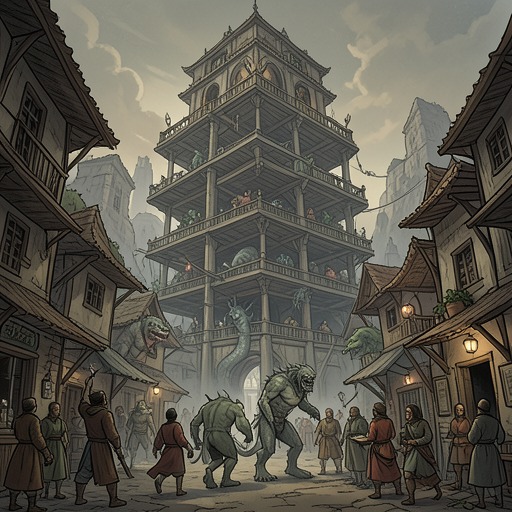
The Legend of William OhThe Hunting Grounds is the early-game wilderness surrounding the orphanage and the principal training ground for Aspirants seeking their Classes. Its decisive significance is practical rather than ceremonial: it turns an unclassed survivor into a participant in the Tower’s advancement economy, while forcing every promise of progress through distance, supplies, injury, monsters, and the risk of death. For Will, the region is where preparation becomes action, where the System’s rules first acquire physical consequences, and where later returns to family and unfinished business keep the beginning of his journey present within the larger Climb.
Setting and Access
The Hunting Grounds lie within the arid territory near The Tower, whose proximity leaves the orphanage exposed to substantial heat. The region is not equally accessible to everyone: some people travel for days or weeks from the outskirts to earn their Classes, while those living in the frigid wastes at the edges of civilization may spend months reaching the process. Will’s route is comparatively short, requiring only an hour on foot, but even that journey begins with logistics. Before setting out, he obtains a sling, two dozen bullets, two pounds of pemmican, and a waterskin from Leon’s General Store.
The landscape demands practical navigation rather than trust in ordinary geography. A scarred man directs Will and Ben toward a hunting ground roughly three miles from the entrance, identifying a large boulder at the edge of a meadow as one landmark and the entrance as another. He specifically warns them not to navigate by the sun because the sun moves; Will’s attempt to verify this by looking upward only leaves him with burning eyes. The advice establishes The Hunting Grounds as a place where inherited assumptions are liabilities and survival depends on local knowledge.
Aspirants and Hunting Practice
The Hunting Grounds initially draws a stream of Aspirants, but the procession thins as Will and Ben follow it before turning into the forest. Other Aspirants appear intermittently, each heading toward a separate objective, and the division of routes creates a temporary community without removing the threat of competition. Their hunt is conducted among people who may cross paths, yet the immediate danger is sufficiently real that the absence of anyone being shot counts as good fortune.
The region is also a place of deliberate risk management. After Will is injured, he considers hunting wheat gremlins rather than pursuing more dangerous targets. Wheat gremlins are slow and stupid, and killing dozens of them would provide the money needed to buy Dreamcatcher Vine, though the process would be tedious. The choice reflects a shift from ambition toward sustainable progress: Will recognizes that worsening his wounds could delay The Trial more than cautious hunting would. In The Hunting Grounds, the difference between courage and recklessness is measured in recovery time, supplies, and whether a body remains fit enough to continue.
Not every expedition is solitary or cautious. Will later agrees to leave with complete strangers for an overnight hunting trip after telling Leon to inform Gertrude of his plans. The party reaches The Hunting Ground at apparent sunset, when the sun sinks below the horizon and casts long, ominous shadows rather than simply dimming. They spend an hour searching the woods for an elusive monster without seeing it. The failure is still instructive: the location does not guarantee immediate reward, and the pressure of hunting extends into darkness, uncertainty, and the possibility that the desired prey will remain unseen.
The Trial and Systemic Advancement
The Hunting Grounds are directly tied to the System’s progression structure. The Trial presents itself when an Aspirant has acquired all the required Sacrifices. For Will, the final component is the dried Uru Drake carried in a leather satchel whose workmanship suggests a subtle enchantment: the satchel remains balanced, always fits, and weighs slightly less than it should. Once the necessary materials are assembled, a pale yellow archway opens from thin air, marking the transition from ordinary hunting to formal Class generation.
The system does not treat every offering as equally valid. When Will places a thumb-sized piece of pemmican on one of the Class Trial Altars, a beam of light consumes it and the System reports that the Sacrifice is suboptimal; the attempted Class Seed generation fails. This failure gives the hunting economy a sharp procedural edge. Food is not merely food, loot is not merely wealth, and effort is not automatically convertible into advancement. The Hunting Grounds therefore function as a supply chain governed by hidden or only partially understood requirements, with Will compelled to learn which materials the System will recognize.
After further progression, Will becomes a full-blooded Climber and later reaches level five during his first Establishing Quest. The System then nerfs experience gain in the Hunting Grounds and on the 1st Floor, making continued power accumulation there less efficient. The region’s role changes accordingly: it begins as the most immediate route toward a Class and early levels, but the rules eventually push successful Climbers upward toward the 2nd Floor. The Hunting Grounds are thus both a beginning and a deliberately temporary economy, useful until advancement makes them insufficient.
Recurrence and Narrative Significance
The area remains connected to Will even after his career expands. Following the destruction of Oilton, Loth requires time to regrow scales and is confined to a rental wheelchair because her entire body is hypersensitive and movement is painful. Will explains that Loth has already reached the level cap for the floor after blowing up Oilton, so he will grind while she recovers before the pair return to The Hunting Grounds to visit family and eventually attempt the 4th Floor. The return is not merely a retreat to easier enemies. It joins bodily recovery, family obligation, resource gathering, and future planning in the same place where Will first learned to hunt.
The Hunting Grounds also embody the book’s larger contrast between inherited structures and improvisation. The sky above the Tower is a strange grey ceiling fitted with reflective surfaces installed by Climbers thousands of years earlier to catch and redirect sunlight; the landscape is therefore shaped by both ancient engineering and present-day survival. Within that layered environment, Will learns through immediate experiments: he buys supplies, follows landmarks, evaluates prey, survives traps, studies Sacrifices, and responds to System prompts. The region’s narrative function is to make the Tower’s immense rules legible at human scale. Advancement begins not with mastery, but with a waterskin, a sling, a dangerous walk, and the knowledge that even the sun cannot be trusted.