The Kaith Cavern System
The Legend of William OhThe Kaith Cavern System is the subterranean logistical network beneath the First Floor through which the Kaith transport supplies toward their front lines. Its branching darkness, treacherous gaps, and connection to the Kaith Bridge make it both the immediate objective of Establishing Quest: Break the Supply Lines and a physical expression of the Tower’s larger logic: advancement depends on finding routes through spaces designed to confuse, divide, and kill.
Definition and Setting
The system is an extensive cave network reached through a large hole in the ground near the newly assembled Climbers. Nathan explains that the Kaith use it to move food to the front lines, where they are fighting higher-level Climbers. The stated task is therefore not to engage the Kaith army directly, but to locate and destroy the supply lines running through the caves.
The interior is a branching web of tunnels that plunges into pitch-blackness. The geometry quickly forces the expedition to divide into seven groups, turning the caves from a single path into a distributed search space. The Kaith workers encountered inside are weaker than the warriors at the front, resembling the kind of creatures expected on the First Floor, but the reduced combat threat does not make the environment safe. Darkness, disorientation, vertical gaps, and the need to preserve a route back impose their own hazards.
Exploration and Navigation
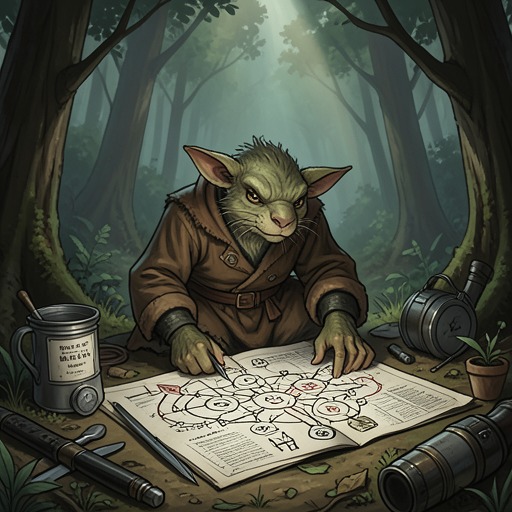
Will and Loth explore the tunnels together, with Loth’s controlled insects providing both equipment and orientation. A bucket-sized barrel of soil topped with food scraps contains dozens of insect species, and Loth controls them with ease. His glowbugs serve as portable lights, allowing the pair to advance through the darkness while also marking their progress.
At every branch, Loth leaves an arrow pointing toward the route they came from, drawing the mark with the luminescent juices of glowbugs crushed against the wall. This practice gives the cavern system a fragile, improvised cartography. The expedition does not possess a stable map; it creates one incrementally, using living creatures and their residue to resist the caves’ capacity to erase direction.
The system also tests climbing ability as much as combat ability. When Will reaches a ledge after crossing a dangerous gap, Loth throws him a rope and instructs him to hold it against the wall. The rope converts an isolated leap into a traversable route for the rest of the party, showing how the expedition’s progress depends on temporary infrastructure as much as individual strength.
Discovery of the Kaith Bridge
The expedition eventually approaches the suspected supply line in silence, guided by Loth’s glowbugs. The Kaith Bridge comes into view as a ruddy-brown structure resembling regurgitated stone mixed with rust, reinforced by organic latticework that arches into the chasm and appears to stretch into the distance without end.
The bridge is not merely a crossing but a moving artery. Kaith travel across it at full speed, their rotund, insectoid bodies gliding silently past one another. One stream carries the rotting corpses of First Floor fauna and occasional humans, while the opposing stream carries nothing. The traffic reveals the bridge’s function before any formal confirmation: it is a route through which material from the lower environment is fed into the Kaith war effort.
Will reports that a Kaith bridge lies a couple of hundred feet ahead. Mason argues for obtaining reinforcements, and Will agrees. Their decision preserves the distinction Nathan established between identifying the objective and attacking it. Reconnaissance produces knowledge, but knowledge alone is not enough to justify an immediate confrontation with a functioning enemy supply route.
Thresholds, Routes, and Spatial Control
The Kaith Cavern System belongs to a broader pattern of spaces in which access is controlled by architecture, rules, and accidents. Earlier, Will is trapped in the Class Creation Room, a plain white room with three altars and no exit. The walls withstand every force an Aspirant can bring to bear, including Relic weapons supplied by high-level Climbers, so an enclosed room can become a starvation trap rather than a neutral starting point. When Will later accepts a doorway outside Leon’s shop, the opening is identical to the doorway that confined him for two days, turning a system prompt into another spatial threshold whose danger depends on where it is used.
The cavern system reverses that condition. It has too many exits and branches rather than none, but the practical result can be similar: without light, markers, and coordination, movement becomes a form of entrapment. The same Tower that places a visible emergency escape hatch above a room can leave an expedition to construct its own way through darkness. In this sense, the caves are both physical territory and a test of whether the Climbers can produce navigable space under pressure.
The wider Tower repeatedly makes geography vertical and discontinuous. On the Second Floor, Will and Loth discover that land can end at a sheer cliff and that their apparent mountain peak is actually a floating mountain, separated from surrounding land by open air. Later, a yeti spawning ground lies beyond switchbacks at the entrance to an extensive network formed largely of ice beneath a mountain whose underside never receives the sun’s warmth. These environments establish that a cave system in the Tower is never simply underground: it is part of a layered world in which routes, elevation, and environmental boundaries determine who can reach resources and who remains cut off.
Strategic and Narrative Significance
The caves convert the Establishing Quest into an exercise in logistics. The objective is to interrupt movement rather than win a battle, and the system makes that objective legible through its traffic: workers, food, corpses, bridge routes, and the front-line war all meet in one constrained network. The party must manage information, light, physical access, and reinforcements before attempting decisive action.
That emphasis on routes continues elsewhere in the Tower. The fastest way to reach the next Floor is to follow behind a Bus and assist in clearing a Key Site, provided the Climbers do not sabotage the main group. Yet the rules allow such advancement only within broader limits, and Loth considers ascending before reaching the maximum level for the current Floor foolish. Progress therefore depends not only on finding a path but on understanding the rules attached to it.
The Kaith Cavern System’s most important narrative function is to make infrastructure visible. The Kaith are dangerous because they are organized: their bridge carries material, their tunnels divide the terrain, and their supply line connects the First Floor to a larger conflict. Will and Loth’s discovery matters because it identifies the point where that organization can be interrupted. The caves turn darkness into an opponent, navigation into a survival skill, and a bridge into the visible structure of an enemy’s power.