The Lanover Expedition
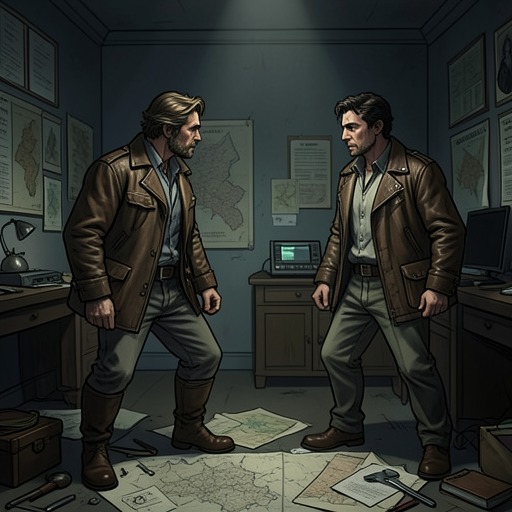
The Legend of William OhThe Lanover Expedition is Mason Lanover’s Party, an organized Climber group whose identity is revealed through action rather than formal description. In the available evidence, it operates as a coordinated expeditionary force: its members hold a combat line, respond to breakdowns collectively, move through dangerous terrain with the help of improvised infrastructure, and protect the material rewards of their work. The Party’s defining significance is therefore logistical as much as martial. It survives by maintaining formation, restoring control quickly, and treating information, routes, rescue, and recovered treasure as parts of the same expeditionary system.
Identity and Organization
The Lanover Expedition is introduced as Mason Lanover’s Party. When Mason is brought back into the cavern system, he presents the masked Will as someone who has helped him before and identifies the surrounding group as his Party, The Lanover Expedition. The introduction places Mason at the center of the organization, but it also indicates that the Expedition contains a larger body than the handful of people immediately involved in the rescue: behind Reggie are roughly a dozen Climbers whom Will does not recognize, along with June.
The evidence does not provide a complete roster or a formal hierarchy beyond Mason’s visible leadership. It does, however, show a group capable of acting as a unit under pressure. The Expedition is not merely a collection of adventurers traveling together; its members can reform a line, push an enemy toward a choke point, and resume coordinated killing after a local failure. That practical cohesion is the organization’s most securely established characteristic.
Battlefield Discipline and Mutual Responsibility
The Expedition’s military character appears in the response to a threatened defensive line. After a smoking disruption, Mason scans the remains and asks whether control has been restored. A mercenary Warrior answers for the group, and the others reform their line, drive the kaith back to the choke point, and cut them down in large numbers. The sequence emphasizes recovery rather than individual heroics: the important achievement is that the formation returns and the front becomes functional again.
Reggie’s reaction gives this discipline an ethical dimension. He thanks Mason even though Reggie was not the person who had folded under pressure, because one person’s problem was understood as everyone’s problem. Responsibility therefore travels through the whole formation. The Expedition’s strength lies not only in the weapons of its members but in its ability to absorb a momentary failure without allowing that failure to become a collapse of the group.
Rescue, Routes, and Expeditionary Infrastructure
The Lanover Expedition is also associated with movement through hostile spaces and with the material systems that make such movement possible. Loth winds a rope bridge between the openings of the yeti ice cave and the kaith tunnels, linking two otherwise dangerous routes. When Mason and the others reach the stone side of the cavern system, Reggie helps Mason back up, while the bridge provides better footing for hauling them in. The rescue is consequently a collective operation involving elevation, ropework, terrain, and coordinated labor rather than a simple act of personal combat.
Mason’s survival is immediately connected to the Expedition’s network of allies and contacts. He recognizes the masked Will as a previous helper and introduces him to the Party as Billy Goat. That exchange shows the Expedition temporarily incorporating an outsider into its operational narrative without erasing the distinction between established members and a newly encountered collaborator. Its reach is thus defined by both internal cohesion and the ability to make use of assistance beyond its core group.
Loot, Ownership, and Expeditionary Stakes
The Expedition’s practical interests become explicit when another Climber peers into the ice caves and sees the corpse of Alicia Zodiac. Steve identifies the corpse and announces that it is accompanied by loot worth tens of thousands of gold. He also insists that the information is being disclosed because the onlookers have no means of taking the property away from the group; the corpse and treasure belong to the Expedition’s side, and the statement is delivered as a challenge to anyone frustrated by that fact.
This moment gives the organization an economic boundary as well as a military one. The Lanover Expedition does not treat a dangerous recovery as an abstract victory. Alicia Zodiac’s corpse is a significant payday, and the treasure becomes a source of potential conflict the instant it is revealed. The group’s claim depends on possession, strength, and the confidence that its surrounding allies can prevent others from seizing the reward. Expeditionary success therefore produces a second problem: defending the gains created by the expedition.
Narrative Significance
Within the larger Climbing system, The Lanover Expedition represents organized cooperation in a world where advancement depends on routes, Key Sites, and dangerous inter-floor movement. The System distinguishes between slow, safe established routes and faster but riskier progress made by clearing a Key Site; the Expedition’s scenes make that broader logic concrete by showing how survival depends on bridges, choke points, formations, and rescue capacity. Its members embody the practical side of climbing: progress is never only a matter of individual level or class, but also of who can hold a line and who can get others out.
The organization’s presence also sharpens the contrast between direct violence and expeditionary method. Nathan’s Quest warns Climbers to destroy kaith supply lines rather than seek a direct fight, and the later scenes around The Lanover Expedition similarly privilege control of space, transport, and timing. Even Loth’s earlier use of insects to scout branching tunnels and mark the return route with glowbug fluids belongs to the same world of distributed tools and coordinated movement. Against that background, The Lanover Expedition is significant as a model of collective agency: its identity emerges from the network formed by Mason Lanover, Reggie, June, the Party’s other Climbers, rescue equipment, hostile terrain, and the contested rewards of the climb.