The Second Floor
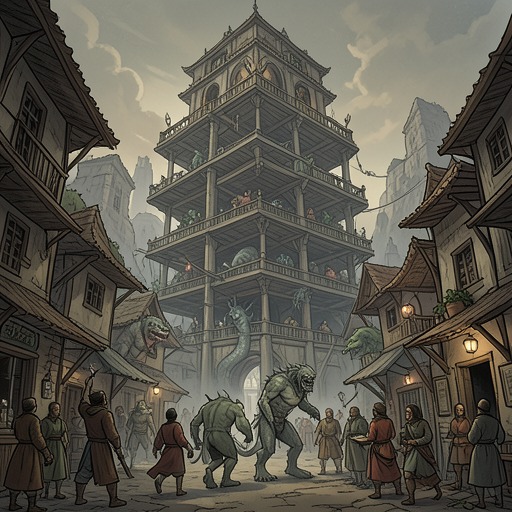
The Legend of William OhThe Second Floor is the first major threshold where The Tower’s vertical geography becomes a practical system of trade, warfare, and survival rather than merely a sequence of higher levels. Its lack of agricultural land forces dependence on imports, while its floating mountains, treacherous routes, and distinctive Sacrifices make movement and commerce unusually demanding. The floor is therefore both a frontier and a logistical bottleneck: whoever controls its paths, supplies, and contracts gains leverage over Climbers and the Kaith conflict alike.
Geography and Travel
The Second Floor does not present itself as a continuous terrestrial landscape. William Oh and Loth discover that what appears to be a mountain peak is actually a floating mountain suspended in the sky, separated from neighboring land by sheer cliffs and gaps of open air. One break leaves hundreds of feet between the travelers and their destination; elsewhere, at least fifty feet of empty space cuts the peak off from every surrounding landmass. The discovery transforms the meaning of a journey on the floor. A route that looks merely steep or inconvenient may instead terminate in open sky, making ordinary assumptions about ground, distance, and direction unreliable.
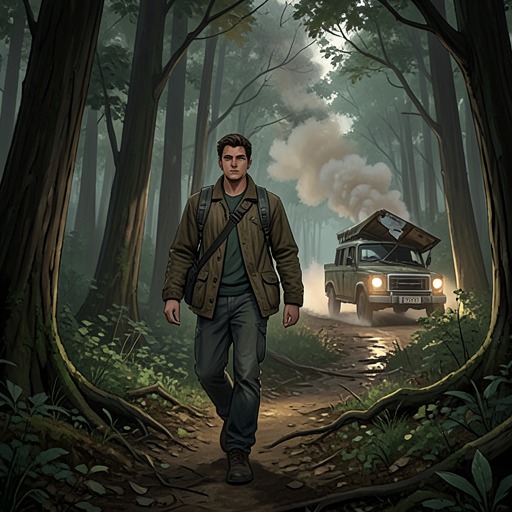
The difficulty of navigating this terrain has created a market for specialized equipment and prepared transport. A caravan traveling between levels carries a wagonload of rope, along with steel hooks and pulleys, because even the Second Floor’s own infrastructure cannot be trusted completely. Rope is not a minor convenience but a form of insurance against a landscape in which a misplaced step, a broken route, or an unseen gap can turn travel into a fall. The floor’s geography thus produces its own commercial necessities before any monster or enemy appears.
Economy and Exchange
The Second Floor lacks sufficient land for agriculture, so its settlements and Strongholds rely on exchange with other levels. Traders bring bulk fabrics, including magical fabrics, from the First Floor and trade them for the floor’s unique Sacrifices, salt, and other exports. They then descend toward The Pit, where those goods are exchanged for coin outside The Hunting Grounds, before returning to their farms on the First Floor and repeating the circuit. This recurring route places the Second Floor inside a wider economic loop linking cultivation, extraction, adventure, and cash circulation.
Salt is one of the floor’s most tangible cultural and commercial signatures. Steve later serves stew made with salt from the Second Floor and flammenwulf from the current floor, treating the combination as a regional specialty. William Oh’s delighted reaction to the salt emphasizes its scarcity elsewhere and gives the commodity an immediate bodily importance: the floor’s export is not abstract wealth but something remembered through food, appetite, and relief. The Second Floor’s value is consequently measured both in contracts and in the ordinary material pleasures that its resources make possible.
War and Strategic Pressure
The floor is also central to the campaign against the Kaith. Kaith forces have pushed into the First Floor and are under an extermination order issued for higher-level Climbers, while their primary nest is under siege. They continue receiving supplies through unknown channels, creating the need for an Establishing Quest to locate and sever those lines. The Second Floor is implicated not simply as the enemy’s origin point but as the space from which movement, supplies, and military pressure extend downward.
The operation’s instructions distinguish logistical victory from direct combat. Nathan tells the new Climbers that the objective is to enter the cave system used to move food toward the front lines and destroy the supply lines, not to fight the Kaith directly. This framing reveals the floor’s strategic character: routes and provisions can matter more than raw strength. The campaign depends on reconnaissance, infrastructure, and controlled withdrawal, with the Second Floor functioning as the contested depth behind the immediate battlefield.
Hazards and Thresholds
The Second Floor’s dangers are not limited to its visible cliffs. During the supply-line expedition, William Oh nearly falls through a three-foot-wide opening in the tunnel floor. The apparent shadow is actually a pitch-black shaft of immeasurable depth; he drops for a fraction of a second before catching the far edge with his remaining hand and pulling himself back into the tunnel. The incident condenses the floor’s governing hazard into a single image: the environment can conceal an abyss inside an ordinary path, and survival may depend on a reflex performed before understanding catches up.
The floor also marks a threshold in preparation and character construction. Climbers are warned that the Third Floor’s extreme heat will require strong fire resistance, even if acquiring it damages an otherwise effective Build. Loth’s insects will need to shelter in their barrel with a block of ice unless he can give them heat resistance. The warning places the Second Floor between known hardship and a harsher ascent, turning it into a staging ground where equipment, abilities, and alliances must be reconsidered before advancement.
Social and Narrative Significance
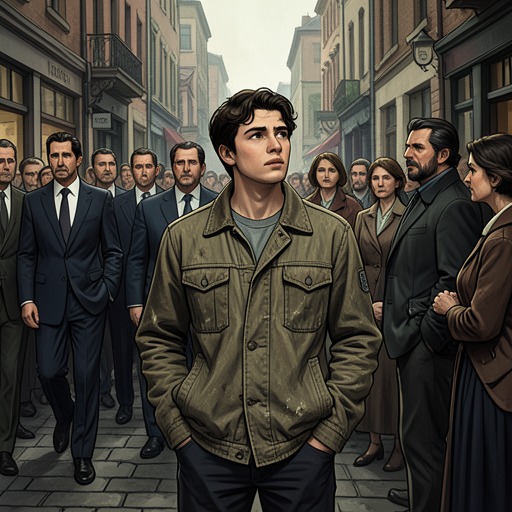
The Second Floor produces status as well as danger. William Oh’s name begins to acquire brand value, even while a Lord he angered there may still be searching for him. His growing reputation attracts copycats, making it difficult for others to establish that a team contains the genuine William Oh or merely offers William Oh-level quality. The floor therefore contributes to the conversion of personal survival into public identity: contracts, enemies, imitators, and commercial expectations follow a Climber upward.
Its importance is also visible in what remains unresolved. A body recovered during the ice-cave expedition is identified as Mark Wyrd’s, yet Mark Wyrd’s corpse is ultimately missing from the division of recovered remains. The Second Floor’s expeditions thus leave behind more than loot and routes; they generate uncertain deaths, disputed ownership, and information that cannot be neatly secured. Later, the possibility of returning to the Second Floor to feed Summer Relics until it grows large enough for another ascent shows that the level is not merely crossed once. It remains a place for grinding, preparation, trade, and delayed advancement. In The Tower’s structure, the Second Floor is the level where vertical progress becomes an economic and political practice, paid for through logistics, risk, and the continual management of scarcity.