The System
The Legend of William OhThe System is the Tower’s governing interface and procedural authority, transforming a fantastical climb into a sequence of measurable decisions. It assigns quests, evaluates sacrifices, generates Classes, records experience and levels, opens routes between Floors, and announces rewards or consequences. Its prompts appear objective and administrative, yet they determine what opportunities exist, which risks are worth taking, and how survival is translated into progress.
Definition and Interface
The System communicates through concise notifications, displayed choices, and direct mental messages. In the Class Creation Room, it responded when William Oh placed a thumb-sized piece of pemmican on an Altar: a beam of light consumed the offering, after which the System reported that the sacrifice was suboptimal and that generating a Class Seed had failed. This exchange establishes both its ritual mechanism and its strictness. Sacrifice is not merely symbolic; it is processed according to requirements the Aspirant may not fully understand, and failure produces no Class.
The same interface then required William Oh to choose his Primary Abilities. The prompt appeared alongside numerical information, including two Charges and one Free Point, making the System function simultaneously as menu, character sheet, and resource ledger. Its presentation gives abstract advancement a concrete operational form: William Oh must interpret what a Resourceful Climber is before deciding how its abilities might develop, because the choice is a permanent-looking intervention in his future build rather than a decorative label.
Quests, Rewards, and Advancement
The System turns external objectives into formal quests. At Leon’s shop, it issued the Establishing Quest: Break the Supply Lines, explaining that the Kaith had pushed into the First Floor, were under an extermination order for higher-level Climbers, and were still receiving supplies through unknown channels despite their primary nest being under siege. The quest therefore translated a broad military problem into an actionable assignment with a defined objective and implied reward structure.
After the supply-line objective was completed, the System announced Quest Complete and directed William Oh to the local Exchange Hall for monetary reward disbursement, while granting 1,500 XP. The reward did not remain an informal accolade; it entered the Tower’s institutional economy, linking experience, money, and recognized achievement. Later, it issued a new quest to ascend to the 2nd Floor, showing how one completed task feeds directly into the next stage of progression.
Reaching level five on the first Establishing Quest also triggered a congratulatory ranking notice. William Oh was placed 1,053rd among that year’s Aspirants, but the message immediately paired recognition with restriction: experience gain in the Hunting Grounds and the 1st Floor had been reduced. The System thus rewards achievement while closing off the efficiency of remaining in a safe or familiar zone. Continued growth required ascent, not indefinite farming of earlier content.
Rules, Routes, and Spatial Control
The System explains advancement through two routes to the 2nd Floor. Established routes are slow, safe, and reliable; clearing a Key Site on the 1st Floor is quick, dangerous, and rewarding because it opens an inter-floor Door. This distinction makes geography a controlled progression system. A Door is not simply discovered by wandering: access is earned through a prescribed form of risk, and the choice between safety and acceleration becomes a strategic decision.
The System further warns that above the 5th Floor, established routes no longer exist. Climbers must secure Key Locations to ascend or descend, so it recommends acclimating to those trials early. The warning reaches beyond immediate instruction. It reveals a Tower whose higher regions eliminate ordinary circulation and make territorial control the only reliable form of movement. The System does not merely describe the environment; it teaches Climbers how the environment has been designed to govern them.
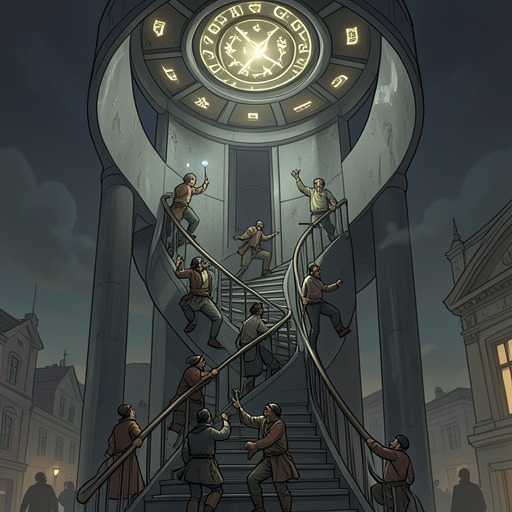
Its prompts also regulate thresholds between Floors. When William Oh entered the 3rd Floor, the System announced his arrival and imposed a three-day Miasma Acclimation period. It advised against ascending or descending before the period elapsed, listing fever, bulging bloodshot eyes, coughing, pustules, necrosis of the extremities, parasitic twin growths, and Death among the possible effects. The warning combines bureaucratic clarity with grotesque physical stakes: a transition that might otherwise resemble a level-up is presented as a biological hazard with a mandatory adjustment period.
Danger, Information, and Tactical Use
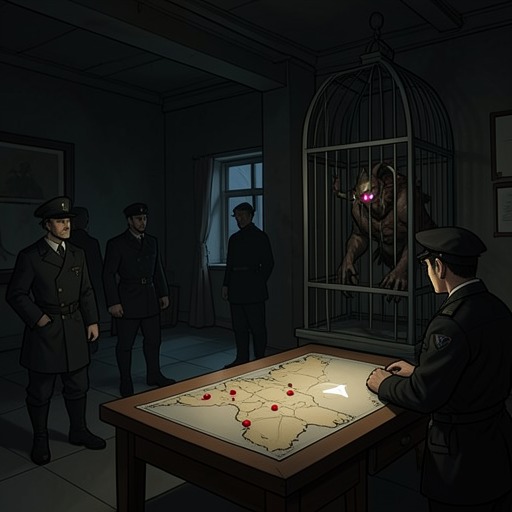
The System’s notifications can alter the meaning of a scene even when they do not directly intervene. During the escape from a feral monster, William Oh used Phantom Hand to throw a bell into the creature’s cage, hoping the noise would lure investigators into believing that he had been caught. The System did not solve the problem for him; its surrounding rule structure made every second valuable, while William Oh exploited the situation through improvisation rather than waiting for a formal prompt. This contrast shows that the System supplies conditions and information but does not remove the need for judgment.
The same mixture of guidance and danger appears in the Yeti spawning ground. The System eventually announced that William Oh had become a level 9 Resourceful Climber after the expedition, converting the outcome of the encounter into a permanent advancement record. The announcement gives numerical form to a dangerous accomplishment and confirms that the Class is not static: survival, combat, and quest activity accumulate into visible progression.
At another Key Site, the System issued Cull the Down, directing a group to investigate a wild population of Sky Hares, cull those displaying aberrant behavior, and drive the remainder away from the site. The wording assigns a practical ecological task while also defining acceptable and unacceptable life within a controlled area. The System’s categories determine which creatures may remain near a Key Site and which must be removed, making classification itself a mechanism of territorial management.
Consequences and Narrative Significance
The System’s authority is powerful but not necessarily compassionate. William Oh spent two days trapped in the featureless Class Creation Room, a plain white room containing three Altars and no exit. The walls resisted every force an Aspirant could bring against them, including Relic weapons provided by high-level Climbers. When the System later offered the choice to accept the Establishing Quest, a doorway opened that was identical to the one associated with his earlier imprisonment. The interface therefore connects opportunity with remembered danger: accepting progression means voluntarily approaching a mechanism that has already demonstrated its capacity to confine him.
Its most dramatic effect is to make arbitrary-looking survival legible as achievement. After William Oh killed a restrained Climber, the System began announcing his rise to level 10, but he dismissed the prompt and immediately scanned his surroundings. The reaction is revealing. The notification records power, yet the living person remains focused on immediate danger. The System can certify a level, but it cannot guarantee safety, erase moral weight, or replace vigilance.
Across these episodes, The System operates as a game-like progression engine, a quest distributor, a ranking mechanism, and a spatial government. It offers clear rewards and explicit routes, but its clarity is inseparable from limitation: failed sacrifices produce nothing, low-level areas lose their value, dangerous shortcuts promise greater returns, and crossing Floors carries potentially fatal costs. Its prompts give the Tower an intelligible structure while preserving the unease that no visible administrator explains who designed that structure or why its rules permit people to starve, mutate, or die. The System is therefore both the means by which Climbers understand the Tower and one of the Tower’s central instruments of control.