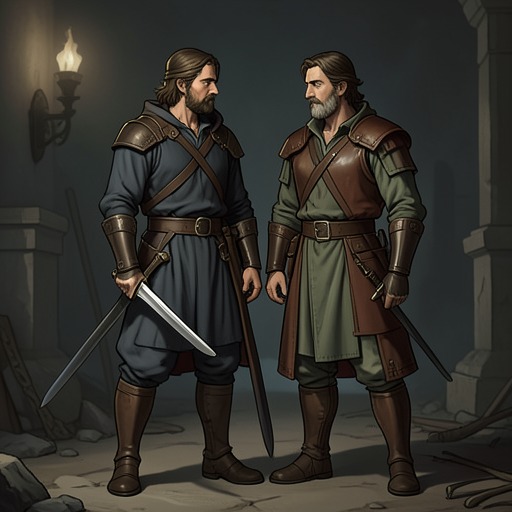
Will’s First Hunt
The Legend of William OhWill’s First Hunt is the first substantial expedition undertaken by Will and Ben as Aspirants, and it establishes the practical logic that will govern Will’s advancement: monsters are threats, but they are also resources, while every mistake is paid for in pain, time, or silver. The hunt begins as a search for Sacrifices and ends when the collected materials summon The Trial, turning a hazardous outing into the threshold of Will’s attempt to obtain a Class.
The Hunt Begins
Will and Ben initially follow the thinning stream of Aspirants before leaving the path and entering the forest on their own. Other Aspirants appear intermittently as the pair stalks through the trees, each group pursuing a separate route; the encounter remains tense but does not become a firefight. About half an hour into the hunt, Ben catches Will’s attention and points out a Jumper, a creature marked by short tawny fur, gripping scaly feet, sharp forelimbs, and extraordinarily large thighs. Will recognizes that the monster can serve as a Sacrifice because he has researched its use, so the sight changes the expedition from cautious searching into an immediate attempt to secure material for the Class process.
The Jumper’s speed makes the first engagement far more dangerous than the pair’s initial observation suggests. Will’s arrow misses, striking foliage below the intended target and making enough noise to alert the creature. The Jumper reacts by hissing and charging with reckless fury, leaping from branch to branch as a blur of tawny fur and glittering claws. Will fires his sling, and the bullet strikes the monster’s hip, causing pain without stopping its attack. The failed opening shot and the creature’s sudden movement collapse the distance between hunting and being hunted: the Aspirants are no longer controlling the encounter, but reacting to a monster already inside their defensive space.
The fight ends at close quarters. As a machete descends, Will shoves the Jumper aside and rolls clear; the blow beheads the creature. He then looks from the dead monster to Ben and remembers that some monsters travel in packs, forcing him to assess the forest rather than treat the kill as proof that the danger is over. Ben’s panting question about whether the fight is truly finished receives Will’s uncertain agreement, but Will’s scratched chest supplies the more reliable answer. Once the immediate crisis passes, the pain that adrenaline had suppressed returns, making the first kill both a material success and a physical warning about the cost of the work.
The Wetlands Gulper
The hunt’s second major encounter converts a dangerous monster into a calculation of weight, price, and bodily risk. Will identifies the enormous creature as a wetlands gulper, a species that lacks prominent claws or teeth and instead kills by firing a powerful, sticky tongue, dragging prey underwater, and drowning it. Ben immediately estimates that the tongue could be exchanged for a worthwhile Sacrifice or perhaps a Relic, while Will recognizes the central problem: approaching the water risks being pulled into the wetlands and eaten.
Will answers that problem with an improvised trap rather than a direct attack. He lashes himself to the top of a tree with his sling and thrashes about to attract the monster’s attention. The wetlands gulper erupts from the water and launches its twenty-foot tongue, instantly ensnaring Will and dragging him downward. The plan succeeds only because the tree bends under the strain, lifting the confused creature above the water’s edge by its own tongue. From that exposed position, the gulper becomes a target for Ben, who uses the suspended monster for sustained practice with his weapon.
The tactic leaves Will trapped inside its cost. He had failed to account for roughly five hundred pounds of pressure pulling against the sling rope around his waist, crushing his guts and threatening to tear him in half. The gulper continues twitching for three agonizing minutes before Ben judges it safe to approach and runs forward to cut through the tongue with his machete. The kill therefore follows the expedition’s established pattern but intensifies it: preparation turns the monster’s hunting method against it, while the successful maneuver nearly destroys the hunter who devised it.
Ben values the result in exact commercial terms, admiring the tongue as an eighty-silver trophy and estimating that it could purchase half a dozen Sacrifices. Will, still holding his bruised waist, says he thinks he is going to vomit, and Ben concludes that he is finished for the day. Their exchange makes the hunt’s economy inseparable from exhaustion. The trophy promises rapid progress toward a Class, but its value is measured against pain severe enough to end Will’s participation in the expedition.
The Trial Threshold
The hunt’s immediate endpoint arrives not through another fight, but through the sudden appearance of a door-like sign that the pair has met the material conditions for advancement. Just as Will is preparing to answer Ben, a pale yellow sliver of light flickers in the air and unfolds into a glowing archway. Neither Aspirant has seen anything like it, but both have heard of its meaning: The Trial presents itself to those who have acquired every Sacrifice required for entry. The expedition has therefore crossed from an ordinary resource-gathering mission into a formal system checkpoint, where the accumulated remains of monsters become permission to proceed.
Ben traces the trigger to Will’s satchel, which contains the dried Uru Drake and completes the trio of Sacrifices that summoned The Trial. His question about whether Will wanted a Class associated with a jumper and a wetlands gulper exposes the danger of collecting materials without first fixing a desired outcome. Will rejects that combination as an obvious mistake, yet Ben immediately asks why he brought the Uru Drake at all. The exchange reveals that the hunt has produced success before it has produced a settled plan: Will now possesses enough material to open the path, but the choice of what that path should yield remains unresolved.
The event also gives the expedition a larger significance in Will’s trajectory. The monsters have been treated as threats, trophies, prices, and possible ingredients; the glowing archway converts those practical calculations into a trial with consequences for Will’s future Class. The value shift is decisive: moments earlier, Will was battered, nauseated, and ready to stop for the day, while the next moment presents an invitation to risk himself again for advancement. The first hunt thus ends at a threshold rather than a conclusion, with survival and profit securing entry into a more consequential test.
The Hunt’s Systemic Consequences
Although the expedition is remembered through its confrontations with the Jumper and the wetlands gulper, its importance extends beyond the immediate trophies. The same logic of conversion governs the rest of Will’s early ascent: survival depends on turning danger into usable material, then turning material into access within The System. The dried Uru Drake in his satchel is not merely a preserved monster part; it is the third Sacrifice that causes The Trial to appear, demonstrating that advancement is activated by a precise inventory rather than by courage or effort alone. Later developments confirm how sharply this system structures Will’s choices. A failed offering at the Class Trial Altars results in a beam of light consuming the pemmican and a direct verdict that the Sacrifice is suboptimal, leaving Class Seed generation unsuccessful. The hunt’s improvised victories therefore do not guarantee advancement. They produce eligibility, but the system still judges quality and combination.
The expedition also establishes the economic pressure surrounding that judgment. Ben’s eighty-silver valuation of the wetlands gulper tongue sounds like a windfall, yet Will learns that raw trophies do not retain their apparent retail value: a Spirit Turtle Sacrifice later costs twenty silver, more than half the tongue’s proceeds, because sellers charge for preservation and access to buyers. The hunt’s rewards are consequently unstable. A monster can be worth several Sacrifices in theory while the hunter remains injured, exhausted, and unable to realize the full price without additional labor or infrastructure. That tension between immediate cash, future advancement, and bodily survival recurs as Will continues climbing, making his first hunt the practical prototype for a larger life governed by resource scarcity, system rules, and calculated risk.