William Oh
The Legend of William OhWilliam Oh is the central Climber whose advancement is defined less by a predetermined heroic gift than by repeated acts of choice, adaptation, and refusal to remain an easy target. He begins at the threshold of the Class Trial under pressure to choose a future that will also represent his family, but develops into a Resourceful Climber whose abilities, equipment, alliances, and hard-won experience allow him to keep moving through increasingly dangerous floors. His defining significance lies in that conversion of uncertainty into method: William Oh does not simply receive an identity from the system; he experiments with one until resourcefulness becomes both his class and his name in the world.
Identity and the Class Trial
William Oh is also called Will, William, and, behind his mask, “Billy Goat.” These names mark different degrees of intimacy and self-presentation rather than separate identities. When he reluctantly introduces himself as Will, he is negotiating how others may address him; when he presents himself as “Billy Goat,” he turns the animal imagery associated with his abilities into a public combat persona. The recurring goat motif therefore links his body, his reputation, and his tactical style without reducing him to a single nickname.
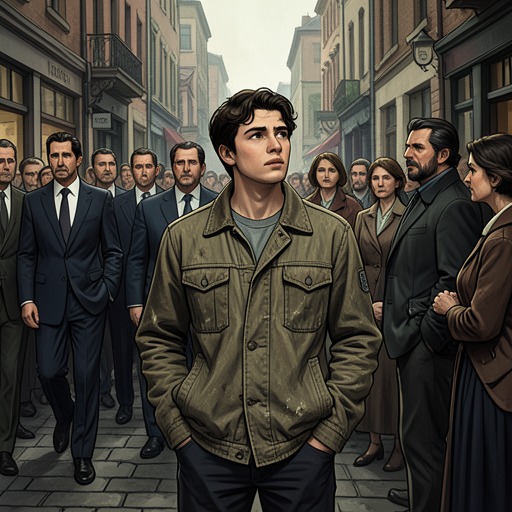
His first decisive conflict is not a battle but a choice about timing. Gertrude advises him to wait before entering the Class Trial, warning him not to seize the first three Sacrifices available merely because they are available. She tells him that he has the whole summer to hunt, sell Sacrifices, buy gear, inspect the market, and possibly find something better from another Aspirant; the rules impose no time limit, and he need not take a Class that year. Her counsel presents patience as a form of preparation and preserves the possibility that William Oh might choose an identity suited to him rather than accept the first one placed within reach.
William Oh does not accept that postponement. He rises and marches toward the door, toward his Class and, by extension, toward his family. The movement makes the abstract decision physical: he crosses from advice into commitment, treating the Class Trial as both personal advancement and familial obligation. The scene establishes a pattern that persists through his later career. He may listen, calculate, and improvise, but once a threshold becomes emotionally or strategically meaningful, he advances toward it rather than allowing uncertainty to become paralysis.
Becoming a Resourceful Climber
The question Gertrude asks him is direct: “Which kind of Climber do you want to be?” William Oh’s answer is eventually formalized by the system as Resourceful Climber. The class is not merely a label attached to him after the fact. It gives institutional form to the approach already visible in his conduct: gather what is available, exploit unusual combinations, change tactics when circumstances change, and turn incomplete solutions into workable ones.
Once the Class Trial is complete, William Oh recognizes the transition in emphatic terms: he is a full-blooded Climber now. That status separates him from the uncertainty of the Aspirant stage and places him within the active economy of ascent, combat, loot, risk, and progression. The system later confirms the title repeatedly. He reaches level 5 as a Resourceful Climber, then level 6, level 8, and eventually level 11. The sequence matters because advancement is shown not as a single initiation but as a cumulative process in which each dangerous passage reinforces the identity he chose.
His build is unusually adaptable. The system identifies Aspect of the Goat and Phantom Hand as his Primary Abilities, and a later ability choice produces a ranged modification in the gauntlet slot. These elements give his fighting style both physical and spatial flexibility. Aspect of the Goat supports the “Billy Goat” persona, while Phantom Hand allows him to act beyond the ordinary limits of his immediate reach. When he and Loth fall through the sky, Phantom Hand accelerates with him, maintaining pace as they descend in a perfectly straight line rather than slowing or arcing. The ability is therefore not a decorative trick; it changes what movement and rescue can mean in a crisis.
William Oh also treats equipment as part of character construction. After a major haul, he pulls out the items he wants, equips everything, and checks his stats. The gesture is practical, but it reveals the logic of the Resourceful Climber: victory is not complete when an enemy is defeated or loot is acquired. Materials must be assessed, fitted into a build, and converted into future capacity. His identity develops through this constant negotiation between ability, object, circumstance, and consequence.
Parties, Progression, and Thresholds
William Oh does not climb solely as an isolated adventurer. The system announces that he has formed a Party, making cooperation a formal condition of his progress. His interactions with Mason Lanover show him maintaining social and practical momentum even amid exhaustion: he greets Mason while trying to inhale a bun, swallows, and immediately asks for another. The scene is comic in its physical urgency, but it also presents William Oh as someone who continues to feed, equip, and prepare himself while others catch up.
His ambitions expand with each level and each cleared threshold. He considers the prospect of reaching the 2nd Floor and is confronted with the system’s question of whether he wishes to clear a Key Site for access. Later, after clearing the Key Site, he receives permission to advance to the 3rd Floor at his discretion. The wording places agency back in his hands: the system grants access, but William Oh must decide when and whether to use it. His climb is therefore structured by gates, yet it is not wholly governed by them.
William Oh articulates his own philosophy when he says that he does not intend to rest on his laurels after reaching a high level and identifies himself as “the William Oh type of Climber.” The statement transforms a personal habit into an archetype. He acknowledges the strangeness of what he has seen while refusing to treat past success as protection against future danger. His progress is consequently recursive: every achievement becomes a platform for another risk rather than a final arrival.
Bodies, Pain, and Improvisation
The evidence repeatedly places William Oh’s advancement in tension with bodily cost. He wakes abruptly in a familiar bed, later turns around amid tremendous pain, and lowers himself into a wheelchair. These moments prevent the Resourceful Climber identity from appearing effortless. Progress leaves him injured, dependent on support, and forced to continue negotiating with a body that cannot simply be ignored.
That bodily vulnerability does not erase his agency, but it changes its form. William Oh’s strength lies in finding actions still available under pressure: using Phantom Hand to maintain a line through the sky, equipping whatever equipment can improve his position, directing healing toward a Party member, or converting movement into an attack through Gravity Charge. His resourcefulness is therefore not abstract cleverness. It is a practical discipline produced at the point where plans meet pain, limited mobility, hostile terrain, and the need to act before conditions become safe.
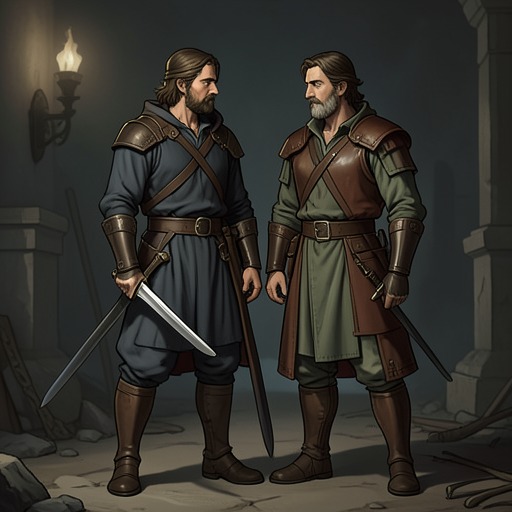
The contrast becomes sharp in combat. When a Sword Bandit acknowledges that William Oh fought well and prepares a killing blow, William Oh remains in the fight long enough to command healing, shouting for it while an ash-caked line marks his chest and arm. The moment combines near-death vulnerability with tactical insistence. He is not protected from consequence; he survives by recognizing the narrow interval in which another action is still possible.
Relationships, Voice, and Reputation
Gertrude functions as an important mentor and familial authority. Her advice is patient, economic, and protective: hunt broadly, sell what is unnecessary, study the market, and do not confuse urgency with wisdom. William Oh’s decision to proceed anyway does not make her advice irrelevant. Instead, it establishes a productive tension between her long view and his need to claim his future immediately. His movement toward the Class is explicitly movement toward his family, so his independence remains bound to inherited expectations and obligations.
William Oh’s relationships within a Party are equally shaped by practical care. When asked for information during a dangerous encounter, he first gestures toward a health potion and says he will answer after giving it to his Party member. The priority reveals a code beneath his opportunism: resourcefulness is not merely the accumulation of advantages for himself, but the rapid distribution of whatever can keep the group alive. The same logic that makes him inspect loot and optimize equipment also makes him treat healing as a shared responsibility.
His public identity is more unstable and more deliberate than his system designation suggests. He can be William Oh, Will, Billy Goat, or the self-conscious representative of a recognizable “type.” Each name mediates a different relation: family, acquaintance, enemy, or audience. The names also show how reputation is assembled through repeated action. By level 11, “Resourceful Climber” describes not only a class selection but an accumulated record of choices made under pressure.
Change and Narrative Role
William Oh’s trajectory follows a threshold-and-escalation pattern, but it resists the idea that initiation completes a hero. He crosses into the Class Trial, becomes a full-blooded Climber, forms a Party, clears a Key Site, receives access to higher floors, and continues gaining levels. Each milestone opens another demand rather than resolving the previous one. The narrative’s reward for commitment is not rest; it is a larger field in which commitment must be tested again.
His development can be read as a movement from externally offered categories toward self-authored identity. Gertrude asks what kind of Climber he wants to be; the system names him a Resourceful Climber; William Oh later claims the phrase “the William Oh type of Climber” for himself. The progression runs from question, to classification, to personal doctrine. His class becomes convincing because his conduct repeatedly supplies evidence for it.
The character’s most important transformation is consequently not a change from weakness to invulnerability. He remains vulnerable to pain, exhaustion, falls, hostile attacks, and the limits of his body. What changes is his ability to make vulnerability operational. He learns to combine abilities, gear, Party support, healing, and movement into immediate solutions, then convert those solutions into long-term advancement. Reaching level 10 gives him the option to select a Secondary Ability and another Primary Ability upgrade slot; the later level-11 confirmation frames that development as continuing growth rather than a completed build.
William Oh’s narrative role is that of a self-making adventurer whose identity is built in public, one improvised decision at a time. He is a threshold hero without a final return: every cleared Key Site and every new floor makes the next threshold more consequential. His defining achievement is not that he discovers a perfect Class waiting inside him, but that he makes a viable self from Sacrifices, abilities, equipment, allies, pain, and motion, until the system’s designation and his own reputation become nearly indistinguishable.