William Oh's Party
The Legend of William OhWilliam Oh's Party is the adventuring organization formed around William Oh, and its decisive importance lies in the way it converts a wounded, inexperienced Climber into a negotiator of people, money, reputation, and rules. The Party begins as an answer to practical vulnerability: William Oh needs capable allies, while those allies need access to his unusual prospects. It subsequently becomes a public identity, a bargaining instrument, and a legal shield whose members survive by combining William Oh's improvisation with other people's specialized abilities.
Formation and Operating Principle
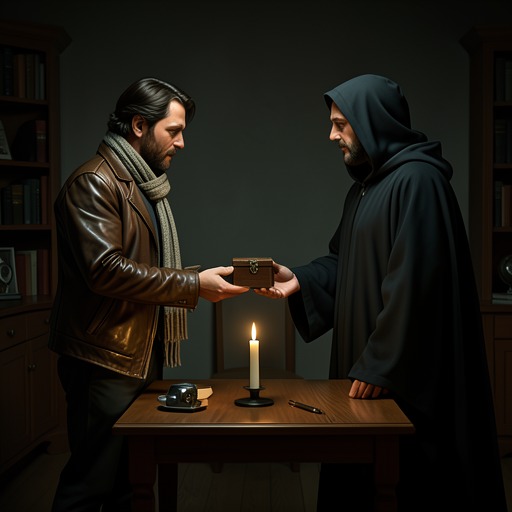
William Oh first proposes that Loth the Luminary join his Party while William Oh is injured and confined to a wheelchair. Loth, a hive-wielding Saboteur, has already demonstrated an exceptional ability to control insects and to support exploration; William Oh recognizes that Loth could serve as both a dangerous combat asset and a partner whose skills compensate for William Oh's own limitations. Loth, for his part, is seeking a human lackey who can lubricate social dealings with humans while also acting as a reliable Scout. The proposed arrangement is therefore reciprocal rather than charitable: William Oh offers social access and flexibility, while Loth offers specialized reconnaissance and sabotage.
The System confirms the alliance directly. When the agreement is completed, it announces that a Party has been formed and that Loth the Luminary has joined; Loth is recorded as a level-five Hive-wielding Saboteur. The formation gives an informal conversation mechanical force. The relationship is no longer merely a promise between two Climbers but an administratively recognized unit capable of accepting Quests, receiving rewards, and being identified as a collective.
Membership, Bargaining, and Authority
The Party's membership is unusually fluid. Loth briefly leaves after stating his price—one hundred gold per Quest and fifty gold for each floor advancement, with special missions negotiable and higher floors commanding higher pay. His departure appears to threaten the arrangement, but he immediately rejoins, admitting that he could not resist, and tells Mason Lanover that he has decided to join William Oh's Party. The sequence establishes Loth's independence while also showing William Oh's Party becoming attractive enough to compete with a more established expeditionary alternative.
William Oh does not lead through rank, wealth, or superior experience. He leads by making himself the point at which useful talents, social access, and risk can be combined. His recruitment of Steve Holland makes that method explicit. After Steve is compelled by a contract to tell the truth, avoid attacking or abandoning the Party, guide it to his hidden monetarily valuable assets, and help it leverage those assets, William Oh invites him to join. Steve grumblingly accepts and is registered as a level-thirty-five Itinerant Charlatan. The Party thus absorbs not only fighters but also a specialist in deception, information, and financial recovery.
Steve's attitude changes with startling speed once he recognizes the Party's potential. He offers to continue working for a one-percent fee and admits, under William Oh's demand for a full explanation, that he expects William Oh to become a successful Climber and wants to profit by association. William Oh's authority is consequently investigative as well as tactical: he uses the contract to interrogate Steve's reasoning instead of trusting his sudden loyalty. The Party's internal order rests on enforceable terms and tested usefulness, not on sentimental confidence.
Rules, Contracts, and Survival
The Party operates inside a system that can be exploited without being ignored. Its members understand that advancement is not simply a matter of charging ahead. The fastest route to the next Floor is to follow the wake of a Bus and assist in clearing the Key Site; the rules allow Climbers who are present and not actively sabotaging others to receive the benefit. Yet William Oh and Loth are still Acclimating, and Loth warns that ascending below the maximum level permitted for the current Floor would be foolish. The Party therefore combines opportunism with restraint, recognizing both the loophole and the danger attached to it.
Its most consequential protective device is the agreement governing Steve Holland. Steve must tell the truth to William Oh's Party, must not attack, abandon, or mislead it into danger, and must support it while directing the members toward his hidden assets. In exchange, the Party agrees not to kill Steve and to use those assets expressly to pay his Corpse Fine, attempting to raise the required capital within thirty days. Steve remains alive not because the Party trusts him, but because a contract transforms his survival into a shared financial project and makes his knowledge actionable.
That arrangement also reveals the Party's moral and practical logic. William Oh is willing to preserve a dangerous charlatan when preservation has measurable value, but he does not remove the threat entirely; Steve will still be killed if the assets are plainly insufficient and the Party is unlikely to succeed in time. Mercy, here, is conditional and operational. The Party's cohesion comes from aligning incompatible interests under terms that specify both benefit and consequence.
Reputation and the Public Party
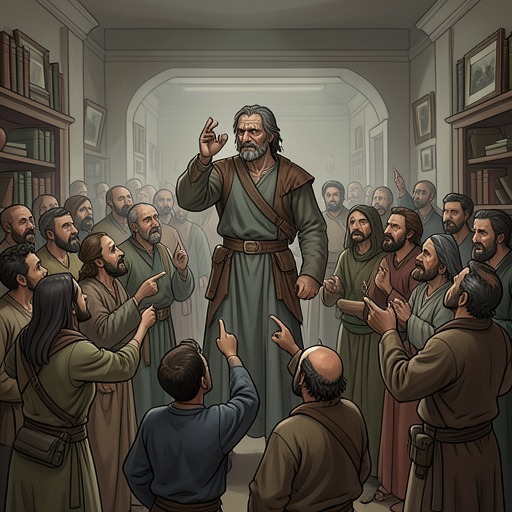
William Oh's Party exists in public discourse before its reputation is fully under its control. Jason Salazar serves as a hype man because he is good with words, and William Oh sees even a limited chance that Jason might mature into a reliable team member. Jason's performance soon turns the Party's leader into a story. Over a bowl of soup, Jason claims that William Oh was born on the Hundredth Floor and bathed in lethal Miasma, presenting an impossible origin as promotional legend to an audience that immediately questions it.
The rumor system grows beyond Jason. At an inn, strangers claim that William Oh can turn into lightning, create a thundercloud, and strike from above; others say that his missing hand became a talisman that roams the world and brings ill fortune to his enemies, while another version claims that he absorbed a lightning bolt fired into his face. These stories are exaggerated, but their exaggeration preserves a residue of real events: William Oh's lightning-related abilities and amputation become raw material for collective myth. The Party's public identity is therefore partly detached from the people inside it. Reputation becomes an autonomous asset that can attract attention, distort expectations, and alter how later encounters are interpreted.
The System reinforces that public identity by recognizing William Oh's name at a Quest reward desk and noting that several people have attempted to claim rewards under it. The clerk identifies the correct William Oh as the sixth claimant and reports that the System rated his performance as exceptional. The Party's name is consequently vulnerable to impersonation precisely because it has become valuable. Recognition brings reward, but it also creates administrative confusion and invites opportunists to imitate the organization or its leader.
Collective Function and Narrative Significance
In action, the Party's strength is distributed across different forms of agency. Loth's barrel of soil and food scraps houses dozens of insect species that he controls with ease; during the search for the kaith supply line, he uses those creatures as a mobile technical resource rather than treating them as mere decoration. He marks the branching tunnels with arrows made from the luminescent juices of crushed glowbugs, turning the cave itself into a navigable record. When William Oh lands on a dangerous ledge, Loth throws him a rope across the gap and directs him to hold it against the wall. The Party survives through small systems of scouting, marking, and rescue as much as through direct combat.
The same principle extends to engineering. When Carrie asks how an explosion of steam could be created, Loth reasons through underground water tanks, flow controls, accumulated natural heat, and the timed release of water against a curtain of fire. William Oh's Party is thus not simply a group that attacks enemies together. It is a network in which insects, rope, tunnels, water, heat, contractual language, public rumor, and System permissions all redistribute what its human members can accomplish.
Its narrative role is to make advancement visibly collaborative without making collaboration stable or innocent. William Oh's Party grows through recruitment, bargaining, publicity, and coercive contracts; every new member brings both capacity and risk. Loth joins because William Oh can supply a human interface, while Steve joins because William Oh's projected success promises financial benefit. Even the Party's fame is double-edged: it earns exceptional recognition but attracts impersonators and wild stories. The organization embodies a central survival principle of the Climb—strength is not located in one body, but in the temporary alignment of specialized powers under a leader capable of keeping that alignment useful.