William Oh's sudden fame
The Legend of William OhWilliam Oh's sudden fame is a social force that outruns the facts of William Oh's life. It begins with Jason Salazar's deliberate promotion, gathers credibility from William's dangerous successes, and then mutates into a rumor-driven legend involving impossible origins, supernatural abilities, and even attempts to impersonate him. Fame brings William attention, allies, rewards, and leverage, but it also makes him the object of envy, scrutiny, and expectations that no ordinary person could satisfy.
The Making of a Reputation
Jason Salazar is the first visible architect of William's public image. William gives Jason five silver and hopes that the twelve-year-old will spend it on becoming stronger, healthier, and eventually a reliable team member. The arrangement is practical as well as promotional: Jason is good with words, and William recognizes that a capable Climber can still use a good hype man. Jason therefore turns William's early exploits into a story that other people can repeat, embellish, and sell to themselves.
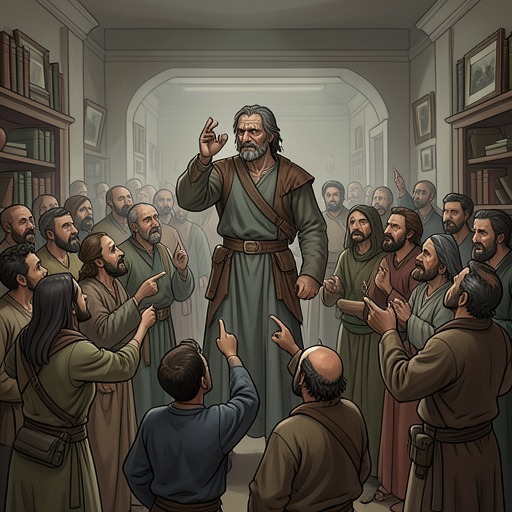
The promotional campaign is not merely private conversation. Jason performs it publicly over soup, claiming that William was born on the Hundredth Floor and bathed in lethal Miasma, an origin that supposedly granted abilities beyond human comprehension. The tale is immediately exposed as implausible by the listeners, who point out that nobody has reached the Hundredth Floor and that a pregnant woman could not simply have been there. Yet the story has already done its work: its dramatic scale gives William a mythic beginning, while the unanswered objection leaves space for further speculation.
William is not fully comfortable with the attention that follows. When he arrives at a gathering of young Climbers, nearby conversations fall silent and someone asks whether he is the William Oh. He admits that he is, only to have a girl seize his arm and announce that he is on her team. The declaration triggers a rush of noise and movement as the crowd closes around him. Fame thus changes his immediate social position without requiring him to make a speech or prove himself in the moment; his name acts before he does.
Rumor, Performance, and Unreliable Legend
The reputation is sustained by a chain of retellings whose distance from reality increases with each repetition. In a tavern, one man insists that William can turn into lightning through an Ability that creates a thundercloud. Another claims that William's missing hand is a cursed talisman that travels the world bringing misfortune to his enemies. A third says that a Nuker shot William in the face with a lightning bolt and that William ate the lightning. These stories preserve a residue of real danger while converting ordinary or difficult events into spectacles of near-supernatural invulnerability.
The rumors also reveal how fame becomes independent of its subject. William's actual abilities and injuries supply raw material, but the public versions no longer need to remain faithful to circumstance. The missing hand becomes a roaming artifact; combat skill becomes bodily transformation; survival becomes consumption of a spell. The legend is therefore neither pure fabrication nor reliable biography. It is a communal fantasy organized around fragments of evidence that are exciting enough to survive correction.
Mason Lanover reacts to this process with particular hostility. He believes William deliberately manufactured rumors before his Establishing Quest to attract girls, and he resents the fact that other Climbers respond to William rather than to Mason's own status as heir to the Lanover fortune and a future Lord. June disputes Mason's certainty, observing that William seemed nervous when he became the center of attention and suggesting that he did not start the rumors himself. The disagreement matters because it separates fame's effects from its origin: William may benefit from the stories without having authored them, while observers still assign him responsibility for the image surrounding his name.
Mason's anger also exposes the class and status inversion created by William's reputation. The heir of the Lanover fortune is treated as a second choice by people eager to join William's team, a reversal Mason finds humiliating. William's sudden popularity temporarily overwhelms inherited prestige. At the same time, Mason's accusation that William is an "obvious faker" shows how quickly admiration can become moral condemnation when fame appears undeserved or strategically acquired.
Fame as an Operational Advantage
William's reputation has material consequences inside the System's competitive world. After the Establishing Quest, the quest clerk checks his identity against a list because five other people have already attempted to claim William's reward. The System confirms that this William Oh is the correct one and rates his performance as exceptional, awarding him a bag of gold roughly equivalent to Mason's. The incident demonstrates that fame has become administratively significant: the name is valuable enough to attract fraud, yet recognizable enough to require verification.
His progress reinforces the public story. William reaches level five on his first Establishing Quest and receives a new quest to ascend to the Second Floor, ranking 1,053rd among that year's Aspirants. The reward and ranking are concrete achievements, unlike the Hundredth-Floor birth story, but they feed the same narrative of exceptional potential. His reputation is consequently anchored by a mixture of measurable advancement and unmeasurable exaggeration.
The public image also changes the terms of recruitment. When William meets Loth, the surrounding teen Climbers react with awe and envy, and a girl claims him for her team before the gathering can settle. Later rumors continue to circulate in places where William is absent, meaning that his reputation works as a form of influence at a distance. It can attract companions, create rivals, and make strangers approach him as if they already know what kind of person he is.
Costs, Contradictions, and Narrative Significance
Fame does not erase William's vulnerability. During one encounter, another Climber praises a run that left William frightened and asks his level; William answers that he is level six. The Climber replies that William fights like a level-nine Climber and runs like a level-forty one. The compliment converts a desperate survival skill into evidence of legendary power, but the scene preserves the gap between public interpretation and private experience. The crowd sees a prodigy; William has just endured an ordeal he cannot yet stop replaying.
The same gap appears in the contrast between the polished legend and the physical person. William's wounds remain stiff for a week, he worries that deeper scratches may begin oozing blood while hunting, and he eventually drops Brianna into the ash after using an Ability to escape the heat of the Third Floor. Such details do not fit the invulnerable figure of tavern gossip. They show a body that remains injured, exhausted, and constrained even while stories describe lightning transformation and magical immunity.
William's fame is therefore both an asset and a loss of control. Jason's words open possibilities for partnership and recognition, while the crowd's enthusiasm gives William immediate social leverage. Yet the same process produces impostors, suspicious rivals, inflated expectations, and narratives that replace his actual motives with public invention. The legend makes William easier to recruit, reward, envy, and fear, but harder to see clearly. Its decisive narrative function is to turn identity into contested territory: William Oh is no longer only the person making choices in the Climb, but also the name that other people continually rewrite.