Yeti Ice Cave
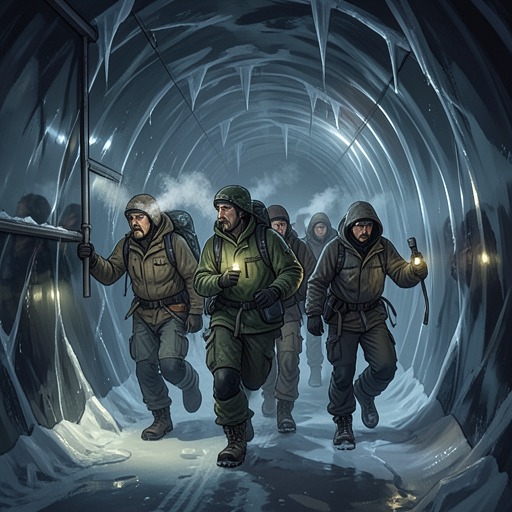
The Legend of William OhYeti Ice Cave is the frozen spawning ground of the yetis, an extensive cave network beneath the underside of a floating mountain. It is not merely a lair but a hostile threshold: the approach narrows into darkness, the floor becomes deceptively smooth ice, and the inhabitants can disappear into the same hoarfrost that coats the walls. The cave’s physical conditions transform exploration into a struggle over visibility, footing, and escape, while the floating island outside turns every tactical mistake into a fall into open air.
Setting and Physical Formation
The spawning ground begins a few switchbacks down the mountain, at the point where the trail turns inward toward a cavernous entrance. The cave network formed largely from ice beneath the mountain’s underside, which never receives the warmth of the sun. As clouds pass beneath the mountain ranges, ice accumulates faster than it sublimates, producing a solid frozen layer in places. The Yeti Ice Cave is one such formation: a massive opening in that layer leading into pitch-black depth.
Inside, repeated partial melting has flattened the lower surface into a sheet of ice. That apparent regularity is misleading. The ground may be smooth enough to walk on, but the cave remains cold enough to overwhelm ordinary comfort, leaving even a prepared traveler shivering. The entrance therefore offers no reassuring transition from the mountain trail to shelter; it replaces exposed height with enclosed cold and darkness.
The Spawning Ground and Its Inhabitants
Steve identifies the cave as the yetis’ spawning ground and is asked to explain precisely where it begins and what lives there. His knowledge gives the expedition a route and an objective, but it does not make the interior safe. The decisive danger is visual rather than merely physical: yeti fur and hoarfrost look nearly identical, so the apparent walls around the travelers are already populated by concealed creatures.
The revelation changes the cave from an empty environment into a surrounding body of enemies. Will discovers that he has been surrounded without recognizing it, and a patch of the wall suddenly lashes out with clawed hands nearly the size of his torso. The first visible creature has a red face and massive canines, and its roar awakens other ice-colored forms on both sides of Will. The cave’s camouflage defeats the ordinary logic of scouting, because the terrain itself is also the enemy’s concealment.
Expedition, Ambush, and Escape
The approach is organized around preparation for an emergency retreat. Will orders Loth to prepare an exit that Steve can use, and Loth begins creating a rope ladder. This response is significant because the cave’s danger is understood before the full ambush is revealed: the party cannot rely on a single route or assume that the entrance will remain accessible once combat begins.
The attack confirms that precaution. Once the yetis emerge from the hoarfrost, the party must manage not only the creatures in front of them but also those behind them. Their numerical advantage is eventually turned against them when Steve throws a mannequin over the cliff. The yetis, confused by the decoy, lock onto it and dive after it, inadvertently throwing themselves from the edge of the floating island. The tactic does not promise experience or loot, but it reduces the immediate number of enemies and restores a measure of control over a battle that began with the cave itself concealing the opposition.
The Cave as a Threshold Space
The Yeti Ice Cave links several forms of danger that are usually separate. The trail’s switchbacks lead from navigable mountain terrain to a cavern entrance; the entrance leads from daylight into featureless darkness; and the interior’s stable-looking floor masks a space where sight and orientation are unreliable. Beyond the cave, the floating mountain’s cliff edge adds a vertical boundary with lethal consequences. The party is therefore moving through a sequence of thresholds rather than entering a conventional dungeon.
This spatial design also reverses the usual meaning of shelter. A cave should provide enclosure against the exposed world, yet here enclosure allows the yetis to merge with the walls, while the nearby open air becomes a possible weapon against them. The expedition survives by using both spaces against their apparent functions: the cave’s concealed geometry is endured, and the cliff outside becomes an improvised means of reducing the swarm.
Narrative Significance
The cave concentrates the book’s recurring tension between exploration and incomplete knowledge. The travelers possess a concrete destination and receive useful information about the spawning ground, but the most important fact is omitted until the danger is already present: the yetis resemble the hoarfrost. Knowledge establishes the route without guaranteeing comprehension of the place.
As a result, the Yeti Ice Cave is a setting where anticipation gives way to revelation. Its darkness first withholds the inhabitants, its frozen walls disguise them, and its apparent emptiness becomes a trap only when the environment moves. The later use of the floating island’s edge provides a harsh counterpoint: survival does not come from mastering the cave completely, but from recognizing the relationship between the cave, its concealed occupants, and the void beyond it.