Görna
The Leopard (Jo Nesbø Edition)Görna is a city in Congo whose black volcanic landscape and precarious position amid armed conflict make it more than a distant setting in Harry Hole’s investigation. Near Nyiragongo and linked to the mineral trade that draws outside investors into the region, the city brings together the novel’s strands of resource extraction, violence, displacement, and Harry’s pursuit of Eddie van Boorst.
Border city beneath the volcano
Görna lies near Nyiragongo, a volcano whose crater contains one of the few open lava lakes. Harry receives that detail in a text message identifying the volcano’s last eruption as 2002. On the journey toward the city, Joe calls it the killer mountain; the enormous lake and surrounding mountains frame the approach, but the view gives way to a road scarred by craters and mud. The route places Görna in a landscape where geological danger is not remote from the ordinary business of travel.
The city’s immediate surroundings are equally shaped by conflict. A military jeep travels ahead of Harry and Joe, while an armed soldier watches them and aircraft pass overhead. Joe explains that the United Nations is present as fighting intensifies: Nkunda is advancing toward the city, and many people are fleeing as refugees. He has not seen Eddie van Boorst for a long time and wonders whether van Boorst, too, has left. Görna is thus introduced not as a settled destination but as a city under pressure, where the movements of armed forces and displaced civilians make even a visit uncertain.
During a brief break between rain showers, Harry reaches what serves as the city centre. People hurry along an almost impassable street between shops. Black blocks of stone are stacked against the building fronts as foundations; the ground looks like hardened black icing, and fine grey dust blows through the air with the smell of rotting fish. These details give the volcanic setting a material presence: black stone is part of the built environment, while the damaged road and unsettled weather shape the pace of everyday movement.
Mineral wealth and armed power
Görna is connected to a wider system of mineral extraction that reaches beyond the city itself. Harry learns that coltan, used in mobile phones, is a rare metal found chiefly in Congo, where many deposits lie in territories outside anyone’s control. Entrepreneurs can seize the ore and move it into Rwanda. The trade’s geography is therefore inseparable from contested authority: the same disorder that makes mineral-rich areas difficult to govern also creates opportunities for those prepared to exploit them.
Herman Kluit’s memories make that relationship personal. During his years as a mercenary, he fought in several African countries, including Congo, and worked in a region where diamonds, cobalt, and coltan offered a route to sudden wealth. The local village chief belonged to the Mai-Mai armed faction, whose members believed water made them invulnerable. Kluit considered the chief reasonable, and described money as a way to settle almost anything; when money ran short, a crate of Kalashnikovs could serve instead. In the course of a year Kluit became rich, and within three years he was extremely wealthy. His account connects the city’s commercial hinterland to an economy in which armed influence and payment can substitute for legitimate control.
The cost of that life appears in Kluit’s recollection of the journey between the jungle and Görna. Once a month, he and his men went to the city to sleep in beds rather than on the ground outdoors, where bloodsucking insects emerged at night. Half his men contracted malaria; others suffered illnesses unfamiliar to white doctors and grouped under the label jungle fever. Kluit himself never fully recovered from one such disease. In his memory, Görna offered relief from the jungle, but not an escape from the conditions that shaped it.
A route from local mines to investors
Tony Leike’s account shows how the mineral economy can be repackaged as an international investment opportunity. During the mobile-phone boom of the 1990s, his group operated near a coltan mine worked by children with picks and shovels. The ore resembled ordinary rock, but could yield tantalum. Leike saw the possibility of financing a modernized, properly run mine, and described borrowing, being cheated by partners, borrowing again, and eventually making a few million dollars—enough to pay his debts and gain access to wealthy investors.
His proposed major deal depends on raising money to exercise stock options and regain a full partnership. Leike says the large investments, including local bribes, are already in place, and that a runway has been built in the jungle so cargo planes can be loaded directly and the goods transported out of the country via Uganda. The plan turns Görna’s wider region into one link in a chain running from child labor and contested mining areas to financing, air transport, and foreign markets. The prospect of profit is presented alongside the instability that makes the operation possible, not apart from it.
Harry’s search in the city
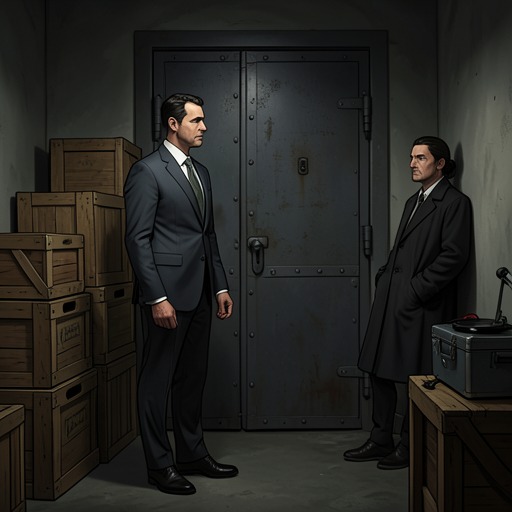
Kluit gives Harry the lead that brings him to Görna: the name of Eddie van Boorst. At a stone house on the city street, a man initially tells Harry that van Boorst is dead. Harry identifies himself and explains that he has come a long way from Hong Kong because he is interested in the Leopoldsapfel. The man checks the street before opening the door farther and inviting him inside. The exchange makes the search depend on discretion as much as distance: the doorway opens only after the visitor has stated his purpose.
The threshold itself is treacherous. The floor inside is substantially lower than the street, and Harry nearly falls as he ducks under the low doorframe; the room smells of smoke and the stale sweetness of someone who has been drinking for days. In a city already marked by cratered roads, black stone, and uneasy encounters, this entrance becomes a concentrated version of the investigation’s physical and moral terrain: Harry must cross into a concealed interior to follow a lead, while the surrounding city remains exposed to conflict and upheaval.