Lene Gabrielle Galtung
The Leopard (Jo Nesbø Edition)Lene Gabrielle Galtung appears at the edge of the investigation into Tony Leike’s disappearance, where a brief report about his possible journey to the mountains and an uneasy interview with Harry Hole make her both a lead and an enigma. The narrative gives her no confirmed role in the crimes surrounding Hävasshütte; her importance lies instead in what she may know about Leike, what she chooses to say, and the doubts her manner leaves behind.
Identity and Family Setting
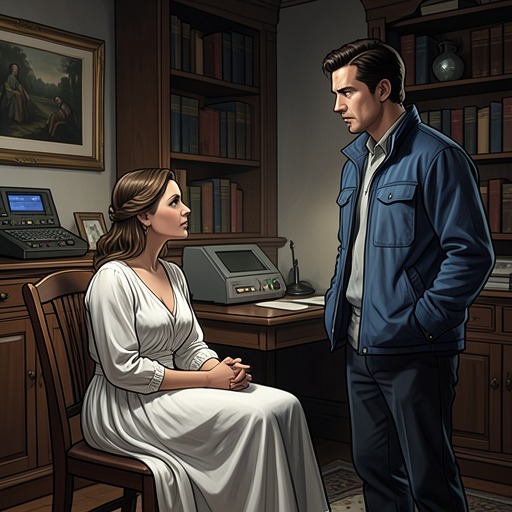
Lene is introduced at her family home during Harry Hole’s visit. She is tall and blond, with her father’s broad features and her mother’s turquoise eyes. The description also distinguishes her from the family mannerisms attributed to her mother: Lene does not display either the modest bearing of a prosperous farmer or her mother’s dignified arrogance. Instead, she walks bent forward, as though trying to make herself smaller, and looks down at her shoes while greeting Harry and giving her name.
Her introduction follows a conversation about the family shipping company and the prospect of Tony Leike becoming part of the family. That context places Lene close to a consequential family decision, but it does not establish that she advocated for the investment. Indeed, her restrained answers and the way she seems to shrink under her father’s gaze lead Harry to reconsider his initial assumption that she had urged her father to proceed. The scene makes her position within the family visible without resolving her influence over it.
Leike’s Disappearance and the Mountain Lead
After Mikael Bellman orders Leike brought in, investigators cannot find him at home or at the office, and he has left no message. He does not appear on airline or ferry passenger lists. An investigator eventually reaches Lene, who says that Leike may have gone to the mountains to think, as he often does. Since his car remains in his garage, the account points toward travel by train. Harry immediately associates that possibility with Ustaoset, which Leike had described as his landscape; Lene’s information thus gives the search a plausible direction without confirming that Leike has gone there.
Ustaoset already matters to the wider investigation. Adele Vetlesen and Borgny Stem-Myhre bought train tickets there for the same date, and evidence about Iska Peller’s account later places payments for beds in four mountain huts, including Hävasshütte, near the area. These facts connect the region to the case, but the evidence does not say that Lene arranged those journeys or knew about them. Her contribution is narrower: she identifies the mountains as a familiar retreat for Leike, turning a general possibility into a specific avenue for Harry to consider.
Harry’s Visit and Her Reserve
During Harry’s visit, Lene says little and asks even less. She appears to duck beneath her father’s gaze whenever she answers Harry, an observable response that complicates any easy reading of her place in the family. Harry initially wonders whether she influenced her father’s investment in Leike, then questions that assumption in light of her apparent discomfort. The encounter therefore offers no firm account of her views; it records Harry revising an inference as he watches her.
About twenty minutes later, as Harry leaves, Lene appears again to open the door. He asks where Leike might be. Her first response is that she believes nothing, but Harry suspects that her quickness—or a twitch at the corner of her eye—may mean she is not telling the truth. The narration immediately qualifies his suspicion: it could also arise from his strong desire to find something. Her next clarification is more definite. Harry has addressed her as Mrs Galtung; she tells him that she is not Mrs Galtung and that the woman he means is upstairs. The correction identifies the woman at the door as distinct from Lene’s mother, while the scene preserves uncertainty about the earlier answer concerning Leike.
Narrative Role and Limits of What Is Known
Lene’s appearances are brief, and the case presents her through other people’s observations: an investigator’s report of what she said about Leike, and Harry’s reading of her posture, glances, and rapid reply. Those details make her a useful but fallible source. Her mountain suggestion has a concrete investigative consequence because it directs attention toward Ustaoset, yet neither that clue nor Harry’s suspicion establishes that she knows Leike’s whereabouts.
The surrounding case sharpens the significance of the location without making Lene part of its proven events. Elias Skog later describes seeing a man pull a woman into the Hävasshütte outhouse; only after reading about the murders does he reconsider the scene as a possible assault. That account, like the ticket and lodging clues, gives the mountain setting a threatening history. Lene’s connection to it remains indirect: she supplies a possible route for finding Leike, while the evidence leaves her knowledge, motives, and any further involvement unresolved.