Sandviken Psychiatric Clinic
The Leopard (Jo Nesbø Edition)Sandviken Psychiatric Clinic is a psychiatric institution where Katrine Bratt returns for treatment after the pressures surrounding an earlier murder investigation overwhelm her. It also becomes an unlikely base for Harry Hole’s covert inquiry: the clinic offers Bratt a measure of safety and privacy, while its restricted computer access forces Harry to find another way to connect her to the case.
Identity and Setting
The clinic is identified as a psychiatric institution, and the narrative places it in a markedly different world from the police headquarters Harry refuses to visit. When asked where he is going, he answers that he is going to Sandviken; Kaja Solness and Björn Holm are taken aback when they realize he means the clinic. Their surprise reflects the unusual nature of his destination, not any stated involvement by the clinic in police work.
The institution is also presented through Bratt’s everyday experience rather than through an account of its staff or formal organization. She describes its room service as poor, but calls it a safe place. She has a television and says she can come and go as she pleases. The clinic thus appears neither as a simple prison nor as a fully comfortable home: it provides a protected setting that Bratt values, even while others believe she is well enough to leave.
Bratt’s Readmission and Privacy
Bratt is referred to only as the patient when Kjersti Rodsmoen explains her history, a deliberate choice intended to preserve her anonymity. Nearly a year before Harry’s visit, Bratt had taken part as an investigator in the now-solved Schneemann case. The strain of that experience later contributed to a relapse, and she returned to the psychiatric clinic where she had previously been treated. Her condition improved unexpectedly quickly, and she was soon discharged home.
Discharge did not end the pressures around her. The press continued to pursue details about the solved case, and three months before Harry arrived, Bratt asked Rodsmoen if she could return to the clinic. Her readmission therefore followed both a recurrence of illness and an intrusive public interest in her past. At the time of Harry’s visit, the clinic’s view is that she is healthy and taking up a place needed by someone else; Bratt herself is less certain that leaving is desirable. She says mental illness comes and goes, and that she may go home in a month or two, but does not treat that possibility as a settled decision.
Harry’s Visit and the Clinic’s Limits
Rodsmoen recognizes Harry by his voice from a call the previous day. She had been waiting for the chance to ask him to speak with Bratt, and accompanies the tall policeman along the clinic corridor. Outside, rain runs down the narrow windows, beyond which the fjord and green trees are visible. The scene establishes a direct route from Harry’s unauthorized investigation to a patient whose experience may be useful, while leaving the clinic’s role in arranging the meeting distinct from the police operation itself.
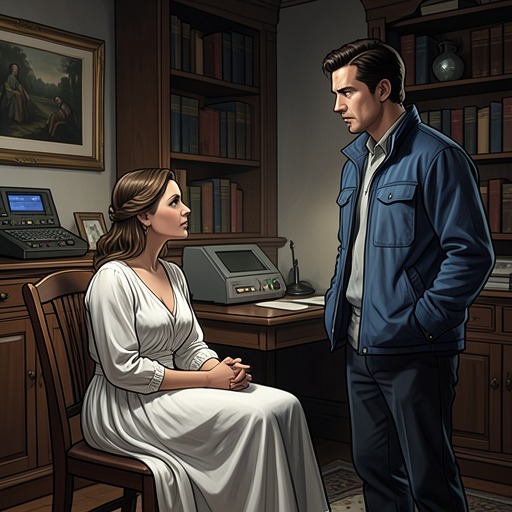
Harry tells Bratt about Rakel and Oleg moving abroad to an unknown destination, Hong Kong, his father’s illness, and the case he has taken on. He asks her to keep this information confidential. Bratt’s response makes their personal connection part of the meeting: she says she wants him to need her, and he confirms that he does. The conversation then turns to practical access. The clinic’s shared computer is in the hobby room, but it has no internet connection because the institution considers that risk unacceptable. Bratt also has a personal computer in her room. Harry directs her to use the shared machine and gives her a mobile internet stick, with the contract paid for by him and, as he puts it, Hagen.
The Clinic as an Investigative Setting
Harry brings Bratt a file concerning three murders and asks her to do what she did in the Schneemann case: find a connection that the investigators have missed. Bratt immediately points out that the victims were women, but the work develops beyond that initial observation. In her subsequent analysis, she identifies Adele Vetlesen, a missing woman from Drammen, as a link: on November 7, Vetlesen bought a train ticket from Drammen to Ustaoset, the same destination for which Borgny Stem-Myhre had bought a ticket from Kongsberg. Bratt also finds that Iska Peller’s account was charged for pairs of beds in four mountain huts, each about a day’s walk from the next; the final one was Hävasshütte, near Ustaoset.
These deductions show what the clinic makes possible without making it an official police facility. Bratt’s prior investigative experience can be put to use because Harry reaches her there, but the clinic’s shared internet restriction remains in force; the mobile connection is a workaround supplied by the investigators. Sandviken is consequently both a refuge from the pressures that followed the Schneemann case and the setting from which Bratt begins to examine a new one.