Tony Leike's Wrongful Arrest and Release
The Leopard (Jo Nesbø Edition)Tony Leike's wrongful arrest and release mark a reversal in the murder investigation: the police lose their publicly celebrated suspect, while Mikael Bellman pressures Harry Hole to accept responsibility for the mistake. The release does not resolve the crimes. Instead, it lays bare how institutional reputation shapes the account of the arrest and sends the investigation back toward Hävasshütte.
The Case Behind the Arrest
The suspicion surrounding Leike had grown from a network of clues linking separate people to the same mountain region. Borgny Stem-Myhre disappeared after leaving a bar in Oslo; later, two builders found her body in a cellar. Investigators established that she had bought a train ticket to Ustaoset on the same date as Adele Vetlesen, a missing woman from Drammen. Iska Peller's account records also showed payment for pairs of beds in four mountain huts, each about a day's walk from the next. The final hut, Hävasshütte, was close to Ustaoset. These details connected missing people and murder victims to a shared route, but did not by themselves establish who had killed anyone.
A further lead came from Elias Skog. On the night of his own murder, he had told a woman in Stavanger about seeing a man and a woman outside the lavatory at Hävasshütte. From his window, he saw the woman moving and the man holding a hand over her mouth, then watched the man pull her inside. Elias initially interpreted the scene as a possible rape. His account gave the investigation a witness to an alarming incident at the hut, but it was an interpretation made from a brief, shadowed view, not a confirmed explanation of what had happened.
The arrest therefore rested within a still-unsettled investigation, not a solved case. The distinction becomes essential when the police must release Leike: the evidence has generated a suspect and a compelling narrative, but the narrative cannot stand in for proof. Later, when Harry revisits Elias's account, he realizes that what appeared to be a rape was not one, and that this correction makes the motive intelligible. The change recasts the scene that had helped direct suspicion rather than simply confirming the initial reading of it.
Bellman's Bargain
Bellman confronts Harry with a proposed press statement and an ultimatum. The statement is to say that Bellman, as head of the investigation, took responsibility for publicly defending Leike's arrest despite already suspecting that one of the police officers had made a mistake. It then presents Harry as the experienced chief inspector who insisted on coming forward and whom Bellman allowed to do so. The wording shifts the public account of the failure toward Harry while preserving Bellman's claim that he had managed the situation responsibly.
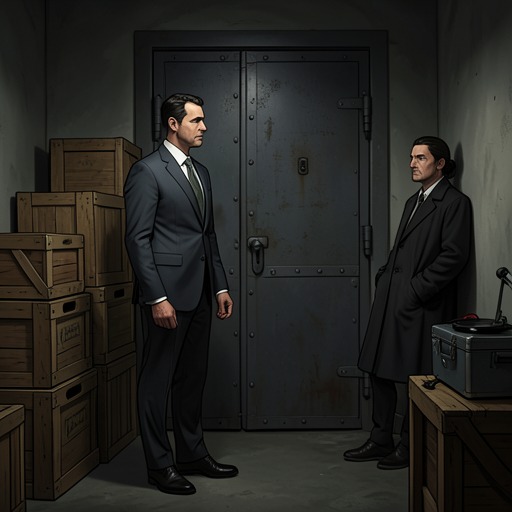
The pressure is personal as well as professional. Harry understands that refusing to sign would expose him to charges of drug smuggling and possession. Bellman puts the prepared statement and a pen on the table; the room is too dark for Harry to read the page, but Harry signs anyway. That small, decisive gesture makes the arrangement concrete: he accepts a version of events he cannot even inspect in the light, under the threat of prosecution. Bellman takes the paper and leaves, presenting the outcome as being in everyone's interest.
Leike is released with immediate effect. The change is stark: the man whose arrest had been treated as a breakthrough is no longer in custody, and Harry's signature makes him the public face of the error. When Harry follows Bellman downstairs, Kaja Solness is still waiting beside her car with her arms crossed. The scene ends not with an explanation between the investigators, but with Harry leaving the building after Bellman and Kaja remaining at the car.
The Public Story
Bellman carries the bargain into the police's public and internal accounts. The next morning, two of the three largest newspapers feature Leike getting into a car outside police headquarters; the third uses an archive photograph of Harry from a television talk show. The images turn the release into a contest over who will be associated with the failed arrest. Bellman tells his officers that Harry has accepted full responsibility, and describes that acceptance as no more than fair.
The same announcement is delivered to an exhausted investigative team of thirty-six people, three times the size of a normal murder inquiry. Bellman acknowledges that the group has worked for a long time without a genuine result and says he had allowed himself and his colleagues to enjoy the apparent triumph of arresting Leike. Now there is no main suspect. The change makes the cost of the premature celebration visible: the team must keep working after the public success has collapsed, while the newspapers and the signed statement give the reversal a ready-made face.
Bellman's account also serves his position at a moment of mounting pressure. The head of the Criminal Investigation Service has told him that the ministry has called to ask about progress, and Bellman warns the room that their time is running out. His handling of the release thus joins two different necessities: controlling the damage from an arrest he had defended and keeping an underperforming investigation moving before higher authorities intervene.
The Investigation After the Release
The release does not make the hut evidence disappear. Bellman tells the team that new leads all begin at Hävasshütte, redirecting attention from the discarded main suspect to the place where the accounts and movements of several people converge. Leike's departure from custody is therefore a reversal in the investigation's public status, not its conclusion. The central question remains what happened at the hut and how that night connects to the murders.
The later reassessment of Elias's testimony sharpens the meaning of the reversal. His description had encouraged investigators to see a possible sexual assault, but Harry's realization that the scene was not a rape changes the interpretation of the evidence and exposes how a plausible reading can still be wrong. The wrongful arrest episode makes that problem institutional as well as deductive: an uncertain account can harden into a public claim, and a failed claim can be managed through blame rather than resolved through evidence. With Leike released and Harry named as responsible, the case returns to the less settled work of interpreting what the clues actually show.