Adele Vetlesen
The Leopard (Jo Nesbø Edition)Adele Vetlesen is the missing woman whose November journey to Ustaoset connects her to the deaths at Hävasshütte and to a false trail leading to Kigali. Twenty-eight and from Drammen, she was reported missing by her live-in companion; the investigation eventually establishes that her disappearance was engineered, her postcard from Africa was part of a deception, and Tony Leike murdered her. The case also makes Adele a contested presence: investigators reconstruct her movements from records and other people’s accounts, while the men around her repeatedly use her sexuality to explain, exploit, or redirect attention from what happened to her.
Identity and Disappearance
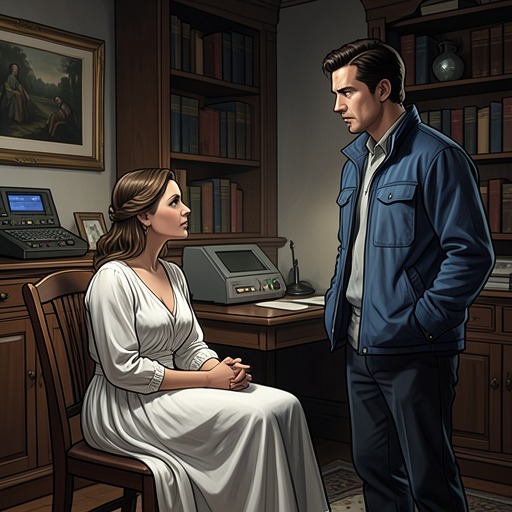
Adele’s absence first enters the inquiry through a search Katrine Bratt conducts after the known victims’ names yield no results. She expands the search to missing people reported in Norway during the previous twelve months and finds Adele, who had disappeared after her live-in companion reported that she had not come home. When Kaja Solness and Harry Hole interview him in Drammen, he explains that he considered reporting her missing his responsibility. His concern gives the case a domestic point of entry, but it does not explain where Adele went or why the other women’s names lead to her.
Travel records provide the first strong connection. On November 7, Adele bought a train ticket online from Drammen to Ustaoset. On the same date, Borgny Stem-Myhre bought a ticket from Kongsberg to the same mountain area. Ustaoset is a region rather than a single town, and the two women’s journeys converge on Hävasshütte, roughly a half-day’s walk away. Adele’s account was charged for an overnight stay there for two people. The second person’s identity was unknown, giving the investigation a crucial absence within the evidence: Adele was not alone, but her companion had left almost no readily discoverable trace.
The gap between Adele’s disappearance and the story circulated about her becomes clearer when Harry examines the supposed African journey. A passenger list showed a flight to Kigali on November 25 under her name, but no traveler called Adele Vetlesen was recorded at Kigali’s passport control. Harry concludes that another woman left Oslo using a forged passport issued in Adele’s name, then presented her own genuine passport on arrival. Because the ticket did not have to be shown at passport control, the mismatch between the ticket and the real traveler could pass unnoticed unless someone checked. The flight record therefore documented a name and a route, not Adele’s presence in Africa.
Hävasshütte and the Unknown Companion
At Hävasshütte, Adele was with a man her friends did not know. Investigators searched her apartment and found no diary, letters, cards, or substantial body of messages that would identify him. They questioned the male and female acquaintances they could locate, but none had seen or spoken with the man who accompanied her to the hut. Adele’s friend had heard her mention some of their turn-ons and turn-offs, including an invitation to a nighttime encounter in an abandoned factory, where Adele was to arrive dressed as a nurse. The detail suggested a deliberately staged sexual scenario, but the friend could not explain what Adele meant when she said the man’s way of speaking reminded her of her live-in companion, Geir Bruun.
That companion was not a romantic partner in the ordinary sense: Kaja points out that Geir was gay. The distinction matters because the investigation’s early assumptions about Adele’s relationships risked turning proximity into intimacy. Adele’s accounts of partners were indirect and fragmentary, reaching the detectives through a friend and through men speculating about her behavior. Bellman reports that she changed partners frequently and privately, and that no one in her circle could identify the Hävasshütte man. Her choice to keep those encounters discreet left investigators with few personal records, but it also made the unknown man harder to distinguish from the stories others imposed on her.
A witness’s later recollection offers a different clue. He remembered seeing Adele and the unknown man together in a scene that he had initially read as consensual sex. Only after learning of the murders did he reconsider their body language and wonder whether what he had seen might have been rape. Kaja rejects the idea that two people who had just met at a tourist hut would naturally take part in a game designed to resemble assault; Harry infers that Adele and the man must have known one another before arriving. The recollection does not identify the man, but it changes the meaning of the encounter: the appearance of a first meeting may itself have been staged.
The False African Trail
The supposed trip to Kigali was built from several coordinated deceptions. Harry determines that a woman used a forged passport in Adele’s name to leave Oslo, while the actual traveler used her own passport at Kigali. The signatures on the relevant documents did not match. A postcard apparently sent by Adele from Africa claimed that she had met the man of her dreams and would not return before March, making her continued absence seem voluntary. Harry suspects that Adele was still in Norway when she was forced to write it and that another person carried it to Africa and posted it there.
The woman who performed that part of the deception was Juliana Verni. Kaja later lays out that Verni traveled to Africa under Adele’s identity, registered at the Gorilla Hotel in that name, and mailed the postcard Adele had written, probably under coercion. Verni was found dead in Leipzig three days after returning from Kigali. Her death makes the false itinerary more than a simple attempt to hide Adele’s whereabouts: someone who helped manufacture the trail was subsequently killed, apparently to erase a connection. The investigation’s question becomes who had been in contact with Verni and who had reason to remove her.
The postcard’s false promise of a return in March contrasts with the real circumstances of Adele’s disappearance. In the investigation’s account, she was in Norway, already under the control of the person who would kill her. The document turned her absence into an apparent choice and made the African journey seem complete. Rather than merely concealing a body, the plot assigned Adele a fabricated future, one that could delay suspicion while directing attention far from the person who had accompanied her to Hävasshütte.
Tony Leike and the Murder
For a time, the unknown companion is called the seventh man: the unidentified person who had joined the people at Hävasshütte and whose identity could connect the victims. Investigators also consider how Adele’s body might have been placed to implicate Tony Leike. His publicly accessible conviction for assault and its connection to Ytre Enebakk could direct police toward Lyseren, where he had lived with his grandfather. Bellman reasons that a killer seeking to frame Leike would choose a location the police could associate with his record. The theory is significant because it treats the apparent trail to Leike as something a murderer might deliberately construct, rather than as proof on its own.
Forensic examination of Adele’s navy-blue ski pants supplies a more intimate clue. Björn Holm and Beate Lonn identify a sperm trace on the elastic, too little to indicate ejaculation and consistent with contact from an erect, wet penis rubbing against the wearer. Harry uses it to reconstruct a sexual encounter between Adele and Tony outside the hut’s toilet. Tony arrived late; Adele’s unknown companion had become angry and gone to bed, leaving the two of them an opportunity to flirt. They slipped out, kissed and touched, and Tony’s bodily trace was left on her ski pants before the encounter continued. Their cries woke Elias Skog, who watched from his window. Harry believes the Hävasshütte companion may also have seen them, while Tony tried to stifle Adele’s cries.
Later, Sigurd Altman explains the murder from the vantage point of a witness who had remained silent. Seeing Adele and Tony together revived his own humiliation by Tony and turned his desire for revenge into a plan. Altman sent Tony a letter pretending to be Adele, claiming that she was pregnant and demanding an initial payment of 400,000 kroner in exchange for keeping the child’s paternity secret. He arranged a midnight meeting in the parking lot behind an electronics store in Sandvika. He then wrote to Adele while pretending to be Tony, inviting her to a rendezvous at the same time and place. Altman intended to photograph the encounter and send the pictures and an exposing account to Anders Galtung, thereby humiliating Tony before the family whose money supported his ambitions.
Tony arrived early and hid among the trees. When Adele came to wait, he approached from behind, put a long Sami knife to her neck, and forced her toward his car, whose seats were covered in plastic. Altman photographed the abduction and saw Tony put a pen in Adele’s hand and dictate the text for the Kigali postcard. He then watched Tony drive the knife into her throat; blood struck the windshield. Tony left the knife in her neck, carried her to the trunk, and drove away. Altman did not report what he had seen. He recognized Tony’s expression as the same grin he remembered from an earlier assault, but his own blackmail scheme had helped bring Adele to the meeting, and he understood that telling the truth would expose his complicity.
Evidence, Exposure, and Narrative Significance
The murder is reconstructed through shifting accounts rather than a single, immediate revelation. Harry’s explanation at first imagines Adele as the first victim of a planned sequence: the killer needed to remove her because she knew his full identity, dictated a postcard under duress, killed her, and photographed her body as a trophy of revenge. The later account from Altman overturns part of that reconstruction. Altman insists that Adele’s death was not what he had planned; he meant to humiliate Tony, and it was Tony who abducted and killed her. Tony later confirms the essentials to Lene Galtung, describing the plastic-lined car, the blank postcard from Congo, the forced message, and the knife in Adele’s throat. The distinction between a staged disappearance and the actual killing is thus also a distinction between the plan Altman set in motion and the violence Tony chose to carry out.
Physical traces keep those competing stories answerable to evidence. Holm removes pale-blue hospital clothes from Adele’s wardrobe, while the ski pants yield the trace that places Tony in sexual contact with her at Hävasshütte. Later, a bloody chopping block, a prepared bandage, and a knife bearing a print connect the violence against Tony to the same weapon seen in a grainy photograph of Adele. Altman says that the photographs he took of Adele and Tony were destroyed in the fire at the Kadok Factory, depriving investigators of the images he had intended to use for blackmail. What survives instead is a chain of records, bodily traces, recollections, and admissions that gradually restores the events the false itinerary tried to erase.
Adele’s role in the novel is therefore both central and sharply constrained. Her ticket, the two-person hut charge, the postcard, the ski pants, and the knife make her disappearance the hinge of the investigation; yet much of what readers learn about her comes through men’s testimony and their interpretations of her sexual choices. Some of those details help identify the unknown companion or reconstruct the circumstances of the murder, while others expose how readily her behavior is used to excuse, shame, or misdirect. The fabricated journey to Kigali gives the case its clearest image of that struggle: Adele’s own words are made to serve a lie, and the investigation must recover her fate from the material evidence and from people who had reasons to distort or suppress what they knew.