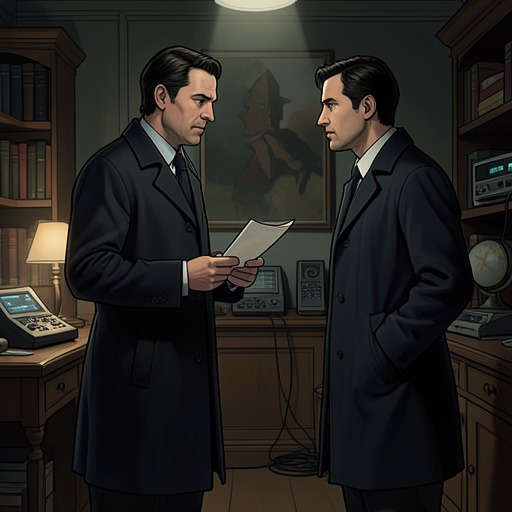
Beate Lønn
The Leopard (Jo Nesbø Edition)Beate Lønn is the exceptionally capable head of forensic technology whose authority rests not on rank or volume but on expertise, integrity, and strength. Her role joins the novel’s murder investigation to its institutional conflicts: she must respect the Ministry’s decision to give the Norwegian Criminal Investigation Service precedence, yet she finds a way to release Björn Holm for Harry Hole’s separate inquiry. Her quiet manner conceals neither weakness nor distance from the work; it makes her command all the more striking.
Identity and Authority
Beate is introduced in a forensic-technology meeting room in Bryn, where Holm finds her alone as the late-afternoon light fades. She is pale, slight, and quiet, a figure who might seem ill-equipped to direct a group of highly professional, self-confident, eccentric, and combative forensic technicians. The appearance is misleading. Those who know her understand that she is the one person who can keep the group in hand.
That authority is founded first on competence: Beate is the best of the technicians. Her integrity and strength make her decisions difficult to challenge, and her orders are carried out even when she gives them in a whisper and with her eyes lowered. The contrast between her subdued manner and the certainty of her command defines her presence in the workplace. She does not need to perform forcefulness for others to recognize it.
Her authority also carries the weight of personal loss. She has had to say goodbye forever to two police officers: her father and the father of her child, Jack Halvorsen. Jack was murdered while working for Harry. On an icy winter day in Grünerlokka, his throat was cut in the street; Holm, called to the scene, saw the still-warm blood melt the ice beneath it. No one blamed Harry for Jack’s death except Harry himself. Beate’s history therefore intersects with Harry’s through a loss that the narrative presents as both intimate and professional, without reducing her authority to that grief.
Making Room for a Separate Inquiry
When Harry asks for Holm, Beate has to work within a clear institutional limit. The Ministry has given the Norwegian Criminal Investigation Service precedence in the case, so she says she has no way to assign forensic technicians to anyone other than Bellman. The constraint is not a judgment about Harry’s ability or the importance of his work; it is the consequence of who controls the official investigation.
Beate nevertheless distinguishes the official murders from other cases. In conversation with Holm, she makes clear that Harry is not investigating one of those murders, and she releases Holm to assist him for fourteen days. The arrangement has a firm condition: a copy of the first report on their work must be on her desk in five working days. The short deadline turns permission into a measured commitment, not an open-ended escape from the agency’s priorities.
Holm recognizes that Beate is giving him a way to join Harry despite the limits she has just described. Kaja Solness, waiting to learn whether she can take part, can barely conceal her excitement; she says she will join if Gunnar Hagen agrees. Beate’s decision thus helps assemble Harry’s working group without pretending that the official chain of command has disappeared. Her influence operates through distinctions, timing, and carefully bounded authorization.
Forensic Work and the Evidence at Lyseren
Beate is not confined to managing staff from an office. At the Lyseren Area, she is among the divers and forensic personnel after a body is recovered, alongside Kaja, while Harry speaks with the local police officer Skai. Later, in the car, Beate asks Harry why he had been searching there for Adele Vetlesen. The question is practical and pointed: she wants the investigative reasoning made explicit, not merely the result.
Her contribution to the discussion is concrete. She notes that Ketanomin is present in the recovered woman’s blood, as it was in Charlotte Lolles and Borgny Stem-Myhre. She explains that Ketanomin is a cheap copy of Ketalar, an anesthetic that allows patients to continue breathing on their own. Because of its side effects, Ketanomin was banned in the European Union and Norway in the 1990s and was then found almost exclusively in developing countries. The Norwegian Criminal Investigation Service had followed it as a leading line of inquiry for a time, but without success.
This exchange shows Beate doing more than supplying a technical fact. By connecting the substance across victims, she makes a pattern visible; by recalling the earlier investigation, she also marks the difference between recognizing a shared clue and having solved what it means. Her knowledge sharpens the case without offering a premature answer. She is attentive both to what forensic evidence can establish and to what remains unresolved.
Institutional Function and Narrative Significance
Beate’s scenes bring together two forms of police authority: the formal allocation of a high-profile investigation and the practical command earned by a forensic leader. Bellman controls the official case, and Beate cannot freely redirect her technicians. Yet she can still make a separate investigation possible by judging where the boundary lies and releasing Holm under explicit terms. Her effectiveness is neither rebellion for its own sake nor passive obedience; it is the disciplined use of the room that remains to her.
The novel also places that professional steadiness beside personal bereavement. Beate’s losses do not erase her capacity to direct, assess evidence, or make decisions under institutional pressure. Instead, her portrait makes authority look less like spectacle than sustained reliability: the quiet leader whose judgment is trusted because she is both exceptionally competent and difficult to compromise. At the scene, in the laboratory’s chain of command, and in the careful limits she sets for Harry’s team, she helps keep an investigation possible without confusing independence with freedom from consequence.