Hävasshütte
The Leopard (Jo Nesbø Edition)Hävasshütte is an unstaffed mountain hut near Ustaoset, a remote setting where a required guest register links several people in the murder investigation to the same night. Its isolation makes it difficult to reconstruct who was there, but also gives the hut a double role: it is a source of evidence whose most important page has been torn out, and the setting for a police operation that turns into an avalanche attack.
Setting and Mountain Access
Hävasshütte lies in the mountain region around Ustaoset, about a half-day's walk from the settlement. The hut belongs to a network of tourist cabins used by people travelling between shelters on foot or skis. The route between them is not merely scenery: records of stays in several cabins, each roughly a day's march apart, help investigators trace who travelled through the area and when.
The landscape makes movement both possible and hazardous. During Kaja Solness's journey to examine the hut's records, she rides a snowmobile with a local guide across a featureless expanse. Snow and wind have smoothed away the terrain's contours; ahead, the Hallingskarvet massif rises like a vast wave. The engine's steady noise and the blank landscape lull her, until the snowmobile stops and the remoteness becomes immediate. Even a mechanical failure would leave the travellers far from help, with several hours of skiing between them and civilization.
The Register and the Missing Page
Because Hävasshütte is not staffed, its visitors must enter their details in the guest register and note where they plan to go next. The rule exists so that rescue teams have a starting point if someone disappears in the mountains. The register therefore serves as a practical safety measure, but also as a record that can reconstruct journeys after the fact.
Investigators find that Adele Vetlesen and Borgny Stem-Myhre had both bought train tickets to Ustaoset for November 7, from Drammen and Kongsberg respectively. A separate search of hut bookings shows that Iska Peller's account was charged for two beds at each of four mountain huts, with Hävasshütte among them. The records place her there on November 7. Adele had also paid for two people to stay at Hävasshütte that night, leaving investigators without the identity of her companion. Together, the bookings make the hut a point of convergence, not proof that every person followed the same route or had the same purpose.
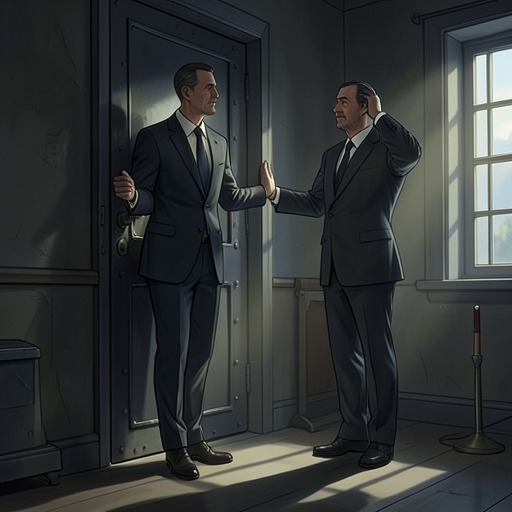
When Kaja turns to November in the register, she finds that the page for the seventh is missing. The entries for the sixth and eighth remain, but the page has been deliberately torn from the binding, with fragments still visible at its spine. Kaja checks for fingerprints and for writing pressed onto the following page. The torn leaf deprives investigators of the names and onward routes it was meant to preserve, while making the register's absence itself a clue.
The Night at the Hut
A later reconstruction places Marit Olsen, Elias Skog, Borgny Stem-Myhre, Charlotte Lolles, and Iska Peller at Hävasshütte that night. Iska is ill and sleeping separately. After dinner, some visitors retire while others remain by the fire; Adele is also present, and a further arrival brings a man whose voice Ole recognizes from a nightmare. Ole hears him speak first with Marit and then with Adele. The sounds from outside lead Ole to the window, where he sees the man behind Adele. The narrative identifies that man as Tony Leike and presents the scene as a recurrence of an earlier trauma for Ole.
Elias Skog later tells a woman on a bus that he had seen two people outside the hut's latrine in the moonlight. At first, he interpreted their movements as consensual sex: the woman appeared to be dancing, while the man held a hand over her mouth. After reading about the murders, he reconsidered what he had seen and wondered whether the woman had been struggling to escape and had been silenced. His account makes the hut's surroundings part of the evidence, but its meaning depends on the belated reinterpretation of an ambiguous sighting.
The cabin is connected to several victims without being established as the place where all of them were killed. The bookings, the recollections of people present, and the missing page lead investigators to treat the night at Hävasshütte as a key to the wider case. The uncertainty is essential: the hut offers a shared time and place, but does not by itself explain what happened to each person afterward.
From Evidence to Police Bait
After the investigation loses its leading suspect, Harry Hole tells the team that new leads point back to Hävasshütte. Mikael Bellman uses a press conference to announce that Iska Peller, who is arriving in Oslo from Australia, will return to the hut with an investigator to reconstruct the night. The announcement is carefully staged to reach the murderer. Its wording makes the witness seem less important and the security arrangements less extensive than they really are, while still suggesting that she may be able to identify other guests.
The police choose Hävasshütte because their presence there can be made credible, because the culprit may feel familiar and secure in the area, and because the geography can be used as a trap. The hut lies in a hollow approachable from the northeast or the south; cliffs make the eastern side too steep, while fissures and crevasses render the west difficult to cross without local knowledge. Harry, Kaja, and Jussi Kolkka take up positions inside the hut. Other officers hide in groups of four in the snow, roughly three kilometres away around the valley.
The conditions isolate the operation as effectively as they conceal it. Only one mobile network reaches the mountain area, so some officers rely on walkie-talkies; Harry has arranged to be contacted through another officer's phone if a message arrives from Rikshospitalet. The snow outside reflects the sun so intensely that, even at night, light blazes through the windows. What is meant to make the site a controlled enclosure also leaves the team exposed to the mountain's scale and weather.
Avalanche and Continuing Significance
During the operation, Harry recognizes a low, bodily rumble and shouts a warning. The ground shakes; air and broken glass are driven through the hut as the avalanche bears down. Harry reaches toward Kaja and Kolkka, but the account ends the moment the wall of snow strikes. The avalanche is not simply a natural hazard in the scene: the later investigation considers it a deliberate attack timed to give its instigator a chance to retreat.
Afterward, Harry reasons that whoever triggered the avalanche knew the terrain and knew that the police were waiting. The public announcement about Iska and the plan to send only one investigator would have made the decoy appear vulnerable, but the attacker chose an assault that could also cover a withdrawal. Harry suspects an insider who understood the Hävasshütte theory and had recognized the danger of the police's announcement. Aslak Krongli's connection to people at the hut and his receipt of an urgent police helicopter landing request make him a subject of suspicion, though the reasoning is presented as an investigative theory rather than a settled conclusion.
The torn register page continues to matter after the failed sting. Harry later confirms that a sheet shown in connection with the killer's collection resembles the pages he saw in the hut; the team wonders whether the missing leaf held the name of a seventh man. Harry recalls that the avalanche and the ensuing fire had turned his attention from the page before he could read it. Hävasshütte thus remains more than a remote meeting point: its register preserves an incomplete route through the case, while the terrain that might have protected its visitors becomes an instrument of concealment and attack.