Archdiocese of Palermo
The LeopardThe Archdiocese of Palermo is the ecclesiastical authority responsible for supervising private chapels within its jurisdiction. In May 1910, an inspection ordered under papal instructions brought that authority into direct contact with the Salina family’s private religious practices: the review examined the chapel’s furnishings and relics, and led to a temporary suspension of services and the verification of five relics.
Jurisdiction and the inspection
The Cardinal Archbishop had begun inspecting the archdiocese’s private chapels to assess whether their owners were qualified to hold services, whether their liturgy and decoration conformed to Church canons, and whether their relics were authentic. The Salina chapel was the best-known in Palermo and among the first selected for inspection. Before the Cardinal’s visit, the Vicar-General came to Villa Salina to prepare for the examination, scheduled for the following morning.
The concerns about the chapel did not amount to a challenge to the Salina family’s right to worship at home or to the regularity of its services. Those services were regarded as nearly faultless, although the sisters’ reluctance to admit outsiders to them was noted. Instead, reports reaching the archiepiscopal Curia raised doubts about a venerated painting and the chapel’s many relics. The chaplain had already been reprimanded for failing to keep the family sufficiently alert to the need to establish the relics’ authenticity.
Examination of the Salina chapel
The Vicar-General asked permission to enter the chapel and view its contents ahead of the Cardinal’s visit. There he saw the painting the Salina sisters venerated: a young woman holding a crumpled letter, represented without the customary symbols that would identify her as Mary. The sisters prayed before the image, while the prelate examined it and remarked on its expressiveness. The visit placed family devotion and the Church’s authority to assess sacred images side by side, without resolving the image’s identity at that stage.
The Cardinal’s visit the next day was formal but restrained. He inspected the chapel and its relics, then told Concetta Salina that services must cease for three or four days while the chapel awaited reconsecration. He also proposed that a Madonna of Pompeii image replace the painting above the altar, which could instead be treated as a work of art. His order temporarily altered the chapel’s use as a place of worship while leaving the family’s collection subject to further examination.
Relic authentication and outcome
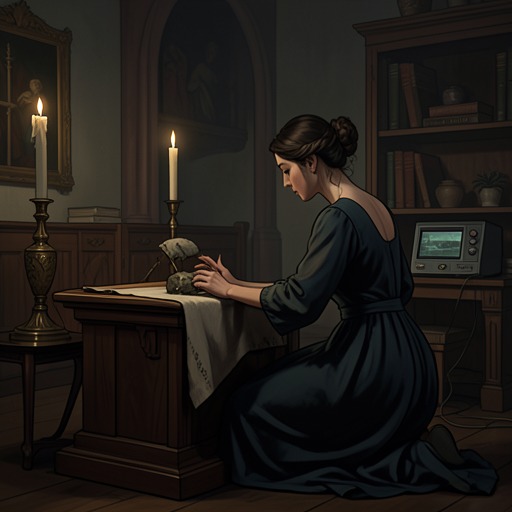
The Cardinal delegated the documentary and material examination of the relics to his secretary, Don Pacchiotti, a priest trained at the Vatican School of Palaeography. Pacchiotti requested the keys to the document case and worked in the chapel for three hours with tools that included a small hammer, a saw, and a screwdriver. His method made the inquiry tangible: he examined the contents rather than relying solely on the family’s devotional claims or the chapel’s papers.
Pacchiotti reported that five relics were authentic and suitable for veneration. He separated the rejected items from the accepted ones, carrying torn papers, cards, and small boxes containing bone fragments out in a basket. The Cardinal had stipulated that the secretary’s findings would stand as his own decision. The episode thus shows the Archdiocese of Palermo enforcing standards of religious practice through delegated inspection, while distinguishing a small number of authenticated relics from the larger collection the Salina sisters had cherished.