Bendicò
The LeopardBendicò is the Great Dane whose life alongside Don Fabrizio Corbera, Prince of Salina, links the routines of the Salina household to the novel’s final reckoning with memory and loss. He is not simply a domestic ornament: he returns at moments of family change, offers a form of companionship distinct from political or social calculation, and remains in Concetta Salina’s room long after his death. An accompanying note calls the dog vitally important and practically key to the novel, a judgment that the recurring scenes support through his place in both Don Fabrizio’s life and the family’s later remembrance.
Identity and Place in the Household
Bendicò is introduced as a large household dog whose movements cross the boundaries between servants’ passages and the family’s formal rooms. After the Salinas finish their daily Rosary, he enters through the door used by the departing servants, wagging his tail and grieving, as the narration presents it, at having been excluded. The prayers have briefly transformed the drawing-room and its religious and mythological decoration; his return coincides with the room and its inhabitants settling back into their ordinary arrangement. He belongs to that ordinary life, but his entrance also makes the household’s boundaries visible: he has been kept out, and now comes back in.
The family’s responses to him vary with circumstance. In the usual course of household life Bendicò is sociable, but when Angelica Sedàra is welcomed as Tancredi Falconeri’s future bride, he crouches behind a console table and growls. His behavior stands apart from the family’s celebration, during which even Father Pirrone’s resistance gives way. The scene does not explain the dog’s reaction, and it should not be mistaken for a stated judgment on Angelica. Its importance lies in the contrast: Bendicò does not follow the room’s emotional consensus, and his unexpected reserve interrupts the otherwise unanimous welcome.
Companionship with Don Fabrizio
Bendicò’s bond with Don Fabrizio is presented as an intimate, largely wordless companionship. When the Prince is troubled by family and political concerns, he compares the dog with the stars: both are difficult to comprehend, but Bendicò, unlike the troubling human circumstances he is turning over in his mind, does not produce anxiety. The comparison places the dog outside the calculations of marriage, inheritance, and political advancement that occupy the Prince. It does not make Bendicò a solution to those problems; rather, his presence offers a different kind of relation, one the Prince can value without having to negotiate its advantage.
A later fragment makes that distinction explicit. When Don Fabrizio’s distress is vague and metaphysical, the affection of a dog can bring genuine relief. When a misfortune has a definite object, however, affection alone cannot resolve it. The text frames this as a limit on what animal companionship can do, not as a failure of the dog’s devotion. Bendicò continues to seek the Prince’s attention, but there are occasions when the human being is absorbed by a specific difficulty and cannot receive that comfort.
Their relationship also appears in a quieter, more reciprocal form after Don Fabrizio has recovered his good humour. He resumes what the fragment calls a brotherly rapport with Bendicò, and the two walk together around the garden. The dog tries to draw the man into energetic activity; Don Fabrizio, in turn, would like the animal to appreciate abstract thought or refined idleness. Neither changes the other. Their contentment comes instead from pursuing an aim together, even without achieving it. The scene gives their companionship a rhythm of its own: affection does not require agreement about how to spend time.
Tancredi and the Dog’s Own Attachments
Bendicò’s ties extend beyond the Prince. When Tancredi returns to the family during a storm, the household gathers around him, and the narration identifies him as Bendicò’s dear playmate. Tancredi knows a particular game involving blowing into the dog’s snout through a closed fist, a detail that marks their familiarity as shared practice rather than generalized affection. Bendicò responds to the return with excited movement around the room. In a scene full of human embraces and reunion, the dog’s exuberance registers his own bond with Tancredi.
The dog’s presence also cuts across moments of social and political transition without turning him into a political actor. When Don Pietro Russo visits the Prince and speaks of the coming changes, Bendicò makes the door shake with his effort to enter. Don Fabrizio lets Russo in, then pauses to admit the dog as well. Bendicò does not join the political exchange; his interruption instead returns the scene to the household’s familiar relations. Later, when the Piedmontese visitor Chevalley is waiting, Bendicò is admitted through the door, carefully sniffs his trousers, and settles beneath the window to sleep. The brief inspection and decision to rest give the dog a small, independent action within a conversation concerned with public office and the future of the state.
Memory, Death, and Preservation
Near the end of Don Fabrizio’s life, the Prince’s review of what he counts as happiness includes Bendicò among the dogs whose companionship has mattered to him. The recollection places Bendicò alongside other animals from different periods of his life, as well as Tancredi, family memories, hunting, and time spent in the observatory. The list does not reduce these experiences to one kind of pleasure: Bendicò’s place in it confirms that the dog’s companionship remains one of the particular, remembered goods by which Don Fabrizio measures his life.
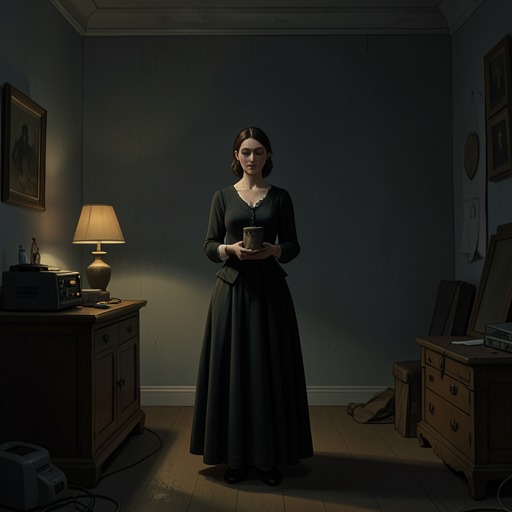
Bendicò outlives the Prince in another form. Forty-five years after the dog’s death, his preserved body lies in Concetta’s room among locked cases of linen, old portraits, photographs, and pictures of places the family has lost. The green cases hold a trousseau she collected fifty years earlier; their contents have yellowed and decayed because she will not open them. In this room, Bendicò is a material remnant of the past, but not simply another distressing relic. Concetta has kept him because he is the one memory of her earlier life that does not cause her pain. The preservation therefore records both attachment and the long passage of time: the dog has been dead for decades, while the object that stands for his presence remains in her keeping.
Concetta’s Decision and the Ending
That attachment finally changes. After a visit from the Vicar-General raises the prospect of changes to the Salina chapel and the removal of relics, Concetta is troubled chiefly by the damage to the family’s standing with the Church and the wider city. In the aftermath, although the chapel’s objects and reputation occupy the immediate concern, she finds that Bendicò’s dusty, moth-eaten remains have become an unpleasant reminder. She calls for Annetta and orders the dog to be taken out and thrown away. The decision reverses her long refusal to part with him: a memory once free of distress has become part of the painful past she no longer wishes to keep before her.
As the preserved body is carried away, its glass eyes seem to look back at Concetta. It is thrown into a corner of the yard visited by the dustman; during its fall, its shape briefly appears to take the form of a dog, before ending as a small heap of dust. The sequence gives Bendicò the novel’s closing image. His final disposal does not undo the companionship that filled Don Fabrizio’s recollections or Concetta’s decades of keeping him. It does, however, end the physical persistence of that memory. The dog’s movement from living companion to preserved object and finally to discarded remains makes the household’s attachment visible in material form—and shows that even a cherished remnant cannot be held unchanged forever.