Bendicò’s preserved specimen
The LeopardBendicò’s preserved specimen is the stuffed remains of the Salina family dog, kept for forty-five years after his death and ultimately thrown away by Concetta. Once associated with affection and companionship, it becomes a dusty, moth-eaten object in her room: a private remnant of a past she can no longer hold without pain. Its disposal closes the novel with a fleeting reappearance of the dog’s shape, followed by a heap of dust.
Identity and Preservation
Bendicò belongs to Don Fabrizio Corbera, Prince of Salina’s remembered circle of dogs. In his accounting of the happy moments scattered through his life, the Prince recalls Bendicò with affection, alongside Fufi, the pug of his childhood, Tom, the poodle who was his confidant, Speedy, and Pop, the pointer. The dogs stand among the varied pleasures that remain in his memory, distinct from the more remote pleasure of owning horses. In that recollection, Bendicò is not yet an inert keepsake: he is part of a companionship the Prince counts among life’s golden moments.
By the time of the closing episode, Bendicò has been dead and embalmed for forty-five years. His preserved body lies as a heap of mangy fur on the floor of Concetta’s room. Beneath that disordered covering are the features that identify him: two upright ears, a black wooden snout, and two astonished yellow-glass eyes. The contrast between the recognizable face and the surrounding fur makes the specimen at once a likeness of the dog and a conspicuously deteriorated object.
Concetta’s Room and the Burden of Memory
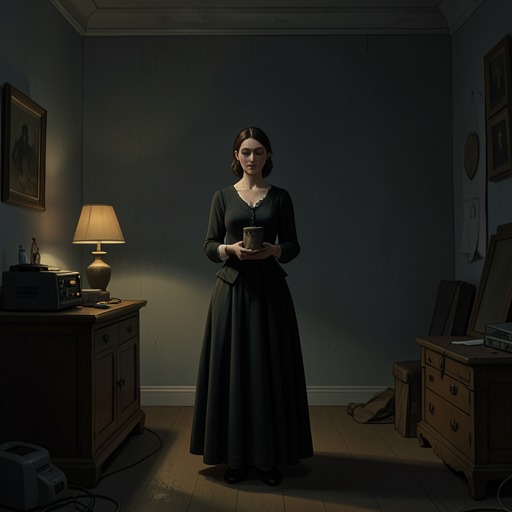
To an uninformed visitor, Concetta’s airy, orderly room might suggest the affectionate care of an old maid. Its clean white floor is patterned with yellow tiles; its inlaid furniture depicts huntsmen, dogs, and game; portraits, watercolours, and sacred images fill the walls. The heap of fur and the four towering green cases with large padlocks are the details that disturb this composed appearance. The room’s two faces—its presentable surface and the private history Concetta knows—are also the distinction between an object’s outward form and what it carries for its owner.
The cases contain the trousseau Concetta collected fifty years earlier: shirts, dressing-gowns, pillow-cases, and sheets divided into best and second-best. Their locks remain unopened because she fears that incongruous demons might spring from them; meanwhile, Palermo’s damp yellows and ruins the contents. The fur on the floor is another preserved remainder, but it has a different hold on her. Concetta has refused for decades to let the servants throw Bendicò away because he is the only memory of her past that awakens no distressing sensations. Keeping the specimen is therefore not simply the preservation of a family possession. It has served as a rare point of attachment to a past otherwise crowded with loss and hurt.
From Keepsake to Discarded Thing
By the time Concetta faces the dog’s remains, that old comfort has failed. After the day’s events, she feels no emotion and experiences familiar surroundings as emptied of their former impulses: her father’s portrait seems only a few square inches of canvas, and the green cases only a few square yards of wood. The specimen, too, has become newly intrusive. She senses an unpleasant atmosphere coming from the heap of furs and recognizes it as part of the day’s distress. The change is not in Bendicò’s physical condition alone, which has deteriorated over many years, but in the memory the object now brings forward.
Concetta calls for Annetta and orders her to take the dog out and throw it away, describing it as too moth-eaten and dusty. As the carcass is dragged away, its glass eyes seem to give the discarded remains a last, humble reproach. The servants take it from the room and throw it into a corner of the yard visited daily by the dustman. Concetta’s order breaks the long-standing refusal that had kept the specimen in place; the object’s removal marks the end of its role as a tolerable relic of her past.
Ending and Narrative Significance
During its fall from the window, the remains briefly re-form in the air as the image of a four-legged creature with long whiskers and one foreleg raised in a gesture of imprecation. The moment gives the discarded object a final semblance of life without reversing its destruction. The shape lasts only for the fall; what remains is a little heap of livid dust. In the book’s closing image, the once-loved dog is neither restored nor ceremonially preserved, but reduced to matter that can be carried away with the rubbish.
The specimen’s final passage from keepsake to refuse gathers together the tension between memory and physical survival. Its stuffed body has lasted for decades, yet preservation has not kept it intact: damp, dust, moths, and time have made the likeness shabby and unwelcome. For Concetta, the object had once offered an exception to painful recollection; now it joins the distress of the present and must go. The brief airborne likeness gives Bendicò a last visual return, then yields immediately to dust, making the novel’s ending turn on the disappearance of a material remnant as well as the memory it could no longer console.