Carolina Salina
The LeopardCarolina Salina is the elder Salina sister whose devotional zeal shaped the family’s private chapel and its crowded collection of relics. By the time Church officials came to inspect the chapel, the household’s transfer of authority to Concetta had left Carolina’s religious convictions intact but her influence diminished. Her resistance to the inspection sets personal faith, family custom, and ecclesiastical authority against one another.
Place in the Salina Household
Around 1910, Carolina was one of three sisters, all roughly seventy years old. She was older than Concetta, though not the eldest of the three. A past struggle for control of the household had ended with Concetta’s victory: Concetta’s adversaries had been routed, and no one now challenged her position as mistress of the house. Carolina therefore lived within a family order in which her elder status did not give her the final say.
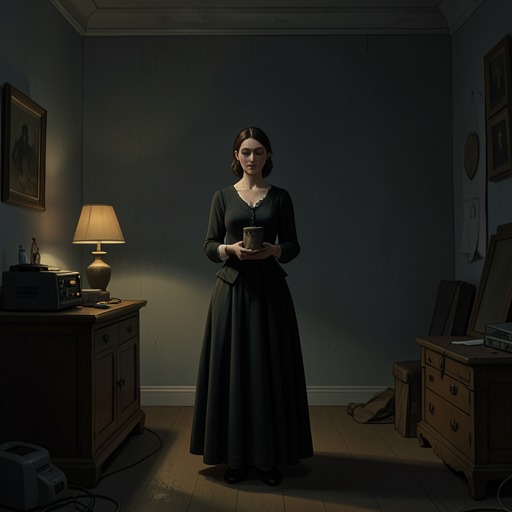
Carolina’s appearance and manner suggest a formidable presence. She wore stiff black watered silk, and her raised white hair, contemptuous eyes, and resentful expression gave her an authoritarian, almost imperial air. A nephew privately likened her to Catherine the Great, a nickname the narrator makes comic by noting that Carolina’s life was entirely pure and the nephew knew nothing of Russian history. The comparison captures her commanding bearing without implying that she held the household power that had passed to Concetta.
The Chapel and Its Devotional Treasures
The family’s private chapel did not exist during Prince Fabrizio’s lifetime. After his death, following complications of inheritance, the Villa became the exclusive property of the three sisters, who established an oratory in an out-of-the-way drawing-room. They adapted its decor for worship, removing a mythological ceiling fresco and installing an altar. The chapel thus belonged to the sisters’ later household, rather than to the religious arrangements of the Prince’s time.
Carolina was the real creator of the relic collection. She found Donna Rosa, a large, elderly woman with connections among the churches, convents, and charitable institutions of Palermo and its surroundings. Every few months Donna Rosa brought a relic wrapped in tissue paper, claiming it had been obtained from a declining parish or a decayed family. She supplied documents said to prove each relic’s authenticity, written in Latin or in scripts she identified as Greek or Syriac. Concetta, acting as administrator and bursar, paid for the acquisitions and for their frames; Carolina’s role was to set the collecting enterprise in motion and sustain its devotional purpose.
The resulting display comprised seventy-four relics covering the walls on both sides of the altar. They were enclosed in frames of many kinds, from silver, bronze, and coral to tortoiseshell, velvet, and wood, with the frames ranging from costly workmanship to inexpensive shop purchases. Each contained a card and a number corresponding to authentication documents, which were kept in a damask-covered chest. Carolina and Caterina became so absorbed in collecting that, for a period, they disturbed each other’s sleep by recounting dreams of miraculous discoveries; some hoped-for finds did arrive after they had told Donna Rosa about them. When Donna Rosa died, the flow of relics nearly stopped, and the sisters already had more than enough.
The chapel’s principal image was likewise an object of Carolina’s devotion. It showed a young woman holding a crumpled letter, with no customary Marian symbols to identify her, but Carolina identified it as the Madonna of the Letter and described it as miraculous. She connected it with a message asking for the Virgin’s protection over the people of Messina, and with miracles associated with the earthquake two years earlier. The picture’s uncertain appearance did not unsettle her claim about its sacred identity.
The Inspection and Carolina’s Resistance
The Archbishop of Palermo had begun inspecting private chapels under papal instructions, examining the fitness of those permitted to hold services, the conformity of their rites and decoration, and the authenticity of their relics. The Salina chapel was among the best known in the city and was scheduled for a visit the next morning. The immediate concern was not the family’s right to worship or the continuity of its services, but rumors about the image and the large number of relics. The family’s reluctance to admit outsiders to its rites was also noted, although the services themselves were described as close to perfect.
At the preliminary meeting in the Villa’s drawing-room, Carolina sat among her sisters and the visiting clergy. When the Vicar-General presented the inspection as a pastoral measure intended to strengthen faith and verify the objects’ authenticity, Concetta remained silent, but Carolina protested that the sisters were being treated as accused people before their friends. The official answered that her vehemence expressed simple faith and that the inspections were taking place throughout the Catholic world. Carolina’s objection was not merely to an inconvenience: she resented the Church’s intervention in a devotional world the sisters had assembled and guarded within their home.
The mention of the Pope sharpened her response. Carolina regarded herself as possessing religious truth more securely than the Pope, and she had already been angered by Pius X’s moderate measures, including the abolition of some secondary feast days. She said the Pope should mind his own business, then crossed herself and murmured a Gloria Patri, apparently reconsidering the impropriety of what she had just said. Concetta intervened, warning her not to say things she did not mean or leave a bad impression on the visitor. The Vicar-General, rather than taking offence, regarded her as an old-fashioned believer shaped by narrow ideas and arid piety, and indulged her benignly.
Judgment and Significance
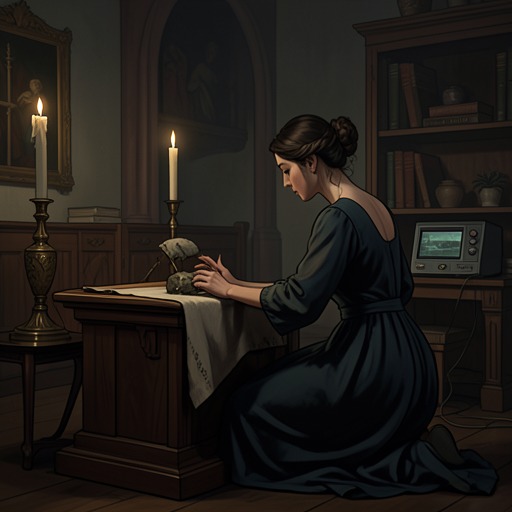
The inspection moved from argument to material examination. The next morning the Cardinal Archbishop visited the chapel, where the sisters’ picture and its seventy-four relics were presented for scrutiny. After the visit, the Church official left his secretary to examine the documents. Using a hammer, saw, screwdriver, magnifying glass, and pencils, the secretary worked for three hours among the records and reliquaries. He emerged with a basket of torn papers, cards, and small boxes containing bone and gristle, reporting that only five relics were perfectly authentic and worthy of devotion. Carolina’s collecting achievement was thus also exposed as a vulnerable arrangement: its impressive documentation and ornate frames could not secure the genuineness of most of its contents.
The decision provoked an immediate household reaction. Before the carriages had reached the Falconeri turning, Carolina declared that the Pope must be a Turk; Caterina was so overcome that she needed smelling salts. Concetta, by contrast, was calmly talking with the secretary over coffee and a baba. That contrast recalls the sisters’ different positions: Carolina supplied the collection’s devotional passion, while Concetta managed the household and could engage the Church’s representative without the same outburst. Carolina’s fervor gave the chapel its abundance, but the inspection demonstrated that private conviction and elaborate displays could not substitute for institutional authentication. Her episode makes the relic collection both a record of family piety and the point at which that piety meets an authority it cannot control.