Cavaliere Aimone Chevalley di Monterzuolo
The LeopardCavaliere Aimone Chevalley di Monterzuolo is a Piedmontese civil servant whose mission to Donnafugata brings the new Italian government’s hopes for political participation into direct contact with Don Fabrizio Corbera, Prince of Salina’s skepticism. A dutiful representative of the emerging state, Chevalley believes that honest men should enter public life and work to improve conditions in Sicily. The Prince declines the Senate seat he offers, turning Chevalley’s official visit into an encounter between reformist confidence and a deeply rooted expectation that political change will leave much unchanged.
Identity and Mission
Chevalley serves as Secretary to the Prefecture at Girgenti. A letter from the Prefect announces that he is coming to Donnafugata to discuss a matter close to the government’s heart. The Prince responds by sending his son Francesco Paolo to receive the visitor and inviting him to stay at the palace. The hospitality is also an act of practical compassion: the Prince does not wish to leave the Piedmontese official to the poor conditions of the local inn.
Chevalley’s assignment is to ask the Prince to approve his proposed nomination as a Senator of the Kingdom. Following the union of Sicily with the Kingdom of Sardinia, provincial authorities have been asked to suggest prominent Sicilians for consideration by the central government and, ultimately, royal appointment. Chevalley explains that the Prince’s ancient name, personal standing, scientific distinction, and conduct during recent events have made him an obvious candidate. He has prepared his appeal carefully, even making notes in a small book, and first seeks the Prince’s consent before his name is sent onward.
Arrival in Donnafugata
The post coach arrives at dusk with an armed guard and several passengers. Chevalley has already spent a month in Sicily, sent there from his small property near Montferrat, but remains unsettled by the island. Timid and instinctively bureaucratic, he feels out of place in what he takes to be an unfamiliar and threatening environment. Tales of brigands have led him to regard ordinary objects in his office with suspicion, and local food has upset him. In Donnafugata, the run-down street and the peasants standing along it do little at first to persuade him that he has arrived within his own nation; he fears he will not be understood and hesitates to ask for directions.
Francesco Paolo’s calm manner reassures him. Once Chevalley understands that he is being invited to stay with the Salina family, his alarm gives way to relief. The journey to the palace becomes a small exchange of formal courtesies: Piedmontese and Sicilian politeness compete over who will carry his light valise, and both contenders end up bearing it. The episode establishes Chevalley as cautious and unfamiliar with local life, but also as someone responsive to personal kindness.
The Senate Offer and Refusal
In the Prince’s study, Chevalley presents the Senate as the Kingdom’s upper chamber, where distinguished members will examine and debate proposed laws. He describes it as an institution able both to encourage useful measures and to restrain harmful ones. A seat, he argues, would allow the Prince to represent Sicily alongside the other members and make the island’s voice heard as it enters the modern political order. His account reflects genuine confidence in the new institution and in the value of the Prince’s participation.
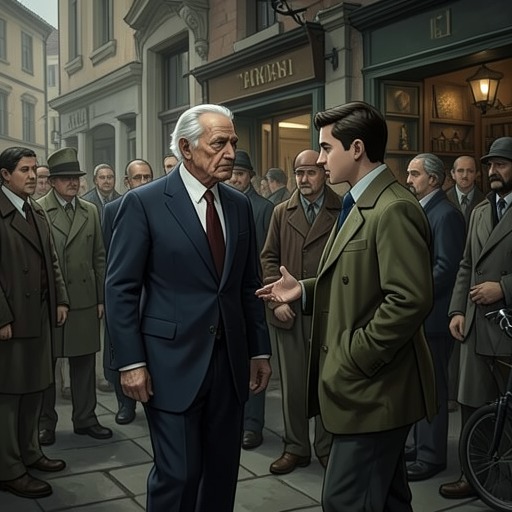
The Prince distinguishes support for the new state from participation in its work. He says he would accept if the Senate seat were merely an honorary title, and he acknowledges the importance of avoiding an appearance of national disunity. But he does not believe he should help administer a transformation carried out without consulting people of his class. He describes Sicilians as shaped by a long succession of rulers who did not share their religion or language, and argues that this history has produced habits of caution and division. The Prince’s refusal is therefore not presented as a simple rejection of Italian unity: it arises from his conviction that the new government cannot make him a genuine participant merely by offering him office.
Chevalley’s appeal becomes more personal when he challenges the Prince to help relieve the people’s physical hardship and moral distress. He argues that if conscientious men withdraw, figures such as Don Calogero Sedàra will be left to take their place. The Prince acknowledges Chevalley’s sincerity and calls him a gentleman, but disputes his assumption that Sicilians want to improve their condition. Their disagreement is not about whether hardship exists; it is about whether political engagement can overcome the social habits that, in the Prince’s view, perpetuate it.
Political Judgment and Social Contrast
Chevalley is portrayed as honest and capable of understanding suffering beyond his immediate experience. He does not mistake the Prince’s wealth for contentment: after envying the Salina household’s grandeur, he comes to pity the Prince as well as the poor people he has encountered during his month on the island. The narrative places these forms of distress beside one another without making them identical. Chevalley’s response shows that his belief in public responsibility is not merely procedural; he wants the proposed office-holder to use influence to address people’s conditions.
The Prince redirects the nomination toward Don Calogero Sedàra, whom he regards as better suited to the new politics because he has practical power and can generate public ideals when necessary. Chevalley, an honest supporter of the legislative chambers, chooses not to reply rather than compromise himself. The narrative later reports that Don Calogero does in fact enter the Senate. This outcome gives the exchange an irony Chevalley cannot settle in the room: the institution he regards as a vehicle for responsible government will include the kind of politically effective man the Prince has recommended, while the Prince himself refuses its invitation.
Departure and Narrative Role
Chevalley leaves early the next morning, accompanied to the post station by the Prince and Don Ciccio Tumeo. In Donnafugata’s poor and neglected streets, Chevalley maintains his belief that a vigorous modern administration will change conditions. The Prince, standing beside him, expects that they will endure for generations and that future rulers will be no better than those they replace. Their contrasting expectations remain unresolved as Chevalley boards the coach and continues his journey; alone, he tries to clear a small space on the window through which to look at the landscape.
Chevalley’s importance lies partly in the way his visit makes the Prince articulate what he believes about political change, class, and Sicily. He is neither a triumphant reformer nor a mere target of the Prince’s cynicism. His serious appeal gives the refusal moral stakes, while his departure carries the new government’s faith in administration back into a landscape the Prince considers resistant to lasting improvement. The scene leaves both positions visible: Chevalley’s hope that honest service can make a difference, and the Prince’s conviction that replacing one governing class with another will not, by itself, transform the island.