Colonel Pallavicino
The LeopardColonel Pallavicino is the officer who stopped, wounded, and captured Giuseppe Garibaldi at Aspromonte. His account of the encounter turns a politically charged act of force into a revealing portrait of divided loyalties: he insists that he obeyed written orders and protected the Kingdom, yet speaks of Garibaldi with unmistakable tenderness and respect. At a ball, his ceremonious public manner gives way, in conversation with Don Fabrizio, to a bleak assessment of the new Italy.
Appearance and Public Manner
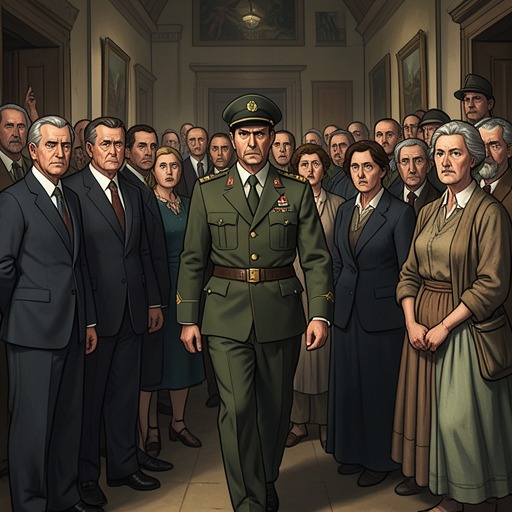
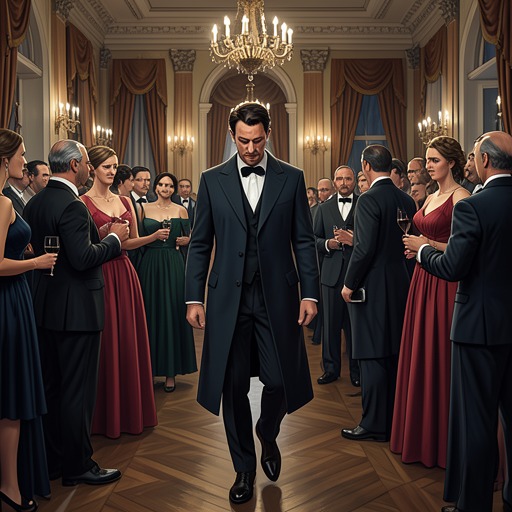
Pallavicino makes his entrance at the top of the stairs in a padded, double-breasted uniform, with epaulettes, chains, and spurs accompanying his movement. He carries a plumed hat under his arm and rests his left wrist on a curved sabre. The military display is softened by the manners of a man of the world: he is graceful, practiced in the ritual of hand-kissing, and already famous across Europe for the expressive ceremony with which he approached the wounded Garibaldi.
The evening’s political praise has prepared the way for his arrival. The Prince of Ponteleone commends the tact and delicacy with which Pallavicino had fired on Garibaldi, as well as the bowing, kneeling, and hand-kissing that followed. The compliment has several meanings: it recognizes Pallavicino’s military skill, but also approves his capture of Garibaldi as a means of preserving a compromise between the old order and the new. Pallavicino thus enters a room where the force he used has already been recast as both courteous conduct and political prudence.
After receiving the Prince’s praise, Pallavicino shakes the two fingers Don Fabrizio offers him, then joins a group of ladies. He tells them that he sobbed like a child and describes Garibaldi as serene as an archangel. The ladies are enchanted by his sentiment, which sits alongside the reassurance they draw from the musketry of his Bersaglieri. His cultivated emotional display is therefore not separate from his military identity: it makes the violence easier to admire, even as it keeps its consequences in view.
The Aspromonte Encounter
In conversation with Don Fabrizio, Pallavicino proves more than a performer of sentimental phrases. Away from barracks rhetoric and admirers, he reveals the skepticism he associates with his class. He says that the political Left wants to punish him for ordering his men to fire on Garibaldi the previous August, but stresses that he was carrying written orders. He also admits that, when confronted at Aspromonte by a few hundred followers, he was glad those orders coincided with his own feelings. He believed that without the order to fire, the crowd would have hacked his soldiers and him to pieces.
For Pallavicino, the danger extended beyond the immediate clash. He argues that a failure to stop the crowd could have invited French and Austrian intervention, with consequences that might have brought down the Italian Kingdom. He also presents the gunfire as a means of freeing Garibaldi from followers who, in his view, were using him for generous but inept purposes. Those figures differed from the men who had landed with Garibaldi at Marsala, some of whom had believed Italy could be made by repeating 1848. Pallavicino’s explanation casts the shooting as both an act of self-preservation and an intervention that protected the state—and Garibaldi himself—from a compromised political movement.
His respect for Garibaldi is personal as well as strategic. Pallavicino recalls that, after he had fired the shot that wounded him, he knelt and kissed Garibaldi’s hand; Garibaldi responded by warmly shaking his hand and thanking him. Pallavicino rejects Don Fabrizio’s suggestion that such courtesies went too far. He remembers Garibaldi lying beneath a chestnut tree, suffering in body and mind, and sees in the bearded, wrinkled general a simple, adventurous child. The image makes the officer’s action harder to reduce to either obedience or triumph: he has wounded a man whom he pities and honors, and understands the hand-kissing as homage to the person whose restraint, he believes, helped save the Kingdom.
Conversation with Don Fabrizio
The contrast between Pallavicino’s public sentiment and private judgment emerges over supper. Don Fabrizio initially considers sitting with Tancredi and Angelica, whose wit and cordiality appeal more than Pallavicino’s affected-sounding phrases. He chooses the Colonel’s table instead, reasoning that it is better to bore himself than to bore others. Pallavicino rises when Don Fabrizio arrives, a small gesture acknowledging the Prince’s pride. As Don Fabrizio eats blancmange with pistachio and cinnamon, their conversation reveals the intelligence beneath the officer’s social performance.
Pallavicino is not eating, though he eventually drinks champagne. His recollection of the clash remains vivid: as his Bersaglieri disarmed Garibaldi’s men, they cursed Garibaldi, the one man among them who had personally paid the price. Pallavicino calls this foul but natural, because Garibaldi’s larger, almost childlike personality had concealed the followers’ obscure intrigues. He also maintains that his own courtesies were sincere, even if they were unnecessary. In his view, Italy cannot have too much sentiment or hand-kissing; such gestures are among the country’s most effective political arguments. Courtesy becomes not a denial of violence but a language through which political antagonists can recognize one another.
Political Foreboding and Narrative Role
The Colonel’s account broadens from Aspromonte to the condition of the reunited country. He tells Don Fabrizio that the mainland is an unappealing sight and that Italy has never been so disunited as since unification. Turin resists ceasing to be the capital; Milan considers the administration inferior to the Austrian one; Florence fears for its works of art; and Naples mourns its lost industries. In Sicily, Pallavicino senses a vast, irrational disaster taking shape. His catalogue turns regional grievances into a warning that political union has not produced a shared national life.
Pallavicino says that, partly because of his actions, red shirts are no longer being discussed, but predicts their return; when they disappear, others of different colors will take their place, before red shirts return again. He doubts the reassurance offered by Italy’s Lucky Star, noting that even fixed stars are fixed only in appearance. The prophecy unsettles Don Fabrizio, whose heart contracts at the prospect. Pallavicino’s role in the episode is therefore double: he explains the military act that preserved the immediate political settlement, then exposes how little that settlement has resolved. His controlled manners, reverence for Garibaldi, and forecast of recurring upheaval place him between old and new Italy—not outside the conflict, but acutely aware that force and ceremony have only temporarily contained it.