Concetta Salina
The LeopardConcetta Salina’s life is shaped by an attachment she cannot openly resolve and a memory she cannot finally verify. As a young woman, she loves her cousin Tancredi Falconeri, but he turns toward Angelica Sedàra and marries her. Concetta appears to accept that change with generosity, yet her hurt persists beneath the family’s celebrations. Nearly fifty years later, a visitor’s account of Tancredi’s earlier feelings unsettles the explanation she has lived with, only for the possibility of certainty to dissolve. Her story makes private disappointment part of the novel’s broader inquiry into pride, family memory, and the instability of truth.
Identity and Family Position
In the household of Don Fabrizio Corbera, Prince of Salina, Concetta is one of his daughters and, in the family’s later years, the eldest surviving sister, though she is not the eldest of the three sisters portrayed in the inspection scene. In youth, she is reserved and attentive to the behavior of those around her. Her feelings for Tancredi Falconeri become known to her father through Father Pirrone, the family chaplain: the news makes Don Fabrizio suddenly conscious of his age, while his immediate assumption that he knows whom she loves confirms how familiar the attachment is to him.
Concetta’s position within the family changes with time. By the period of the chapel inspection at Villa Salina, she is around seventy and has become the household’s unquestioned mistress. A past contest for authority has ended in her opponents’ defeat, and her sisters no longer challenge her role. Her appearance retains traces of her former beauty, while her formal dress, white hair, and stern expression contribute to an imposing presence. The contrast is striking: the daughter once anxious about her father’s response to her love now presides over the family home with considerable authority.
Love, Rivalry, and the Engagement
Concetta’s attachment to Tancredi is exposed most clearly when Angelica enters the family’s intimate circle. At dinner, Concetta welcomes her cousin and urges her to use the familiar form of address from their childhood. That outward warmth does not relieve her distress. As Tancredi divides his attention between the two young women, Concetta reads his glances as evidence that his desire is directed toward Angelica. She fixes on small differences in manners and background, hoping that Tancredi will be put off; instead, he remains drawn to Angelica. Concetta’s jealousy is thus sharpened by the realization that noticing and judging her rival cannot change his choice.
At another dinner, Concetta objects when Tancredi tells a politically charged story in a manner she considers inappropriate for the young women present. Her reproof and withdrawal show her trying to defend both propriety and her own dignity. Yet the incident also becomes part of the later uncertainty surrounding their relationship: decades afterward, Senator Tassoni recalls that Tancredi remembered the episode tenderly, while Concetta had understood his story as something to take offense at. What she experienced as a rebuff or affront may, in his memory, have been a moment of affection.
When Tancredi’s intended marriage to Angelica becomes clear, Concetta’s mother, Princess Maria Stella of Salina, protests that she had hoped he would marry Concetta and condemns his decision. Don Fabrizio answers that Tancredi had made no proposal to Concetta and that she herself had treated him badly since the family arrived at Donnafugata. Concetta’s disappointment is therefore not simply a romance blocked by her father or by the family’s arrangements: even within the household, responsibility and motive are contested. At the engagement celebration, Concetta is particularly affectionate toward Angelica and so moved that tears come to her eyes. The scene permits genuine welcome and private grief to coexist; her support does not erase the cost of Tancredi’s choice.
Other Prospects and the Family Household
Count Carlo Cavriaghi arrives with hopes of winning Concetta’s affection. He gives her a specially bound volume of Aleardo Aleardi’s poems, marked with her initials and a dedication that casts her as deaf to his sighs. Concetta responds with amusement, but she does not return his feelings. Tancredi, who had brought Cavriaghi in part hoping his friend might take his place in Concetta’s affections, observes that the count’s efforts are failing. Later, Cavriaghi confides that he has not dared make a formal proposal and expects to leave with regret. Concetta’s reserve keeps this possible match at a distance, even as Tancredi interprets her manner as evidence of pride and withdrawal.
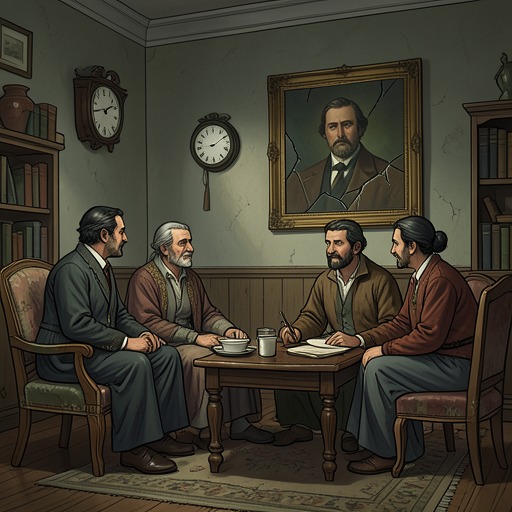
The household’s later portrait gives that reserve a different scale. Concetta sits beside the Monsignor Vicar-General when church officials visit to arrange an inspection of the Salina chapel, including its furnishings and relics. Her sister Carolina objects to the prospect of the family being treated as suspect, while Concetta remains silent during the reported discussion. The scene presents her not as the young woman whose romantic future is being debated by others, but as the senior authority in a family home now facing scrutiny from outside. Her silence here is distinct from the emotional silence of her youth: it accompanies a settled position of power.
The Past Reconsidered
The chapel visit becomes the occasion for a belated account of Concetta and Tancredi’s earlier encounter. Senator Tassoni tells her that Tancredi had remembered a story he invented about fighting around Palermo. Concetta, he says, had believed the tale, taken offense at its frankness, and reproved him. Tassoni presents Tancredi’s recollection as evidence that he had felt tenderness toward her, and connects the encounter to the day he first met Angelica. The disclosure does not prove that Concetta and Tancredi could have married, but it challenges the assumption that his feelings for her were absent or that her own conduct had meant nothing to him.
At first, the news reaches Concetta slowly; after the visitors leave and she is alone, its implications become painful. For years, she has interpreted her unhappiness through a sense of injury: she blamed her father for neglecting her and carried resentment over Tancredi. Tassoni’s story offers a harsher possibility, that her own pride and imprudence helped close the future she later mourned. She recalls Tancredi asking Don Fabrizio to let him visit her at the Convent of the Holy Ghost, and now wonders whether she misread his earnestness and turned him away. The long-standing account in which she was wronged gives way to a suspicion that she also contributed to the loss.
The revelation remains uncertain. The narrative emphasizes how quickly a fact in Sicily can be altered by imagination, self-interest, shame, fear, generosity, or malice. Tassoni may be offering a genuine recollection, but the novel does not establish that his version restores an intact truth. Angelica, on the journey home with him, gives her own account: she says Concetta had been deeply in love with Tancredi, but that he had paid her no attention. Her claim differs from the interpretation Tassoni has just offered and further complicates the evidence. Concetta is left with pain that is certain and an explanation that is not.
Change and Narrative Significance
Concetta’s arc moves from concealed longing, through apparent acceptance and established household authority, to a late reassessment of her youth. The engagement scene reveals the gap between outward conduct and inward feeling; the later conversation shows that memory can preserve the wound while distorting its cause. Her decades of resentment had offered a structure for understanding herself, but the new account threatens to make her the agent of her own loss. It does not, however, replace one definitive story with another.
Through Concetta, the novel connects individual pride to the larger difficulty of knowing the past. She is neither simply a rejected lover nor a figure who achieves closure: she welcomes Angelica, rejects or fails to reciprocate Cavriaghi’s affection, and later discovers that the meaning of her encounter with Tancredi may have escaped her. By the end of the available account, the truth of their feelings remains unsettled, while the consequences of the disappointment have become part of her life. Her authority in old age cannot undo the choices or misunderstandings of youth, and the final revelation offers no certainty—only a more painful awareness of what may have been lost.