Decline and Replacement of the Aristocracy
The LeopardDecline and Replacement of the Aristocracy in The Leopard describes a transition in which the old landed nobility loses economic control and political primacy without immediately surrendering its identity or social forms. The change is visible in shrinking estates, Don Calogero Sedàra’s accumulation of property and influence, and the alliance created by his daughter’s marriage to Tancredi. The result is neither simple continuity nor a clean overthrow: new wealth enters aristocratic life, while aristocratic names and habits adapt to the new balance of power.
A Crisis Seen from Within
The novel’s account of the Salina family’s decline is framed as an intimate view of a Sicilian nobleman confronting crisis. In the author’s description, that crisis is not limited to the political upheaval of 1860; the degeneration of the family becomes increasingly marked and approaches near-collapse. Yet the story is told without rancour and with a degree of complicity with its aristocratic subject. That perspective makes decline more than a judgment passed on a vanishing class: it shows how a member of that class recognizes change, interprets it, and tries to live with it.
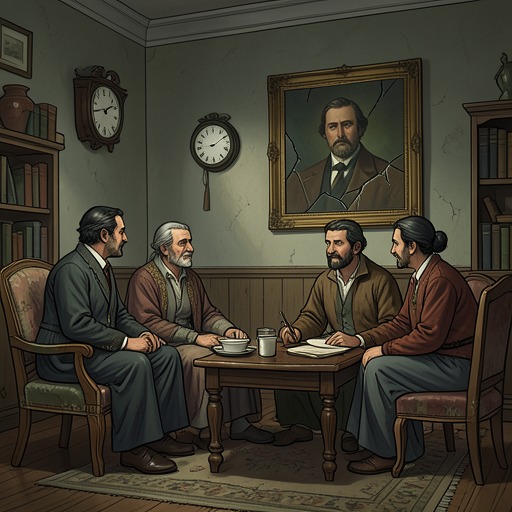
The estate office at Villa Salina gives this decline a material form. Its walls display colorful paintings of the Salina properties, each protected in the pictures by a reassuring sky and the family’s Leopard emblem. The images celebrate the House of Salina’s past rule, but they do not provide reliable information about boundaries, tenancies, or the actual administration of the land. The wealth of generations has been converted into ornament, luxury, and pleasure; after feudal rights are abolished, the privileges and duties that once accompanied that wealth no longer hold together. The paintings preserve the appearance of dominion even as the estates themselves begin to disappear.
Some properties have already passed out of the family’s hands, leaving their names and bright depictions behind. Others resemble swallows still gathered before departure: present, but poised to leave. The contrast between the lively estate pictures and the precarious holdings they represent turns the office into an image of aristocratic survival by representation. The family’s heritage remains visible, yet visibility cannot restore its economic basis.
New Wealth and the Limits of Change
The shift becomes concrete in the account of Don Calogero Sedàra’s fortunes. A mortgage of one thousand ounces of gold enabled him to take possession of Baron Tumino’s estate, which yielded five hundred ounces a year. He also bought land containing a vein of sought-after stone and profited from grain sales during the confusion and famine after the landings. His income at Donnafugata was expected soon to equal Don Fabrizio’s, while his political influence had grown alongside his wealth: he headed the liberals locally and in the surrounding districts, and was expected to win election to the Chamber of Deputies.
Don Pietro Russo offers the Prince a local reading of what this new political presence means. In Russo’s view, able men will get their chance, but otherwise life will remain much as before. Don Fabrizio interprets the assurance as a plan not to destroy the old ruling class but to take its place gradually. He imagines the Salina name surviving even as the social order around it changes, with the family perhaps receiving compensation or a place in the Senate of the Kingdom of Sardinia. His interpretation is both perceptive and self-protective: he recognizes the transfer of power, but pictures it as orderly, limited, and compatible with the continued prestige of his own house.
Marriage as a Channel of Incorporation
The engagement of Tancredi and Angelica Sedàra gives the transition a family structure. Don Fabrizio presents Tancredi to Don Calogero as ambitious, socially perceptive, and equipped to advance; Don Calogero, in turn, makes the resources he will place at his daughter’s disposal explicit. The marriage contract is to assign Angelica the Settesoli estate, comprising 644 salmi, or 1,010 hectares, of prime corn land, as well as 180 salmi of olive groves and vineyards at Gibildolce. On the wedding day, he promises the bridegroom twenty linen sacks, each containing 10,000 ounces of gold.
The scale and precision of the settlement expose the material terms beneath the language of love and family. Don Calogero presents Angelica as the person to whom he will leave his wealth, while Don Fabrizio sees the match as a consequential political and social coup for Tancredi. The Prince is startled by the size of the offer; Angelica’s beauty and Tancredi’s grace partly soften, for him, the crudeness of the bargain. The marriage does not merely connect two young people. It joins new bourgeois resources to aristocratic standing, giving the rising family access to an old name and the old family fresh funds.
Political Adaptation and Continued Influence
Don Fabrizio’s response to the proposed Senate appointment further reverses the expected direction of succession. When urged to accept a seat, he says he is ill at ease between the old and new worlds and declines the role. Instead, he recommends Don Calogero, arguing that Sedàra possesses practical power and political usefulness, while the Prince lacks the qualities needed to guide others in the changing political order. Don Fabrizio’s recommendation is not simply resignation: he identifies the figure better suited to the new institutions and directs recognition toward him. Ten years later, Don Calogero does in fact enter the Senate.
The later fortunes of the newly connected families show how replacement can proceed through adaptation rather than expulsion. After their extended engagement and marriage, Tancredi and Angelica travel through Europe. Meanwhile, restoration work at Villa Falconeri, overseen by Don Fabrizio and financed by Don Calogero, makes the house habitable again and dispels the threat of legatees and bailiffs. Tancredi’s new funds and energy also make him influential in politics. He operates on the extreme left of the extreme right, masking intensive political activity with a manner of nonchalance. New capital sustains an old aristocratic setting, while an aristocratic heir uses changing political alignments to establish a place in public life.
Continuity Through Transformation
The pattern is captured by the gap between the estates’ bright images and their diminishing substance. The old family’s properties and authority recede, but its symbols, connections, and social prestige remain useful. Don Calogero’s rise supplies the wealth and political power that the Salina family is losing; the marriage makes that transfer intimate, and Tancredi’s career carries it into the new political order. The aristocracy is therefore replaced in part, but not simply erased: newcomers enter its circle, while old forms give the transfer a language of continuity.
This process also clarifies the limits of Don Fabrizio’s hope that the change will be only a small alteration of classes. The social arrangement does change, and the family’s economic foundation is weakened, yet the transition preserves enough of the old order to make the newcomers’ advancement legible as incorporation into it. The Leopard presents aristocratic decline as both loss and survival: a house may retain its name and ceremonial presence even as its estates pass away and its power depends increasingly on alliances with those who have risen.