Decline of the House of Salina
The LeopardThe decline of the House of Salina is both material and historical: estates disappear, inherited wealth loses its foundations, and the family’s distinctive memories have no secure successor. Its contraction is measured through Don Fabrizio, who witnesses the loss of property and the rise of new arrangements while recognizing that continuity of name cannot guarantee continuity of tradition. The result is not a single reversal but a gradual narrowing, from a house that appears to command a world to a legacy preserved in pictures, objects, and the recollections of one dying man.
A crisis seen from within
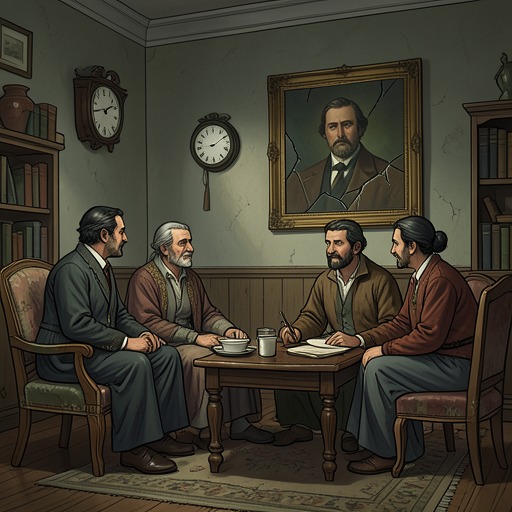
The family’s degeneration unfolds against a crisis that is not limited to the political upheaval of 1860. The novel follows how a Sicilian nobleman responds to changing circumstances and how the decline of his family becomes increasingly pronounced, approaching almost complete collapse. Its perspective remains close to the family’s own experience, with a degree of the author’s complicity rather than the rancour of an external indictment. This inward angle makes decline more than a judgment on an obsolete class: it is also the loss of a lived world, understood by someone who belongs to it.
Don Fabrizio’s household initially seems spacious enough to absorb change. He has a wife and seven children, and the family’s landed presence is represented in a collection of large estate paintings. Yet possession and continuity are already coming apart. The pictures show a reassuring world under the Salina family’s rule, while failing to record the practical boundaries, tenures, and tenancies on which ownership depends. The estate office’s grand visual map therefore preserves the appearance of command more effectively than the details of economic control.
Wealth becoming image
The paintings turn estates into ornament, and their beauty registers the paradox of Salina wealth. The abolition of feudal rights has swept away obligations along with privileges; wealth accumulated over centuries has been converted into luxury and pleasure, while care and prudence have ebbed away. In the novel’s metaphor, the family’s resources have achieved their purpose and dwindled to something like essential oils, vivid but liable to evaporate. Some of the estates represented in the office have already gone, leaving only their names and bright-painted likenesses. Others seem poised to depart, like swallows gathering before migration.
The family’s decline is thus visible before its final collapse. The images remain jocund and the leopard emblem continues to guard them, but the properties they commemorate are no longer all securely present. The contrast between a confident heraldic image and the weakening estate behind it makes the family’s loss legible as a change in substance, not merely in appearance. Don Fabrizio can turn from the troubling papers in his office to astronomy, but that private refuge does not restore the land or the inheritance. The records of the estate and the pictures of its former extent remain signs of a world whose actual foundations are slipping away.
Marriage, property, and adaptation
The fortunes of Tancredi, Don Fabrizio’s nephew and ward, bring the economic contraction into the next generation. Tancredi’s father squandered the family fortune and died, leaving his widow and son; after her death, the King placed the fourteen-year-old Tancredi under his uncle’s guardianship. By the time he is twenty-one, the family estates around Mazzara, the pistachio woods of Ravanusa, the mulberry plantations of Oliveri, and the Palermo palace have all been lost. Don Fabrizio managed to preserve a villa through legal manoeuvres and personal sacrifice, but even this remnant is in such poor repair that its best-kept room can scarcely serve as a goat stall.
Don Fabrizio nonetheless supports Tancredi’s marriage to Angelica, and the negotiation exposes how the family adapts to its diminished resources. When Concetta asks whether Tancredi has made a definite proposal, her father postpones judgment and weighs the dowry against the unequal division of the Salina fortune among seven children. He recognizes that Tancredi needs wealth, while doubting that a young woman’s confidence in his attentions proves that he loves her. The marriage that follows is therefore connected to both personal attachment and the practical question of how a young man with an old name can move forward.
The terms Don Calogero offers make the transfer concrete. He promises Angelica the Settesoli estate, measured at 644 salmi or 1,010 hectares, and 180 salmi of olive groves and vineyards at Gibildolce. On the wedding day, he will also give the bridegroom twenty linen sacks, each containing 10,000 ounces of gold. These commitments astonish Don Fabrizio: the scale of the arrangement exceeds what he had imagined. The marriage links Tancredi’s aristocratic identity to the resources of the rising Sedàra family, allowing a future for the younger man even as the older house’s own wealth recedes. Continuity is maintained through an alliance that also reveals how much the old order now depends on wealth from beyond itself.
The last bearer of family memory
The novel distinguishes descendants from heirs to a family’s inner history. Giovanni, the only son said to resemble Don Fabrizio, is away in London. Every couple of years he sends greetings; he has moved from dealing in coal to dealing in diamonds. After his mother’s death, he sends her a letter and then a bracelet. His distance becomes a form of departure from the life his father tried to organize: he lives on, but no longer shares that household’s daily world.
Don Fabrizio’s grandson Fabrizietto appears to offer a more immediate continuation, yet the Prince regards him as shaped by different instincts and a middle-class smartness. He imagines the boy’s memories as ordinary ones, unlike the unusual experiences that give the family’s traditions their particular meaning. Even the name Salina, he fears, may become empty pomp, its significance increasingly measured by outward display and comparison with others. The tapestries of Donnafugata, the almond groves of Ragattisi, and the fountain of Amphitrite might, in his anxious projection, be reduced to transient luxuries. These are fears about the future, not events that the passage confirms; their importance lies in the distinction Don Fabrizio draws between inheriting a name and inheriting the memories that once gave it substance.
He concludes that he himself is the last Salina in this deeper sense: the last person to possess unusual family memories and recognize their meaning. He had believed the Salina would endure unchanged, but sees that he was wrong. Garibaldi’s victory names the historical defeat in political terms, while the Prince’s reckoning names its intimate consequence: a family may continue in descendants and possessions even after its shared past has become difficult to transmit.
Remnants and the final contraction
The last chapters carry the decline from estates and inheritance into the fate of family objects. Don Fabrizio’s death is presented as the end of a man who has been alone despite having a wife and seven children. The question of the relics, which the author describes as authentic and personally witnessed, sets a final seal on the account. At a later moment, Concetta sees her father’s portrait and the green cases as no more than canvas and wood. Their familial meanings have not vanished from history, but they no longer produce an emotional response in her; she experiences the familiar world as emptied of its former impulses.
The final treatment of Bendicò sharpens that loss. Concetta finds the preserved dog dusty and worn and orders it taken away. A companion associated with her father’s household becomes an unwanted remnant, too depleted to remain in the rooms where the family’s past is being sorted. Across the estate paintings, the lost properties, the relics, the portrait, and Bendicò, the pattern is consistent: material forms may survive for a time, but their connection to a living family memory grows fragile. The decline of the House of Salina ends not simply with diminished wealth, but with the fading capacity to make its objects and name carry the past forward.