Dogs
The LeopardDogs in The Leopard are more than a feature of the Salina household: they accompany Don Fabrizio Corbera, Prince of Salina through hunting, domestic life, and recollection, giving affection a steady but limited presence amid political and personal change. Bendicò, his great dog, is the most important companion, while the other named dogs gather into a record of earlier stages of the Prince’s life. Their actions are concrete and ordinary; their significance grows from how the narrative sets that ordinary companionship beside the Prince’s isolation, mortality, and concern with the past.
Household Companions
Bendicò moves freely through the Prince’s domestic world. When Don Onofrio Rotolo visits, the dog makes the door shake with his friendly approach, and Don Fabrizio gets up to let him in before returning to his conversation. In a later exchange, Don Onofrio invokes his own local connections while reassuring the Prince that Villa Salina will be safe; the Prince, feeling reduced to someone who might depend on another man’s protection, takes comfort in the thought that Bendicò remains with him. The dog’s presence cannot alter the political balance, but it is a familiar bond the Prince can still claim.
The relationship is reciprocal, though not identical in what each companion seeks. In a later fragment, the Prince and Bendicò walk together in the garden: the energetic dog appears to invite his master into activity, while Don Fabrizio would prefer the animal to share his taste for cultivated idleness and abstract thought. Neither changes the other, yet both are content. The scene presents companionship not as perfect understanding but as a shared routine whose value does not depend on agreement or achievement.
Hunting and the Sicilian Landscape
During the morning shoots near Donnafugata, dogs are part of a repeated practice that connects the Prince’s present to a much older landscape. Don Fabrizio and Don Ciccio Tumeo cross scrub where myrtles and broom grow, and the narration compares their exertion with that of hunters in ancient Sicily. The dogs’ pauses and alertness before pursuing prey seem to repeat an equally ancient pattern. Hunting briefly reduces life to physical movement and attention; for Don Fabrizio, this stripped-down routine makes existence more tolerable than the anxieties of politics and social change.
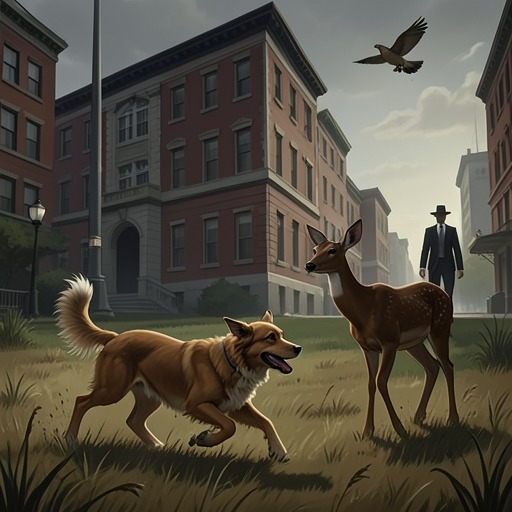
In one hunt, Arguto and Teresina respond to the scent of prey. Their poised movements hold the scene before a rabbit crosses the grass and the hunters fire. Arguto brings the animal to Don Fabrizio, who regards it with compassion even as he has participated in its killing. The episode places the dogs within a chain of pursuit and human feeling: they help make the hunt possible, while the Prince’s response to the animal’s death complicates the pleasure he takes in shooting. The passage does not give the dogs human reflection; it attends instead to their trained alertness and the physical sequence of the hunt.
Afterward, Don Fabrizio and Don Ciccio rest beneath cork trees, share food, and feed hunks of bread to the dogs, which stand before them. The animals’ presence belongs to the immediate practical texture of the outing, alongside the wine, chicken, cakes, and grapes. As the men doze, the dogs also sleep, while ants continue moving across the ground. The contrast sets human and canine rest within a landscape whose other forms of life continue without regard for political events.
Comfort and Its Limits
The narrative makes a distinction between general gloom and a specific problem. When Don Fabrizio’s distress is vague and metaphysical, a dog’s affection can genuinely relieve it. But when a defined difficulty demands action, such as a painful letter or an unpleasant meeting, canine devotion cannot solve the problem. The distinction gives the dogs emotional importance without making them an all-purpose remedy: affection can ease a state of mind, but it cannot substitute for confronting a particular obligation.
Bendicò’s return to familiar companionship marks the Prince’s recovery of good humour. Their garden walks resume after a period when the dog’s attempts to engage him would have been ineffective. The account emphasizes the difference between the animal’s energy and the Prince’s preference for repose, then finds contentment in their unsuccessful efforts to convert one another. Their bond offers a modest counterpoint to the Prince’s broader disappointments, not an escape from them.
Memory and Narrative Significance
When Don Fabrizio takes stock of his life near its end, dogs appear among the memories he counts as its genuine pleasures. He recalls Fufi, the fat pug of his childhood; Tom, an impetuous poodle and confidant; Speedy, remembered for gentle eyes; Bendicò, associated with affectionate nonsense; and Pop, a pointer then searching beneath bushes and garden chairs for a master he will never see again. The sequence makes the dogs distinct rather than interchangeable: each name attaches companionship to a particular period or quality, and Pop’s search brings that accumulated affection into the Prince’s present absence.
The remembered dogs stand among other entries in the Prince’s private balance sheet, including hunting, family, scientific work, and life at Donnafugata. They do not reverse the losses or resolve the uncertainty that shadows his final reflections. Instead, the shift from living companions to remembered ones gives the motif its quiet force: the dogs have shared the recurring routines of his life, and their loyalty is real, but time eventually separates even the closest household companions. Bendicò’s central place in that pattern makes the dog both a participant in the Prince’s daily world and one of its most enduring images in memory.