Don Fabrizio Corbera, Prince of Salina
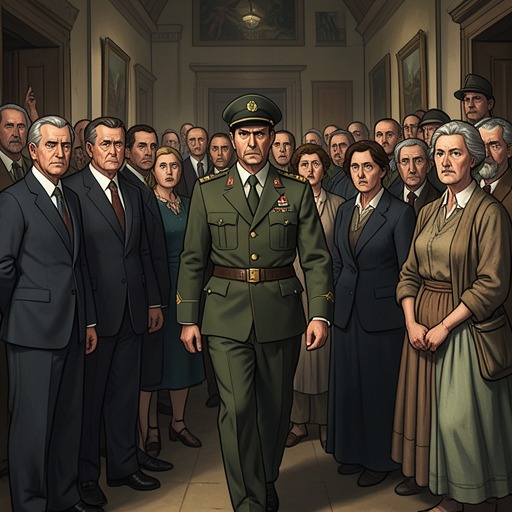
The LeopardDon Fabrizio Corbera, Prince of Salina, stands at the meeting point of aristocratic authority and its impending eclipse. In 1860 he can read the political weather, arrange a marriage that joins old nobility to new wealth, and recognize the limits of both the Bourbon monarchy and the coming Italian order. Yet his intelligence does not become a program of rescue: he watches his class and inheritance decline, lends support to changes that may prolong their life, and finally declines a place in the new Senate.
Identity and Background
Don Fabrizio is the first and last member of his family with a genuine aptitude for mathematics. He applies it to astronomy, earning official recognition and personal pleasure, and discovers two small planets, which he names Salina and Speedy after his principal estate and a beloved shooting dog. The discoveries seem to offer his family a future fame beyond Earth, turning the villa’s flattering frescoes, in his imagination, into prophecies. His scientific pride is thus at once sincere achievement and a private counterweight to the visible ruin of his inheritance.
His temperament carries the marks of both parents. His mother, Princess Carolina, was German-born, proud, and intellectual; his father was sensual and irresponsible. In Don Fabrizio, the maternal inheritance takes the form of authoritarian habits, moral rigidity, and a taste for abstraction, altered by Palermo society into capricious arrogance, recurring scruples, and contempt for relatives and friends whom he sees as drifting with Sicilian pragmatism. Torn between those inheritances, he lives in discontent, watching the decline of his class without making, or wanting to make, an effort to save it.
The Prince’s body makes his lordship tangible. His enormous frame can shake a floor, and in ordinary houses his head would reach the lowest ornament of a chandelier. He is strong enough to bend a coin and, in controlled fits of anger at table, to twist silver forks and spoons into hoops. The same hands, however, can handle delicate instruments with care: in his observatory, the screws and lenses of his telescopes receive gentle attention. His height and strength therefore coexist with precision, whether he is handling astronomical equipment or exercising authority over the household.
Science, Religion, and Mortality
Astronomy gives Don Fabrizio both intellectual discipline and a vantage point beyond the immediate disorder of political life. He and Father Pirrone can resume the work of preparing a report for the observatory at Arcetri after a tense disagreement about the anticipated dispersal of Church property. For the Prince, the predicted return of comets is no supernatural warning: their punctual appearance demonstrates the mind’s ability to calculate and participate in the ordered motions of the heavens. From the observatory, the everyday violence of animal life and human appetites seems to merge into a larger, tranquil pattern.
His account of the Church’s future reveals how sharply he distinguishes institutions that claim eternity from classes that cannot. The Church, he argues, has been promised immortality and must therefore concern itself with remote generations; his social class has no such guarantee. Any reprieve that gives it another hundred years is, from its limited human perspective, almost eternity. He accepts that the Church might preserve itself by sacrificing the aristocracy, and regards that choice as justified by its different timescale. His reasoning is disillusioned but not simply irreligious: he acknowledges the Church’s enduring horizon while measuring his own obligations by what he and his descendants might actually live to see.
Authority and the Bourbon Court
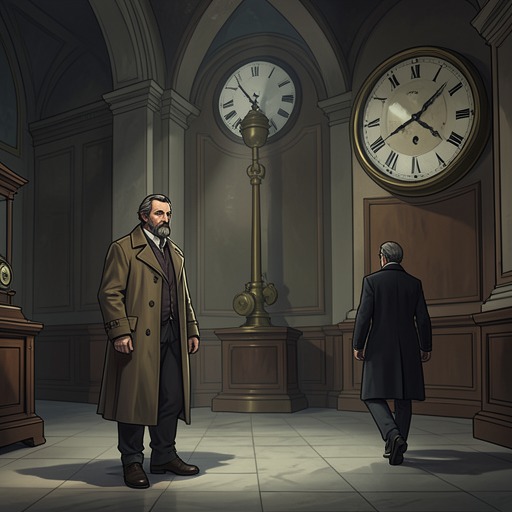
Don Fabrizio’s relationship with royal power is shaped by personal access without political trust. His repeated audiences with Ferdinand II of the Two Sicilies carry him through grand rooms, shabby passages, and waiting chambers before he reaches the King’s modest study, where papers await the royal signature. The setting makes government appear less majestic than its ceremonies suggest: the sovereign is the final point in an administration reduced to documents and personal favor.
The King moves between familiarity and command. He asks after Don Fabrizio’s daughters, praises his scientific reputation while warning against science that attacks religion, and then tests him for information about the Lieutenant-General of Sicily. Don Fabrizio offers guarded generalities rather than becoming a royal informant. When the King turns to Tancredi Falconeri, for whom Don Fabrizio is guardian, he warns the Prince to keep the young man out of danger. The exchange makes the limits of their intimacy plain: royal warmth can become a demand, and the Prince will not readily serve as an instrument of surveillance.
After leaving the audience, Don Fabrizio signs the royal book with his full name and title. He wonders what will replace a monarchy whose face seems already marked by death, but doubts that rule from Turin will alter the underlying condition: the dialect may change while the substance remains. Even the prospect of a republic associated with Mazzini offers no inviting identity; in that alternative, he imagines himself reduced to the plain status of Signor Corbera. He recognizes dynastic fragility without mistaking political replacement for social renewal.
Family, Marriage, and Social Change
Don Fabrizio’s guardianship of Tancredi becomes a practical test of his adaptability. Tancredi’s carefully prepared letter tells his uncle that he has fallen in love with Angelica Sedàra and asks him to approach her father, Don Calogero Sedàra, on his behalf. The letter joins ardent declarations to an argument for the union of families such as the Falconeri and the Sedàra: new blood should enter old houses, and class divisions should be leveled. Don Fabrizio enjoys this political argument because it confirms his own predictions, but he also admires Tancredi’s tact in placing it on a separate sheet that could be withheld from readers of the more conventional declaration.
The request pleases him for reasons that are emotional and material at once. The marriage promises Tancredi an outlet for desire and lasting financial security, while the alliance confirms that old aristocratic families must accommodate new wealth. At the same time, Don Fabrizio is embarrassed by the intimacy of negotiating with Don Calogero and uncomfortable at having to proceed with the caution and cunning the task requires. His support is neither a simple surrender of rank nor an attempt to preserve it unchanged; he helps turn social upheaval into a marriage that may keep the old name in circulation.
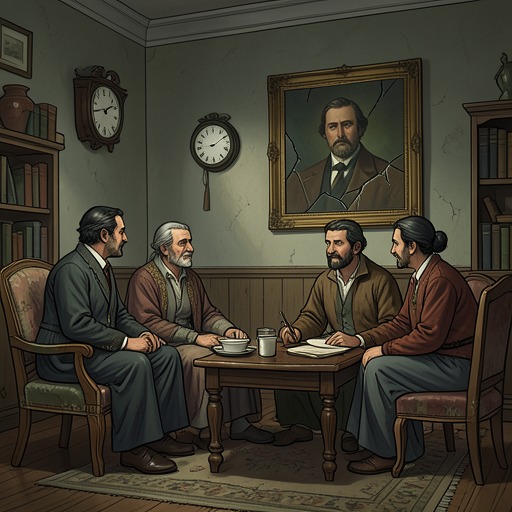
At the marriage discussions, he presents the Falconeri lineage as having survived successive rulers and expresses confidence that it will prosper under the new dynasty from the mainland. The long genealogy asserts inherited prestige, while his assurance that Angelica will adorn the family acknowledges the importance of her beauty and her father’s position. He also vouches for Tancredi’s essential goodness. Father Pirrone knows the young man’s failings and privately understands that the Prince’s praise leaves out grounds for doubt, but religious and worldly considerations keep him from contradicting it. Don Fabrizio’s public guarantee thus helps the match proceed while revealing how family strategy depends on selective speech.
Revolution and the Refusal of Office
The Donnafugata plebiscite gives Don Fabrizio a concentrated view of political change as public ceremony. The announced figures record 515 voters, 512 votes cast, 512 in favor, and none against. Applause, speeches, fireworks, and messages to the new King and the General fill the square; Angelica claps from her balcony. By eight o’clock the celebration is over, and the town has returned to darkness. The numerical unanimity and the speed with which the spectacle disappears leave the Prince with a disquiet that is not, he insists to himself, a straightforward matter of lost privilege. He feels instead that someone or something has died in a hidden corner of the popular conscience as Italy is born in Donnafugata.
That unease informs his response when Cavaliere Aimone Chevalley di Monterzuolo brings the Turin Government’s proposal to nominate him to the Senate. The offer rests on his ancient name, scientific standing, and conduct during recent events. Don Fabrizio first asks what a senator actually does; if the position were only an honorific, he says, he would be glad to accept in order to signal unity. But he distinguishes supporting the new state from participating in its construction. In his view, too much has been set in motion since Giuseppe Garibaldi landed at Marsala without consulting the old ruling class for its members now to be asked to carry the project forward.
He explains that centuries of foreign rule have shaped Sicilians into people accustomed to division and self-protection. The landscape, climate, monuments built by others, successive rulers, and taxes spent elsewhere have produced a character conditioned by events outside local control and by an inward insularity. He believes a Sicilian might escape that formation by leaving the island very young; by twenty, the habits are already set. His account is a diagnosis of historical constraint, but it also supplies the reasoning behind his withdrawal.
Don Fabrizio declines the nomination as a man compromised by the Bourbon regime, bound to it by decency if not affection, and suspended between old and new worlds. He considers himself an inexperienced legislator without the self-deception required to guide others. Rather than lend the Senate his name, he recommends Don Calogero, whose practical power, political usefulness, and ability to manufacture public illusions make him, in the Prince’s judgment, better suited to the role. The recommendation completes his characteristic response to change: he sees the new political order clearly enough to identify its effective operators, but chooses to stand aside rather than become one of them.