Don Fabrizio–Don Calogero Sedàra relationship
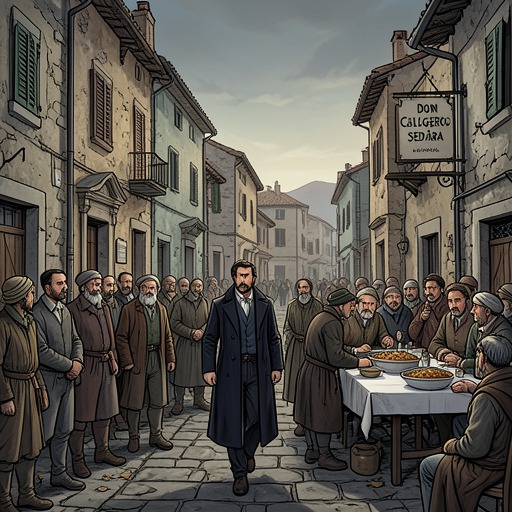
The LeopardThe relationship between Don Fabrizio Corbera, Prince of Salina, and Don Calogero Sedàra turns a marriage negotiation into an encounter between an old aristocracy and a rising local power. At first each man reads the other through the limits of his own class: Don Fabrizio sees a coarse, acquisitive newcomer, while Don Calogero expects a pliable noble whose name and standing can be put to use. The match between Tancredi Falconeri and Angelica Sedàra draws them into sustained negotiation, but the result is more than a family alliance. It reveals how inherited prestige, money, political usefulness, and personal regard can reinforce one another even as the old order loses its command of events.
Unequal Standing and First Impressions
Don Fabrizio enters the relationship with the authority of lineage and rank; Don Calogero has the local influence and practical intelligence that the Prince increasingly recognizes as a new kind of power. The contrast is sharpened by Don Calogero’s appearance and manner, which initially jar against the standards of dress and social conduct Don Fabrizio takes for granted. The Mayor, in turn, approaches the aristocracy with the habits of a man accustomed to buying and selling: he has regarded nobles as people whose land, names, and prestige might be acquired or used. To him, the social distinction of a family can look less like an inviolable inheritance than a resource.
Their positions are not simply opposites. Don Fabrizio’s authority is real but increasingly difficult to translate into control, while Don Calogero’s practical influence is rising. The Prince has relied on royal access and inherited standing; Don Calogero is alert to the material and political opportunities opened by change. The difference comes into view at the Donnafugata vote. Don Fabrizio gives his yes vote into Don Calogero’s hands, and the Mayor later announces a result of 512 votes cast in favour and none against. The episode places the Prince inside a civic process administered by a man whose authority is grounded in local power, and it foreshadows the alliance’s wider negotiation between old status and new influence.
The Marriage Negotiation
The prospect of a match between Tancredi and Angelica brings the two men face to face as prospective relatives. Before approaching Don Calogero, Don Fabrizio weighs whether Tancredi has made a definite proposal and whether his daughter Concetta has mistaken the young man’s attention for love. He also considers the practical question of marriage: the unequal division of the Salina fortune among seven children would leave Concetta with the smallest share, while Tancredi needs money to sustain his prospects. Don Fabrizio’s private calculations place affection alongside family resources and social strategy, rather than treating the choice as a matter of romance alone.
When Don Calogero confirms that Angelica returns Tancredi’s affection, Don Fabrizio’s response is warmly physical and immediate: he rises, embraces the Mayor, and imagines the security and opportunities the marriage could give his nephew. His enthusiasm does not erase the social distance between them. In praising the Falconeri lineage, he traces its long history under successive dynasties and presents Angelica as a bride who will adorn an ancient family. The compliment affirms the prestige that Don Fabrizio can offer, but its ceremonious form also makes the negotiation a contest over what each family brings to the union.
Don Fabrizio speaks for Tancredi as guardian as well as uncle. He acknowledges that Tancredi’s father squandered the family patrimony, naming estates, plantations, and a palace that have been lost. During his guardianship, he says, he managed to preserve the villa near his own, though it is in poor repair. He presents Tancredi’s charm, ambition, and understanding of people and the times as qualities that can compensate for financial decline. In this account, the Prince offers more than a name: he vouches for the young man’s character and future, while recognizing that money will be needed to make that future viable.
Property, Prestige, and Mutual Terms
Don Calogero answers with an offer whose scale surprises both Don Fabrizio and Father Pirrone. He proposes to assign Angelica the Settesoli estate, comprising 644 salmi, or 1,010 hectares, together with 180 salmi of olive groves and vineyards at Gibildolce. He also promises twenty linen sacks of gold, each holding 10,000 ounces, on the wedding day. The details make the new family’s material strength unmistakable. Don Fabrizio’s initial revulsion at the bluntness of the arrangement is tempered by Angelica’s beauty and Tancredi’s charm, which allow him to imagine the bargain as a marriage of affection as well as resources.
The negotiation is reciprocal, though the resources exchanged are different. Don Fabrizio contributes the Falconeri name, his guardianship and endorsement of Tancredi, and the social prestige of the Salina connection. Don Calogero contributes estates and a fortune large enough to repair the young couple’s financial prospects. He also hopes to secure recognition for his own family: he tells the Prince that the Sedàra have documents establishing a title, and that the bridegroom will be known as marrying the Baronessina Sedàra del Biscotto. Don Fabrizio’s account of ancient lineage and Don Calogero’s claim to documented nobility thus meet across the marriage contract, each man seeking to make his family’s standing more secure.
From Appraisal to Respect
As meetings about the contract become more frequent, Don Fabrizio’s judgment of Don Calogero changes. He grows accustomed to the Mayor’s accent, clothes, and unpolished appearance, and begins to recognize his unusual intelligence. Problems that have seemed difficult to the Prince are settled quickly by Don Calogero, whose directness frees him from the restraints of politeness and scruple that shape aristocratic conduct. Don Fabrizio continues to prefer the inherited manners of his own world, yet cannot help admiring the force with which Don Calogero advances through practical affairs.
Don Calogero’s view changes as well. Tancredi has already shown him that a young noble can bargain as cynically and effectively as a man of business, while disguising calculation beneath grace. Don Fabrizio presents a different kind of aristocratic strength: alongside a tendency to yield ground and a lack of self-protection, he has an inward energy, good manners, and an attraction that cannot be reduced to what he can take from others. Don Calogero learns to see courtesy not as useless ornament but as a way of easing social encounters and sometimes obtaining better results. His gradual refinement is not a sudden conversion to the Prince’s outlook; it is a practical adaptation shaped by sustained contact.
That contact has consequences beyond the marriage itself. Don Fabrizio shares information about his complicated affairs, which he has neglected partly because he considers such matters beneath him and has been able to meet difficulties by selling land. Don Calogero’s advice proves useful, but the Prince applies it less harshly than its conception warrants. Over time, the Salina acquire a reputation for exploiting their dependants, a reputation the narrative calls unjustified but damaging to their standing at Donnafugata and Querceta; it does not prevent the family’s financial decline. The relationship therefore brings practical counsel and mutual influence, but not a remedy for the structural loss of Salina power.
Political Consequence and Lasting Significance
Later, Don Fabrizio recommends Don Calogero for a seat in the Senate, judging him better qualified than himself. He points to the Mayor’s power, practical abilities, and usefulness during the May crisis, as well as his ability to create political illusions when needed. The recommendation is at once an act of recognition and an acknowledgment of changed circumstances: the Prince can still identify the qualities required by the new political order, but believes those qualities belong more fully to the man who has risen outside the old aristocracy. Don Calogero does in fact enter the Senate ten years later.
Their relationship ends neither in equality nor in the disappearance of class distinction. Don Fabrizio remains capable of valuing what Don Calogero can do, while Don Calogero absorbs some of the manners and social understanding that aristocratic life has cultivated. Through the marriage, their families exchange resources and status; through repeated dealings, the two men revise their first judgments of one another. The alliance captures the book’s larger transition: the old nobility can still lend prestige and shape a negotiation, but wealth, local influence, and practical political skill increasingly determine who will prosper.