Don Fabrizio–Don Ciccio Tumeo relationship
The LeopardDon Fabrizio Corbera, Prince of Salina, and Don Ciccio Tumeo share a relationship shaped by affection, social deference, and political disagreement. The Prince values Tumeo’s loyalty and dignity, but their bond changes most decisively when Tumeo tells him that he voted against unification and that the official result concealed his choice. In listening, the Prince recognizes not only a personal wrong but the destruction of the good faith on which the new political order ought to rest.
A Patron and a Dependable Companion
The relationship begins within the hierarchy of Donnafugata. Don Fabrizio is the great landowner; Tumeo is a poor organist of the Mother Church, known to the Prince through their shared hunting and the favors and regard that bind a dependent to his patron. Tumeo is deferential, but his respect is not merely a performance: his memory of the old royal household and its assistance to his family gives loyalty a personal and material history. His father had served as a gamekeeper, and Tumeo recalls the royal livery, the King’s attention, and five gold ounces sent to his family in a time of need. The Prince’s own kindness belongs to this web of protection, though the two men understand that arrangement from unequal positions.
The Prince’s affection for Tumeo has more than one source. He feels compassion for a man who had imagined himself devoted to the arts and, in old age, continues as an organist despite the disappointment of those ambitions. He is also touched by Tumeo’s poverty and the dignity with which he bears it. These feelings are sympathetic, but they remain filtered through the Prince’s aristocratic perspective: he thinks of Tumeo partly as a type, a poor and loyal dependent. Tumeo’s disclosure will make that familiar figure more morally independent in the Prince’s eyes.
The Vote and the Hidden Injury
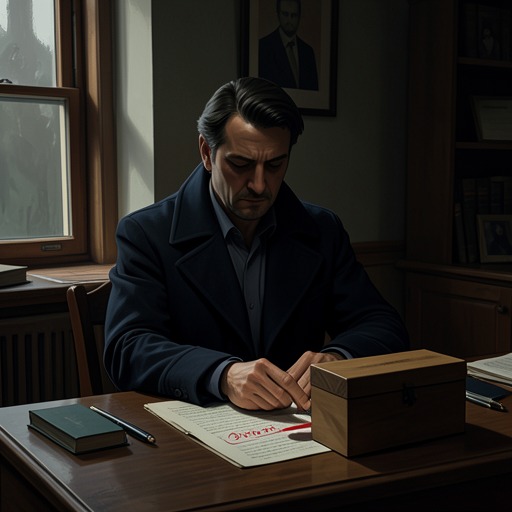
During the Donnafugata plebiscite, Don Fabrizio votes yes. At the Town Hall, Don Calogero Sedàra receives the Prince’s ballot, and the voting is publicly announced as 512 votes cast, all 512 in favor, with no votes against. Later, while the Prince and Tumeo are out together, Don Fabrizio asks how Tumeo voted. Tumeo is surprised by the question; the Prince mistakes his reaction for fear and urges him not to be afraid. The exchange shows how the Prince’s authority can shape even a private conversation: Tumeo has to find his way outside the customary caution that he shares with the other townspeople.
Tumeo then says that he voted no. He explains that his choice was swallowed up and recorded as the opposite, as though his opinion and even his existence did not count. He identifies Don Calogero as the man responsible for this erasure. His protest is also a statement about his own moral standing: he is poor, he says, but honest, and he remembers favors done to him. His old allegiance to the Bourbons has made him a target of suspicion in the changed political climate, despite the fact that he regards loyalty as a debt grounded in actual help received, not an abstract political label.
For Don Fabrizio, the revelation solves the unease he has felt about the announced result. He understands that the injury is not that Tumeo’s single negative vote could have altered the outcome; it is that the vote was falsified when it could have been counted honestly. The Prince imagines that numerous dissenting votes would still have left the result decisive, but their honest inclusion would have spared the voters’ consciences. He comes to see Tumeo’s experience as part of a larger political wrong: the new order has damaged the good faith it ought to have nurtured. He also wonders whether Tumeo has behaved more nobly than he has.
Candor Within an Unequal Bond
Tumeo’s speech does not dissolve the social distance between the two men. After voicing his indignation, he becomes anxious that his words may have displeased the Prince. The narration characterizes this deference as a form of passive snobbery: Tumeo values the approval of those he considers socially superior and tries to restore the Prince’s good humor by suggesting that they resume hunting. His candor and his wish to please coexist. He can condemn the falsification and still feel responsible for easing the discomfort of the man before him.
Don Fabrizio, in turn, does not answer Tumeo’s accusation with a rebuke. His regard deepens into admiration, although it remains entangled with the habits of class. He continues hunting with Tumeo, and both men shoot with particular accuracy at birds and a rabbit they have come to associate with Don Calogero. Yet the sport does not relieve the Prince’s apprehension about the Mayor. He wants to know what people in Donnafugata think of Don Calogero, and asks Tumeo again for his judgment. Tumeo hesitates: he has already spoken against the Mayor, but rumors that Tancredi Falconeri is courting Angelica Sedàra make him wary of saying anything the Prince might dislike. Even in private, their relationship is tested by Tumeo’s awareness of the Prince’s interests and by his own wish not to offend him.
Respect, Dependence, and Political Change
The episode involving Don Calogero’s visit makes the limits of their intimacy especially clear. While the Mayor is with the Prince, Tumeo waits in the dark gun room. After the visit, Don Fabrizio goes to release him and apologizes, explaining that the situation required it. Tumeo accepts the explanation and asks whether everything went well. The exchange is brief, but it holds their relationship in miniature: the Prince can exclude Tumeo from a consequential conversation, then acknowledge the imposition; Tumeo understands the necessity and returns to the practical courtesies of their association. Affection does not erase the hierarchy that governs access and decision-making.
The relationship’s central change is therefore a change in the Prince’s understanding. He has long liked Tumeo for his modesty, artistic disappointment, and poverty; after hearing about the erased vote, he also recognizes him as a man of principle whose political voice was deliberately suppressed. Tumeo’s attachment to the old monarchy and his rejection of the new result are not simply signs of backwardness. They arise from remembered obligations and an insistence that a vote should mean what the voter chose. Their bond reveals how private loyalty can preserve a space for candor, while also showing how patronage and deference constrain it. For Don Fabrizio, the encounter turns affection into moral self-questioning; for Tumeo, it permits a rare protest without ending the dependence and respect that continue to define his relation to the Prince.