Donnafugata
The LeopardDonnafugata is the Salina family’s Sicilian seat, a town and estate where the apparent continuity of local life meets the political and social changes of 1860. The Prince returns to a palace associated with childhood, family memory, and familiar customs; yet the reception he receives, the plebiscite held in the town, and the new relationships forming within the palace reveal how much has shifted beneath that sense of permanence.
Setting and the Salina Palace
In August 1860, Don Fabrizio Corbera, Prince of Salina, approaches Donnafugata after a journey of more than three days along roads described as little more than rutted, dusty tracks. The journey has unsettled him: its discomfort has prompted bleak reflections on the course of his life. As the town nears, however, the prospect of the palace changes his mood. Its fountains, memories of saintly ancestors, and association with an almost everlasting childhood make it seem like a refuge from the journey and from historical change. He wonders whether the people will be as devoted as before, and the welcome gives him reason, at first, to think so.
The palace stands beside the Mother Church. Its modest square-facing façade has seven windows, while the buildings extend about three hundred yards behind it, arranged around three large courtyards and ending in a garden. The complex gathers buildings of different styles into a harmonious whole, making its scale invisible from the town square. Its physical depth also gives the estate a quality of self-containment: public ceremony takes place at its entrance, while family life and memory unfold within its courtyards and rooms.
Return and Public Welcome
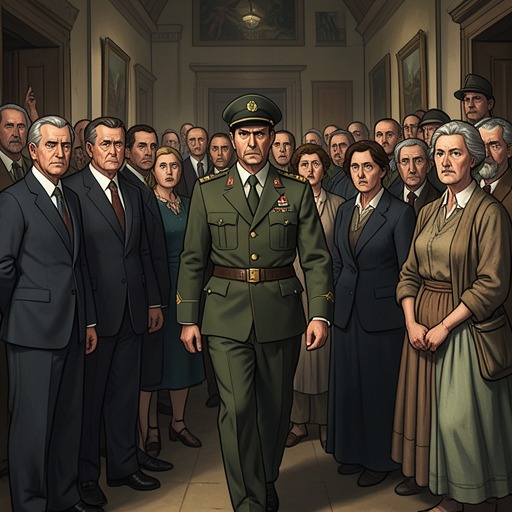
Beyond the short bridge into town, local authorities and a crowd of peasants wait for the arriving family. The municipal band greets them with music, and the bells of the Mother Church and the Convent of the Holy Ghost join in after a child gives the signal. The welcome is ceremonious but locally specific. Don Calogero Sedàra appears as mayor with a new tricolour sash; other civic and religious officials stand beside him, while Don Ciccio Tumeo, the cathedral organist and the Prince’s hunting companion, has come despite not officially belonging among the authorities. Tumeo brings his red pointer, Teresina, and the Prince rewards the gesture with a smile.
The peasants watch quietly, with curiosity rather than hostility. Their affection for the Prince is connected to his tolerant treatment of them and to his habit of forgetting to collect small rents. The leopard emblem familiar from the palace façade, church front, fountains, and household tiles becomes, in the arrival scene, a living figure: the Prince moves among the people, shaking hands with friendly ease. Tancredi Falconeri also attracts attention. The townspeople now see him not simply as an unconventional young aristocrat but as a liberal associated with Rosolino Pilo and a wounded participant in the Battle of Palermo. He jokes with the crowd, speaks in dialect, and invokes Giuseppe Garibaldi with conspicuous reverence before walking away with his cousin Concetta Salina.
The Prince’s own manner is changing too. At his wife’s suggestion, he invites the mayor, the arch-priest, and the notary to dine that evening, then extends an invitation to Tumeo and to the family’s other friends. Such warmth is new for him. The welcome therefore marks a double adjustment: Donnafugata still receives its Prince according to familiar forms, but he responds with a sociability that would once have been out of character. The account connects this change to the gradual decline of his local prestige.
The Palace, Stewardship, and Political Change
At the palace gate, Don Onofrio Rotolo, the family’s local steward, conducts a separate reception. He has not joined the official greeting in town. Educated under Princess Carolina’s strict household regime, he regards ordinary townspeople as outside his sphere and considers the Prince to be away until he crosses the palace threshold. Rotolo waits precisely two steps outside the gates, accompanied by his younger wife, servants, and eight armed rangers wearing gold leopard insignia. He formally welcomes the family home and reports that the palace has been returned in the condition in which it was entrusted to him.
The Prince esteems Rotolo as one of the rare people who has never cheated him. The steward’s honesty is presented as almost compulsive: a small quantity of rosolio once left behind by the Princess remained untouched for a year, even as it evaporated. Rotolo’s reasoning treats even this remnant as part of the Prince’s property. His exacting stewardship contrasts with the shifting public world outside the gates, while his threshold rule makes the palace a boundary between a tightly ordered household and a changing town.
That change becomes starkly visible during the plebiscite on unification. On a windy, grey day, youths circulate with papers marked yes, while songs and political rhetoric meet the silence of overworked or unemployed peasants. The Prince later recalls that the Girgenti visitors addressing the townspeople seemed to give arithmetic precedence over rhetoric, a perception that foreshadows the official result. The count announced from the Town Hall is 512 yes votes and no votes at all, from 512 recorded voters, although the reported number of voters is 515. Applause, speeches, fireworks, and messages to the new King and to the General briefly fill the square; by evening, the celebration has given way to the ordinary darkness of the town.
The outcome sits uneasily beside the evidence of local dissent. Don Fabrizio has reason to expect some negative votes, and people he encounters have expressed reluctance to endorse the new national order. Women, excluded from voting, appear in the square wearing tricolour ribbons as a protest; they are jeered at and forced away. A newspaper later describes their appearance as a patriotic demonstration met with great acclaim. Donnafugata thus becomes the setting for a public performance of unanimity that conceals disagreement and even rewrites the reception of protest. The pageantry of political change does not resolve the town’s divisions; it makes the gap between official account and lived experience visible.
Seasonal Return and Narrative Significance
In November, the family’s return from Donnafugata to Palermo is postponed after Angelica Sedàra’s arrival, and two weeks of enchantment follow. The season is St Martin’s summer, a brief interval of mild weather that gives the palace a different atmosphere from the civic spectacle of August. Its old rooms and rococo decoration seem newly animated by the presence of young people in love. The account recalls that, roughly eighty years earlier, the palace had hosted private pleasures that later household severity and the religious fervour of the Restoration drove from view. Angelica’s arrival stirs that dormant quality, and the arrival of two young men in love makes it more palpable throughout the building.
The palace’s rooms and architecture therefore register changes that the formal world of the town cannot express as directly. Tancredi’s engagement to Angelica, and Count Carlo Cavriaghi’s unreturned love for Concetta, give the household’s autumn a charged private life, while the rooms and fountains provide its setting. The contrast with the plebiscite is telling: in the square, public language declares an unbroken national consensus; inside the palace, desire and family expectations are in motion, though still restrained by convention. Across both seasons, Donnafugata appears familiar enough to promise continuity, but its receptions, vote, and altered household atmosphere show that continuity is already under strain.