Father Pirrone
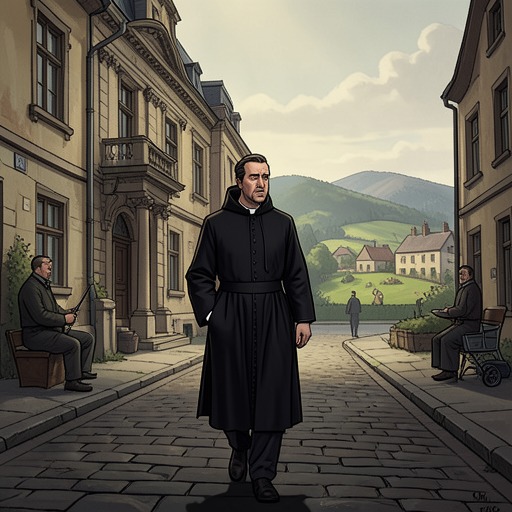
The LeopardFather Pirrone is the Jesuit priest within the Salina household, a figure positioned between private devotion and public upheaval. He attends to religious practice, presses Don Fabrizio Corbera, Prince of Salina, to take confession seriously, and warns that political change may strip the Church of property on which poor people depend. His role is not to resolve the Prince’s political doubts, but to give them a distinctly religious and social counterpoint.
Religious Practice and Household Life
During the family’s daily Rosary, the Prince’s steady recitation leads the household through the prayers. When the voices fall silent and the room returns to its ordinary order, Father Pirrone remains absorbed in extra prayer, his soutane covering the painted figure of Andromeda. The moment places him within the household’s devotional routine while also marking a difference: as others rise and return to domestic life, he continues praying.
His clerical life also includes intellectual work. In the observatory, he is immersed in algebraical formulae beside the Prince’s telescopes and lenses. The scene presents religious and scientific practices sharing the same space, without suggesting that one displaces the other. Father Pirrone’s attention to his calculations is interrupted by the Prince, and their conversation turns from study to confession and conscience.
Confession and His Relationship with the Prince
The Prince initially appears surprised when Father Pirrone asks whether he has come to confession, having forgotten an earlier episode between them. He then treats the priest’s knowledge of his sins as if it made confession unnecessary. Father Pirrone rejects that reasoning: confession requires not only disclosure but sorrow for wrongdoing. His insistence distinguishes knowing a person’s faults from securing that person’s repentance, and makes religious accountability more than a private exchange of information.
The disagreement is personal as well as doctrinal. Father Pirrone has been humiliated by the Prince, and his position in the brougham is physically uncomfortable: he is squeezed into a corner beside the Prince’s imposing bulk and subjected to his bullying. Yet he knows the Prince’s disinterested kindness as well as his rages, and genuinely likes him. After the Prince shares his political intuitions, Father Pirrone asks him to hear the Church’s case; the earlier tension eases, though their underlying disagreement remains. His willingness to speak frankly coexists with caution about offending someone to whom he is attached.
Reading the Political Crisis
On the journey toward Palermo, Father Pirrone echoes the Prince’s sense that the times are troubled, then points out the rebel bands’ nightly bonfires on the heights around the Conca d’Oro. He sees them as ominous signs directed at the city of palaces and convents. The Prince imagines that Tancredi Falconeri might be among the rebels, but Father Pirrone’s contribution is to frame the fires in historical and religious terms: they threaten not only a political order but a city whose character is shaped by its religious houses.
In the observatory, he gives that concern a sharper institutional form. He warns that nobles may make common cause with Liberals and Freemasonry at the Church’s expense, allowing its property to be confiscated and divided among ambitious leaders. For Father Pirrone, this property is also a resource sustaining the poor under the Church’s guidance. He fears that social desperation will eventually bring the transfer of the Salina estates as well, and interprets that possible redistribution as justice arriving by unexpected means. His argument therefore joins concern for the Church’s material position to concern for the destitute it supports, even as it reveals how closely religious authority and property are bound together.
The Plebiscite and Political Change
At the Donnafugata vote, Father Pirrone accompanies the Prince to the Town Hall but does not vote: he has avoided being registered as a resident of the town. After the Prince casts his vote, the priest declines the invitation to drink with the party upstairs, citing abstinence, and remains below with Don Onofrio Rotolo. The result is announced as 512 votes cast in favor and none against. Father Pirrone is not shown intervening in the count; his absence from the ballot and from the celebration instead marks the limits of his participation in the new civic ritual.
Across these episodes, he serves as a religious interlocutor rather than a political strategist. He notices the danger facing the Church, speaks for the poor who depend on it, and maintains a personal bond with the Prince without simply endorsing his judgments. His faith gives the upheaval a moral vocabulary, but does not exempt him from its uncertainty: he can foresee the loss of ecclesiastical property while recognizing that the existing order’s defenders may themselves be implicated in the change.