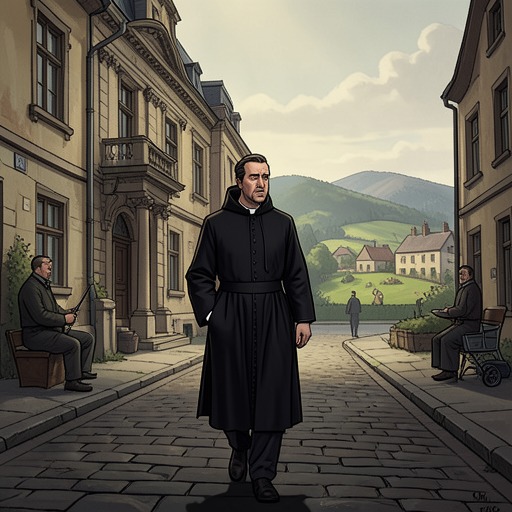
Father Saverio Pirrone
The LeopardFather Saverio Pirrone, a priest of the Society of Jesus and the Salina family’s spiritual adviser, stands between the aristocratic world he serves and the rural life from which he came. His story links religious duty to the practical compromises of family and politics: he counsels the Prince, knows the private weaknesses of Tancredi Falconeri, and eventually has to apply his learning to disputes among his own relatives. He does not resolve these pressures through grand declarations. His characteristic response is measured judgment, tempered by affection and an acute awareness of what cannot safely be said.
Identity and Background
Pirrone was born at San Cono, a small hamlet separated from Palermo by a journey of four or five hours by cart. The distance is more than geographical: the village belongs to a local world whose rhythms and concerns differ from those of the city and the noble households in which Pirrone later lives. His father, Don Gaetano, worked as an overseer of two properties claimed by the Abbey of Sant’ Eleuterio. He survived the dangers associated with that occupation through discretion and caution, and died of pneumonia, leaving his widow and three children—two daughters and Pirrone—relatively secure by local standards.
That security rested on modest holdings rather than great wealth. Don Gaetano had saved from his meagre salary and owned almond trees, a few rows of vines, stony pasture, and a small square house at the entrance to San Cono. The family’s circumstances gave Pirrone a personal knowledge of rural life and limited means, unlike the inherited status of the Salina household. He nevertheless became a member of the Society of Jesus, an order whose traditions and institutional memory he describes as forming a world of its own. His position therefore joins two forms of belonging: the village origins he carries with him and the religious community in which he serves.
Counsel, Confession, and Marriage
Pirrone’s closeness to the Salina family puts him in a position of trust, but that trust does not make him a simple advocate for every choice the family makes. He had served as Tancredi Falconeri’s confessor and knew failings that complicated Don Fabrizio Corbera, Prince of Salina’s public assurance that his nephew possessed abundant goodness. Pirrone liked Tancredi, but disapproved of the proposed marriage to Angelica Sedàra. He also believed Tancredi’s conduct gave reason to expect future infidelity.
At the meeting where the marriage is discussed, Pirrone faces a conflict between knowledge and obligation. Sacramental confidentiality prevents him from disclosing what he knows; worldly prudence also weighs against saying anything that might obstruct the match or cloud its prospects. When the Prince asks him to support the claim that Tancredi will make a good husband, Pirrone does not expose his private reservations. Instead, he offers a carefully qualified blessing: Tancredi may become a good Christian husband if Divine Grace and Angelica’s virtues sustain him. The conditional phrasing lets him participate in the family’s hopes without pretending that his knowledge of Tancredi is uncomplicated.
His restraint is not indifference. Pirrone expresses joy in the Prince’s happiness and invokes God’s protection for the marriage, even while his private judgment remains doubtful. The gap between the two responses shows how he handles competing duties: affection for Tancredi, loyalty to the household, and the obligations of his religious office all remain active, but none permits him to say everything he knows.
Faith and the Social World
Pirrone’s learning gives him a language for interpreting differences that Don Pietrino, a man more familiar with medicinal plants than theology, finds difficult to follow. Recalling a conversation with the Prince in the observatory nearly a year earlier, Pirrone tries to explain why nobles respond so strongly to changes that might seem insignificant to outsiders. They inhabit a world shaped by centuries of specialized experience, shared memories, hopes, and fears about caste and inheritance. Their reactions, in his account, cannot be understood simply by measuring immediate material consequences.
He contrasts that inherited social world with Don Pietrino’s direct engagement with nature. The search for marjoram or Spanish flies, and the consultations of people seeking remedies, place the village healer among the natural possibilities of good and evil that exist before human choice. Pirrone sets this experience against his own membership in a religious order whose history and promised victory extend across generations. His explanation does not persuade Don Pietrino; the old man takes the priest’s abstract language as a sign that too much reading has unsettled him. The exchange makes visible both Pirrone’s effort to translate between worlds and the limits of that effort.
The priest’s religious outlook also registers the bewildering density of ordinary life. After hearing Don Pietrino complain that a mayor would make him pay for grass that God had created and he himself gathered, Pirrone reflects that the world must seem complicated to someone who knows neither mathematics nor theology. His response is prayerful rather than dismissive: only divine omniscience, he thinks, could have devised so many complications. Faith offers him a framework for acknowledging complexity, not a claim that human disputes are easy to settle.
Political Change and Practical Restraint
At the Donnafugata plebiscite, Pirrone accompanies Don Fabrizio Corbera, Prince of Salina, and Don Onofrio Rotolo to the Town Hall. He does not cast a ballot because he had taken care not to be registered as a resident of the town. His absence from the vote is thus presented as a matter of electoral status, not as a declared political position. The detail places him beside the ceremony of political change while keeping him outside its formal act of participation.
His conduct in the marriage discussion offers another example of how he navigates public and private pressures. He recognizes Tancredi’s faults but does not use his privileged knowledge to influence the outcome; at the polling place, he is physically present but does not vote. In both situations, the narrative shows him close to consequential events without turning him into their principal actor. His restraint is shaped by specific obligations—confessional secrecy in one case, his lack of local registration in the other—rather than by a general refusal to engage with the world around him.
Family, Later Life, and Narrative Role
In February 1861, Pirrone’s rustic origins become the setting for a return to his own family. His sister Sarina is among the relatives whose troubles he must face, and he becomes entangled in complicated, dangerous family quarrels. The account emphasizes that he eventually sorts them out with wisdom and kindness. It does not detail each dispute, but it shows that his practical judgment is not confined to advising nobles or interpreting social change. He must also bring it to bear on the ordinary conflicts of kinship, where religious authority, family interest, and human vulnerability meet at close quarters.
Pirrone draws broader conclusions from observing these miseries. That movement—from particular family difficulties toward general understanding—echoes his earlier attempt to explain the nobles’ collective memory to Don Pietrino. In both cases he seeks patterns that can make human behavior intelligible, while remaining attentive to the specific people involved. His role is consequently less that of a political strategist than of an interpreter and mediator, one whose religious learning is repeatedly tested against material circumstances.
Near the end of Don Fabrizio Corbera, Prince of Salina’s life, the Prince thinks of Pirrone as already gone, recalling him among the people and things that belong to a life slipping away. The passage gives no account of Pirrone’s death, but it marks his absence within the Prince’s final reckoning. Together with the later report that Pirrone settled his family’s quarrels, this retrospective mention frames him as a figure whose influence lies in patient acts of counsel and reconciliation. He cannot reconcile every contradiction around him; his importance is that he continues to work within them, guided by faith, loyalty, and prudence.