Palermo
The LeopardPalermo is the principal urban stage of political transition in the novel: a city where the monarchy gives way, the new national order makes itself visible, and the old elite continues its social rituals. Its streets shift from patrols and uncertainty to processions and celebration, but Don Fabrizio Corbera, Prince of Salina sees beneath these changes a society whose habits and hierarchies are unlikely to be remade. Palermo’s repeated contrast between public commotion and social persistence makes the city a setting for the novel’s meditation on change that leaves much intact.
City and Political Tension
Palermo appears first as a city unsettled by the uprising of 4 April. For more than a month, the Salina girls have been kept at home for safety rather than attending the Convent of the Holy Redeemer. The danger reaches even the royal household: when Don Fabrizio Corbera, Prince of Salina visits the King, the King warns him to keep Tancredi Falconeri from harm, reminding him of his responsibility as Tancredi Falconeri’s guardian. The exchange places private family obligations inside the weakening political order.
The King’s court has not lost its ceremony, but Don Fabrizio Corbera, Prince of Salina is already considering what may follow it. He wonders whether Piedmontese rule will differ in substance from the monarchy it replaces, or merely exchange one regional manner of speaking for another. Even a republic offers no reassuring alternative in his private reckoning. The question is not simply who will govern Palermo, but whether a change of rulers can alter the arrangements beneath the state.
A nocturnal journey through the city gives that uncertainty a physical setting. Near Villa Airoldi, a patrol stops the carriage, but a sergeant recognizes Don Fabrizio Corbera, Prince of Salina and lets it proceed. The route passes through the outskirts and enters Palermo by Porta Maqueda; at the Quattro Canti di Campagna, officers on guard eat and laugh, while elsewhere the deserted streets echo with patrols. Continuous monastery walls stand dark along the way, making the city seem withdrawn into sleep even as armed forces occupy its streets.
The journey continues on foot through a disreputable quarter, where soldiers slip away from patrols into houses and armed sentries fire nervously in the distance. By the Cala, decaying boats bob in the old fishing port. These glimpses do not present Palermo as a unified civic space: military presence, precarious livelihoods, and the routines of the old city coexist uneasily. The Prince’s passage through them links his private concerns to a public world already unsettled by political change.
Revolution and the New Public Order
In the months surrounding Giuseppe Garibaldi’s entry, Palermo’s visible life becomes exuberantly political. Don Fabrizio Corbera, Prince of Salina sees tricolour cockades, processions, speeches, and public demonstrations of enthusiasm. At first, the occupation’s drama is sharpened by wounded men in the main streets and the abuse of Bourbon police officers in side alleys. Once the wounded recover and some former police are absorbed into the new force, however, the continuing agitation seems to him increasingly empty and petty.
The political change reaches the Salina household materially as well as symbolically. Villa Salina is spared nearby gunfire, as Don Pietro Russo had predicted, but a service of Chinese porcelain disappears from the Palermo palace after Paolo, Duke of Querceta leaves it packed in cases in the courtyard during the shelling. The loss is attributed not to an abstract upheaval but to a particular failure of judgment amid the disorder. Political events enter domestic life through both public danger and the mishandling of household possessions.
Palermo also draws people into the new order through personal advantage and political connections. Don Pietro Russo, a local dependent whom Don Fabrizio Corbera, Prince of Salina regards as representative of an ascending class, voices support for the bold young men while disclaiming personal involvement. He anticipates the benefits of liberty, security, lighter taxes, and easier trade, and assures the Prince that friends will protect Villa Salina. At the same time, Don Pietro Russo is seeking to buy the Argivocale estate and has previously concealed baskets of the Prince’s lemons in his cellar. His assurances reveal a politics conducted through property, information, and private networks as much as through public ideals.
The Prince’s assessment of the transition is sharpened by his encounter with British naval officers shortly before Giuseppe Garibaldi enters Palermo. He takes them to the roof of his house overlooking the sea and the hills around the city. They admire the view but are appalled by the decay and filth in the surrounding streets. Don Fabrizio Corbera, Prince of Salina treats the landscape and the condition of the city as connected, and uses the encounter to explain his refusal to join politics: he believes that Sicilians regard themselves as already perfect, so that outside intervention threatens their self-image rather than prompting reform. His account is a judgment voiced by an aristocrat within the society he describes, not an external survey of the city.
Society, Class, and Public Ceremony
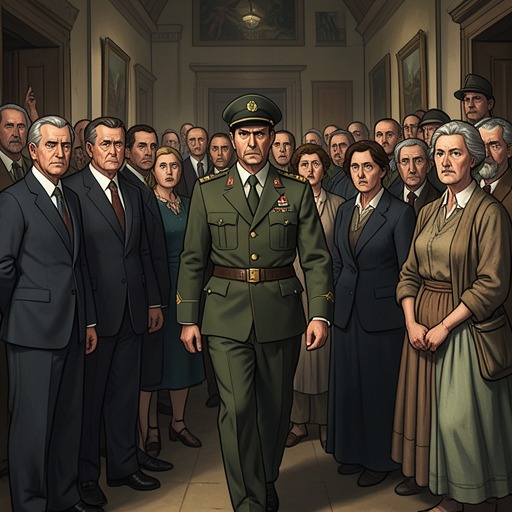
Palermo’s transition also produces a conspicuous new social performance. Don Fabrizio Corbera, Prince of Salina observes that nearly everyone appears pleased with the new order, while a small number of dissenters—including Màlvica, who is arrested by Garibaldi’s police, and Paolo, Duke of Querceta, who is more discreetly dissatisfied—stand apart. The mass display of enthusiasm suggests a rapid change in public allegiance, but the Prince doubts that it signals a corresponding transformation in social foundations. His suspicions are borne out in the relationships between established property, local influence, and the new political class.
Later, after the arrival of the Piedmontese and the Aspromonte affair, Palermo enters one of its recurring periods of social gaiety. The few hundred people who constitute its elite repeatedly meet one another to exchange congratulations on having survived. The Salina household moves to its town palace for three weeks so that it can attend the frequent balls without making the long drive from San Lorenzo each night. The season is both a continuation of aristocratic custom and a careful adaptation to the new political moment.
The ball at Palazzo Ponteleone makes the costs and opportunities of that adaptation visible. The Salina family arrives early to witness the entrance of Tancredi Falconeri and his intended bride, Angelica Sedàra, whom the family is presenting to Palermo society. It has taken effort to secure an invitation for the Sedàras, whose standing in the old social circle is uncertain; Princess Maria Stella of Salina has had to visit Margherita Ponteleone to help arrange it. The engagement therefore links families, but also exposes the small social barriers that the old aristocracy is reluctant to abandon.
At the ball, Angelica Sedàra follows Tancredi Falconeri’s advice by praising the hosts’ possessions with measured comparisons to celebrated works and collections. Her tactful performance earns her a reputation as a discerning art expert. Meanwhile, Don Fabrizio Corbera, Prince of Salina dislikes the palace’s unfashionable furnishings, though his criticism reflects a passing mood: he never makes comparable changes to his own residences. The scene juxtaposes the new bride’s quick social learning with the Prince’s awareness of his own inconsistency, while Concetta Salina and Carolina Salina remain shy among their partners.
The City in Later Life
Palermo remains central to the novel’s later account of mortality. After consulting a specialist in Naples, Don Fabrizio Corbera, Prince of Salina returns by land with Concetta Salina and his grandson Fabrizietto, enduring a slow, exhausting journey before reaching the Hotel Trinacria. On the hotel balcony, he faces the sea in the stillness of a Monday at the end of July and feels his life ebbing. The city is no longer primarily a theater of political change or social display: Palermo frames the Prince’s final recognition of his physical decline.
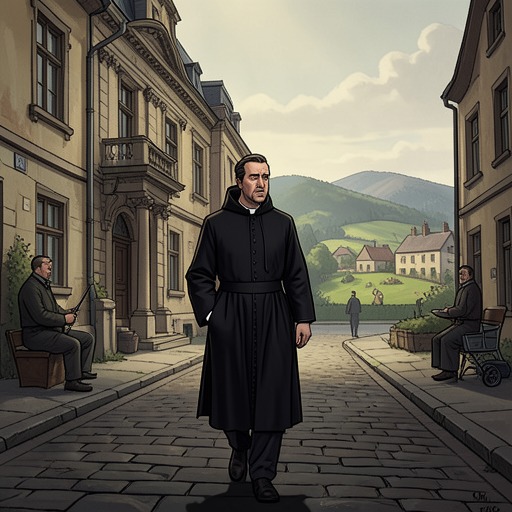
By 1910, the Salina household in Palermo is represented through its three unmarried older women and their religious establishment. Their separate confessors, a chaplain who celebrates Mass in the private chapel, a Jesuit spiritual director, and visiting clergy create a constant clerical presence at Villa Salina. During an inquiry, the arrival of the Vicar-General of the Archdiocese of Palermo is marked by his distinctive hat and glove, while the chaplain’s hat is set apart. Religious authority here is conveyed through household routine, rank, and formal investigation rather than through the political crisis of the earlier Palermo scenes.
The Cardinal of Palermo’s failed effort to reform the island’s spiritual life extends the city’s recurring pattern of attempted change and resistance. He initially tries to remove abuses in the clergy, but comes to believe that his interventions leave the system essentially as it was, while earning him a reputation as a fool. His later charity and faith are remembered, yet his reforming work has little lasting effect. Across the novel’s different periods, Palermo thus gathers both the spectacle of new regimes and the quieter persistence of inherited social and religious habits.