Rabbits
The LeopardRabbits in The Leopard are hunted animals whose appearances unsettle the boundary between sport and pity. One rabbit, killed during a morning outing near Donnafugata, becomes an object of the Prince’s compassion even as he recognizes his own part in its death. Its imagined hope of escape also gives the scene a human resonance; later, rabbits and other quarry become targets onto which the hunters project their hostility toward Don Calogero Sedàra. The animals remain prey, but the narration makes their vulnerability difficult to treat as incidental.
The hunt and the dying rabbit
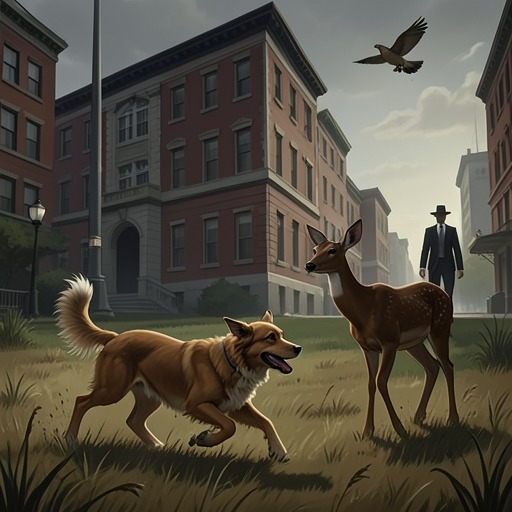
On a morning shoot, Don Fabrizio Corbera, Prince of Salina and Don Ciccio Tumeo climb the slopes with the dogs Arguto and Teresina. Near the top of a hill, the dogs’ alert, restrained movements signal that they have scented prey. Their pause holds the hunters in expectation; then a small rabbit slips through the grass, and two nearly simultaneous shots end the wait. Arguto brings the animal to the Prince’s feet. The sequence is precise about the hunt’s method and suspense, but the moment of capture changes its moral register.
The rabbit’s plain, dun-colored coat has offered no protection. As it dies, the Prince looks into its large dark eyes and reads there not reproach but astonishment at the ordering of things. Its paws still contract, a lingering sign of flight after escape has become impossible. The narration compares that last, futile hope to the hopes of human beings who continue to imagine they may get away when they are already caught. This comparison does not turn the rabbit into a speaking or judging figure; instead, its helplessness gives visible form to a condition the Prince recognizes in human life.
The Prince strokes the rabbit’s muzzle as it gives a final movement and dies. He has taken pleasure in killing it, yet also finds comfort in feeling compassion for it. That coexistence is central to the episode: pity does not undo the violence or absolve the hunter, and the hunt does not prevent him from responding to the animal as more than a trophy. The rabbit’s brief life forces both facts into the same scene.
Prey in the Sicilian landscape
The rabbit’s death takes place in a landscape described as resistant to human ordering. From the hilltop, the hunters see an arid succession of irregular rises, with Donnafugata concealed in a fold of the ground and only sparse rows of vines marking human passage. The sea appears as a distant, dark stain beyond the hills. In this setting, the rabbit is part of a world whose scale and persistence exceed the immediate purposes of the men who hunt there.
After the shot, the wind moves across the land and dries the small drops of blood left by the animal. The same passage of air carries the scene outward: it ruffles Giuseppe Garibaldi’s hair and blows dust into the eyes of Neapolitan soldiers reinforcing the battlements of Gaeta. The rabbit’s death is neither isolated from history nor elevated above it. Rather, the narration places it alongside distant human conflict, where soldiers, like the animal, pursue hopes that may prove vain. The breeze connects these scenes without making their lives or stakes identical.
The hunters rest beneath cork trees, sharing tepid wine, roast chicken, muffoletti, grapes, and bread for the dogs. Their meal and midday drowsiness follow the exertion of the hunt, while the rabbit hangs head down from a branch, swinging in the wind. The ordinary pause makes the animal’s continued presence in the scene especially clear: the men can turn to food and rest, but the rabbit remains the material consequence of their sport.
The rabbit and political uncertainty
As the party rests, activity among the Ants prevents the Prince from falling asleep. Their procession toward discarded grape skins prompts him to recall the recent Donnafugata plebiscite and the uncertainty left by its result. The rabbit hanging from the branch is part of this same landscape of recollection, though it is the insects’ movement that directly sets his memory in motion. Nature offers no ready answer to the political enigma; the Prince looks for one amid living things whose concerns appear not to include the human upheaval around them.
The remembered vote had divided the town in ways the Prince could not confidently read. He had sincerely advised those who sought his counsel to vote yes, but some believed that a Prince of Salina must secretly oppose the revolution and interpreted his advice as irony. Others took him for a turncoat or a fool and meant to vote no, for reasons that included religious allegiance, ties to the former regime, inability to adapt to the new order, or losses suffered during the liberation. The Prince had estimated that about fifteen of the people who consulted him might vote no, and that the total could reach roughly forty among the wider electorate. Against this uncertain count, the dead rabbit’s lost hope of escape becomes an image of vulnerability, not a cipher for a particular voter or result.
Repeated hunting and projected hostility
Later that day, Don Ciccio Tumeo’s concern about displeasing the Prince leads him to suggest that they resume shooting. They do so, and another rabbit, along with several woodcock, falls to their guns. The Prince and Tumeo are described as identifying the creatures with Don Calogero Sedàra. The shift is significant: in the morning, the rabbit’s death had prompted compassion and reflection; in the afternoon, quarry becomes a substitute for a human adversary whom the Prince must soon face.
The renewed shooting does not relieve the Prince. As the return to Donnafugata approaches, he feels increasingly oppressed by the prospect of speaking with the plebeian mayor about the step he has decided to take. Imagining Don Calogero in the hunted animals has not eased his humiliation or settled his need to learn what people think of his adversary. The rabbits therefore recur at two distinct points in the day: first as vulnerable lives that provoke compassion, and then as objects onto which the hunters displace social antagonism. Their narrative force lies in that contrast, and in the way the animal’s exposed position makes the Prince’s own uneasy relation to power and uncertainty newly legible.