Salina Chapel Relics Collection
The LeopardThe Salina Chapel Relics Collection was a family assemblage of seventy-four purported relics that made devotion visible through an abundance of carefully framed objects and documents. Created for the Salina sisters’ private chapel after Don Fabrizio’s death, it became the focus of an archdiocesan inquiry into authenticity. The inspection’s verdict—five relics worthy of devotion, with the rest discarded—turned a display of supernatural treasures into an examination of how belief, family practice, and institutional authority could diverge.
The Private Chapel and Its Collection
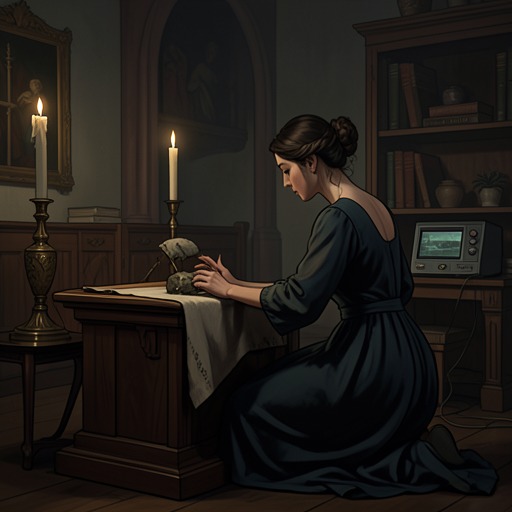
The collection belonged to a chapel established by the three sisters after Don Fabrizio’s death, when the Villa became their exclusive property. During his lifetime the family had attended church on feast days, and the household’s priest had walked some distance each morning to say Mass. The sisters instead converted an out-of-the-way drawing-room into a domestic oratory: they covered an unsuitable mythological ceiling fresco, arranged an altar, and made a sacred space within the family home. Their collection gave that space its most conspicuous inventory of devotional objects.
The seventy-four relics covered both walls beside the altar. Each sat in a frame with an information card and a number corresponding to authentication documents, many of them voluminous and sealed, kept in a damask-covered chest. The frames ranged from worked or smooth silver, bronze, and coral to tortoiseshell, filigree, rare woods, and velvet; they varied in shape and size, and in value, from costly pieces to frames bought at the Bocconi stores. This visual profusion placed the relics on display while the numbered cards and stored papers supplied an appearance of orderly verification. Precious materials, inexpensive frames, and documentary apparatus all served the same purpose: to give the assemblage form as a collection of sacred things.
Assembly and Devotional Practice
Carolina Salina was the collection’s effective creator. Through her connections to churches, convents, and charitable foundations in Palermo and its surroundings, Donna Rosa, a large elderly woman described as half a nun, brought a new relic to Villa Salina every few months, wrapped in tissue paper. She said that she had obtained each from a declining parish or a decayed family. The sellers remained unnamed in the name of discretion, while documents supplied as proof of authenticity were written in Latin or in scripts Donna Rosa called Greek or Syriac.
Concetta Salina acted as administrator and bursar: she paid for the relics and then paid again when the sisters searched for and adapted suitable frames. The division of labor made the collection both a devotional undertaking and a managed household project. Its acquisition had a rhythm, too. For a period of a couple of years, the collecting impulse so occupied Carolina and Caterina that they disturbed one another’s sleep with accounts of dreams about miraculous discoveries. Sometimes, after they had confided these dreams to Donna Rosa, the hoped-for relics did arrive. The narrative leaves Concetta’s dreams unknown, even as it identifies her as the person who funded and administered the process. When Donna Rosa died, the flow of new relics almost stopped; by then, the sisters already had more than enough.
The Archdiocesan Inspection
The collection’s private devotional life became a matter of public religious scrutiny when the Cardinal Archbishop began inspecting private chapels under papal instructions. The inquiry was intended to assess the qualifications of those permitted to hold services at home, the conformity of chapel furnishings and liturgy with Church rules, and the authenticity of venerated relics. The Salina chapel was among the best known in the city, and rumors about the relics had reached the archiepiscopal Curia. The concern was not the family’s right to worship privately or the continuity of its services; attention centered on the genuineness of the objects and the chapel’s venerated picture.
At the preliminary visit, the Vicar-General saw seventy-four relics arranged around the altar, each with its card and number, and the supporting papers locked in their chest. His admiration focused on the display and its frames rather than confirming the relics’ status. The next morning, the appointed examination moved from seeing the collection to testing its documentation and contents. The distinction mattered: an elaborate presentation could invite reverence, but neither handsome workmanship nor an accompanying certificate settled the question of authenticity.
Judgment and Aftermath
The examining priest requested the keys to the document chest, then went into the chapel carrying a small hammer, a saw, a screwdriver, a magnifying glass, and pencils. A pupil of the Vatican School of Palaeography, he worked for three hours. Servants passing the chapel door heard hammering and the squeak of screws; when he emerged, his cassock was dusty and his hands black. He carried a large wicker basket filled with torn papers and cards, little boxes, and bits of bone and gristle that he had discarded.
His conclusion sharply reduced the collection’s claims: only five relics, he reported, were perfectly authentic and worthy of devotion; the rest were in the basket. He asked where he could brush off the dust and wash his hands, then returned to mention that the frames had been laid out on the chapel table and that some were lovely. The separation of relics from frames made the inspection’s result tangible. The frames could retain their beauty, but beauty did not authenticate what they held. The basket, with its rejected papers and fragments, was the material counter-display to the sisters’ ordered walls: the collection’s scale and visual richness could not substitute for the scrutiny of ecclesiastical authority.